Active Listening Skills: How Eye Contact, Nodding, and Verbal Cues Build the Therapeutic Alliance
Eye contact, nodding, and minimal encouragers are clinical interventions in their own right. Here's how to use them to deepen the working alliance.

Key takeaway
Active listening is a cognitive and emotional act of entering the client's experiential world, and nonverbal skills—eye contact, nodding, and minimal verbal encouragers—are powerful therapeutic interventions in their own right. Clinicians strengthen the quality of their listening by calibrating gaze and the rhythm of their nods to the client's emotional intensity, using silence as an active space for insight, and building rapport through mirror-neuron-based attunement. AI-assisted transcription tools ease the documentation burden so clinicians can keep their attention on the client's face and micro-reactions rather than their notepad.
Are You Hearing What Your Client Isn't Saying?
We sit across from clients every day and listen to story after story. But it's worth asking ourselves an honest question mid-session: Am I actually hearing this client right now, or am I rehearsing my next question?
As clinicians, we already know that the active listening Carl Rogers described is not merely a posture or a technique—it is a potent therapeutic intervention in itself. Yet the consulting room rarely behaves like the textbook. We're tracking nonverbal cues we don't want to miss, feeling the pressure to capture the clinically significant material, and simultaneously managing our own countertransference. It's a lot to hold at once.
Many of us know the small spike of anxiety: "Wait—when the client just looked away, what did I miss?" Or the quiet loss of a pivotal moment of emotional contact because we were heads-down, writing. This article revisits the fine-grained mechanics of active listening—eye contact, nodding, and verbal encouragers—through a clinical lens, and offers concrete strategies for using them to build and sustain a strong therapeutic alliance.
The Anatomy of Active Listening: Beyond Simple Reactions
Active listening is not an auditory event—it's a cognitive and emotional act of stepping into the client's experiential world. Clients derive the greatest therapeutic benefit when they feel fully understood, a phenomenon often described as perceived empathy. And in conveying that understanding, our nonverbal behavior sends a far stronger signal of trustworthiness than our words do. So how do we deploy these micro-skills with clinical intention?
Eye Contact: Establishing Psychological Visibility
Eye contact is the most primal way of communicating, "You are safe here, and I am with you." Clinically appropriate gaze can down-regulate amygdala activation and foster a felt sense of safety. But too much can feel intrusive, and too little reads as indifference.
The goal is a soft focus. When a client lowers their eyes while disclosing shame or a painful memory, the clinician holds a waiting gaze rather than withdrawing. The moment the client looks up and finds your eyes still gently with them, the sense of healing connection deepens.
Nodding: The Rhythm of Acceptance and Validation
A nod functions as a pacemaker, helping regulate the client's tempo and the flow of affect. Mechanical, metronomic nodding actually disrupts the client's immersion. Instead, match the depth and speed of your nods to emotional intensity. When a client arrives at an insight, a slow, deep nod invites them to sit with its meaning. When they're pouring out emotion, lighter, quicker nods signal "keep going—I'm with you." This is validation delivered nonverbally.
Verbal Encouragers: Minimal Input, Maximal Disclosure
Minimal encouragers—"mm-hmm," "I see," a soft "ah"—announce your presence without interrupting the client's thought process. They act as a lubricant for self-exploration. Their importance multiplies in phone or video sessions, where nonverbal cues are limited. A well-timed encourager tells the client, "This person is deeply resonating with what I'm saying," which often opens the door to material closer to the unconscious.
Advancing Your Listening Skills in Clinical Practice
So how do we train these skills and bring them into the room? A common struggle for early-career clinicians is losing the thread of listening because they're busy formulating the next question. Even seasoned clinicians can slip into mannerism and produce reactions on autopilot. Below is a comparison of habitual versus clinically attuned responses, followed by concrete practices.
| Skill | Mechanical / Habitual (avoid) | Clinical / Active Listening (aim for) | Therapeutic Effect |
|---|---|---|---|
| Eye contact | Constant staring, or eyes fixed on the chart/notes | Flexible gaze that follows shifts in affect; meeting the client at eye level | Builds emotional safety, reduces resistance |
| Nodding | Fast, repetitive, perfunctory nods | Speed calibrated to the weight of the content; emotional resonance | Strengthens felt sense of being received; promotes self-disclosure |
| Verbal cues | Empty repetition ("yeah, yeah," "right, right") | Tone- and pitch-modulated sounds that reflect affect ("ah…," "mm!") | Sustains the client's flow of thought; provides emotional release |
Table 1. Mechanical responses vs. clinically attuned active listening, with their effects.
Use Silence as an Active Tool
Many clinicians find silence uncomfortable and rush to fill it with an unnecessary encourager or question. But silence is precisely the time a client uses to metabolize emotion and internalize insight. When a client pauses, try holding eye contact and waiting three to five seconds. That silence becomes a nonverbal encourager that helps the client reach a deeper layer of their story.
Practice Mirroring Deliberately
Neuroscientifically, mirror neurons are a foundation of empathy. Subtly matching a client's posture, facial expression, pace of speech, and the tone of their key words has a powerful effect on rapport. The caveat: it must never look like mimicry. Think of it as tuning your frequency to the client's emotional state, naturally and unobtrusively.
Step Out of the Compulsion to Document and Stay in the Here-and-Now
The central dilemma is documenting vs. listening. The instant we bury our face in the progress note to capture a key statement, eye contact breaks and active listening stops. Our role is not to be a stenographer but to be a mirror for the client. During the session, jot only minimal keywords and devote your full attention to the client's face and the smallest tremor of feeling—clinically, this is far more valuable.
Technological Support for Whole-Person Listening—and Clinician Reflection
Active listening is demanding work. Sustaining eye contact, nodding, and verbal cues for a full 50 minutes while exploring a client's inner world requires real expertise. Ultimately, the essence of therapy comes down to how fully present the clinician is for the client. We attend to the technical elements precisely because they serve the quality of that presence.
This is where AI-based session transcription and analysis tools are beginning to give clinicians new freedom. When a tool reliably captures and analyzes the session in real time, you can set down the burden of note-taking and pour more energy into meeting your client's eyes. Instead of the nagging worry—"Did I miss something important?"—you can review AI-generated summaries of speech patterns and emotional keywords to enrich your supervision material, and even monitor your own listening habits objectively (for example, encouragers or questions you offer too frequently).
Modalia AI is a security-first AI partner built for exactly this: handling transcription, case conceptualization, and documentation so your attention stays where it belongs—with the person in front of you.
Active listening is a trained skill, and it is also a form of deep regard for another human being. In your next session, try setting the pen down for a while and tending to your client's heart with warm eye contact and genuine nods. The breathing room that technology creates can help carry you toward becoming a more profound therapist.
Frequently asked questions
Is active listening really a clinical intervention, or just good manners?
It's a genuine intervention. Active listening is a cognitive and emotional act of entering the client's experiential world. Nonverbal behaviors like calibrated eye contact and attuned nodding can down-regulate threat responses, communicate trustworthiness more powerfully than words, and strengthen the client's sense of being understood—all of which advance the therapeutic alliance.
How much eye contact is appropriate in session?
Aim for a 'soft focus' rather than fixed staring, which can feel intrusive, or avoidance, which reads as indifference. When a client looks away while disclosing something painful, hold a gentle 'waiting gaze' so that when they look back up, they find your eyes still with them.
How can I take notes without breaking active listening?
Keep in-session notes to minimal keywords and keep your attention on the client's face and affect. AI-assisted transcription tools like Modalia AI can capture the full session for you, freeing you to stay present and review accurate summaries afterward for documentation and supervision.
What's the right way to use silence?
Treat silence as an active tool, not an awkward gap to fill. When a client pauses, hold eye contact and wait three to five seconds. That silence functions as a nonverbal encourager that lets the client metabolize emotion and reach a deeper layer of their story.
This article was written and reviewed using Modalia AI's clinical guidelines, with professional human review before publication.
Related articles
 Case Conceptualization
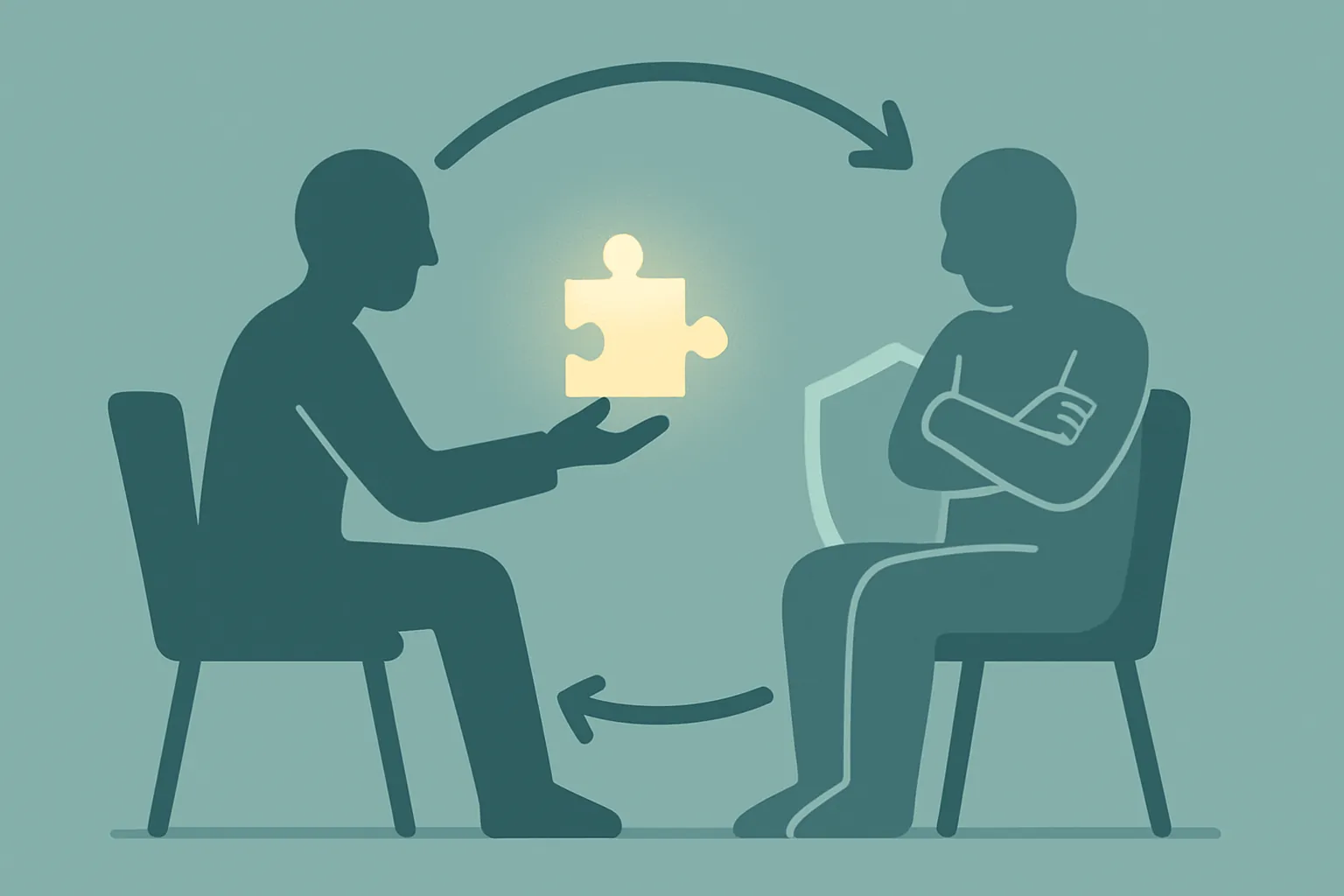
Breaking the "Yes, But" Game: A Transactional Analysis Guide for Therapists
Every suggestion you offer gets met with "Yes, but..." Here's the TA structure behind that stall—and four clinical moves to break it.
7 min read Case Conceptualization
Yalom's The Gift of Therapy: Passages Every New Counselor Should Copy by Hand
Irvin Yalom's prescription for therapists who fear silence: meet your client as a "fellow traveler" and let the here-and-now become the heart of the work.
6 min read Case Conceptualization
Working With Silence in Therapy: What Client Silence Means and How to Hold It
Silence in session isn't empty space. Learn to read its clinical meaning, tell productive from defensive silence, and use it as a therapeutic tool.
6 min read