Active Listening in Therapy: 3 Skills That Separate Reflective Clinicians from Passive Ones
Nodding along isn't therapy. Master reflection, clarification, and affect labeling—the three listening skills that actually move clients toward change.
Key takeaway
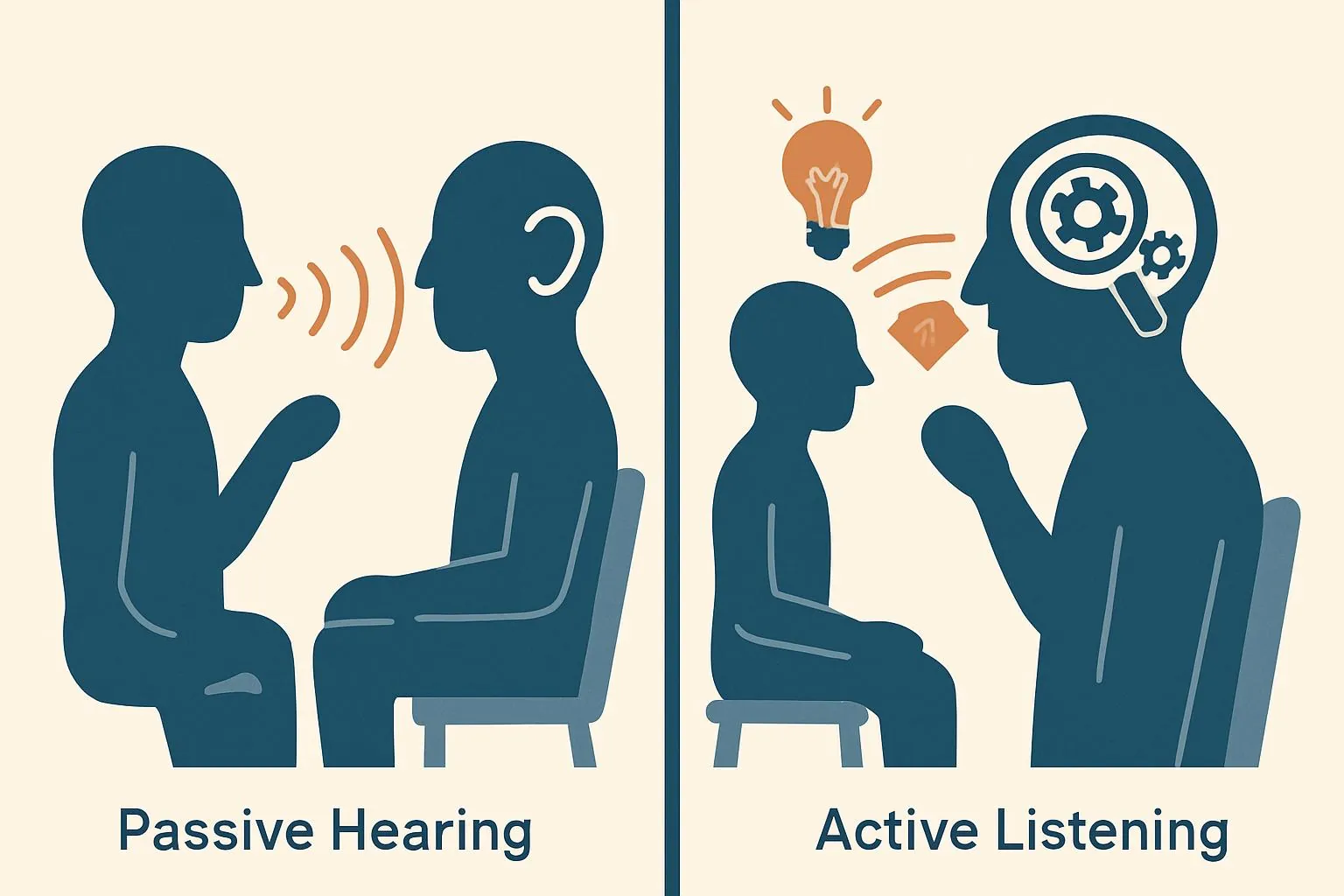
Listening in therapy splits into two very different acts: passive hearing, where the clinician absorbs content and offers reassuring noises, and active listening, where they catch the unspoken emotion and context beneath the words and return it therapeutically. Three skills define the quality of that work—reflecting feelings the client hasn't named, clarifying tangled thinking, and affect labeling to give vague distress a precise word. To deliver these skills fully, clinicians need cognitive bandwidth, which means freeing attention from the burden of in-session note-taking.
"Isn't Therapy Just Listening?" The Real Skill Behind the Silence
Have you ever ended a session and quietly wondered: I listened for the full 50 minutes—but did any actual clinical intervention happen? As trainees, most of us were taught that listening is our most powerful tool. Carl Rogers built person-centered therapy on empathic understanding and congruence, and that foundation still holds. Yet the room often tells a more complicated story. A client unloads, leaves feeling lighter, and comes back week after week with no real shift in symptoms or insight. That gap is where many clinicians start to second-guess what "listening" actually means.
Nodding and repeating "That sounds really hard" is closer to passive hearing than to therapy. Catching the intention buried beneath a client's words and handing it back in a usable form is active listening—and it's a high-order clinical skill. Miss that distinction, and sessions risk becoming expensive conversation rather than treatment. This article breaks down the three skills that turn listening into change: reflection, clarification, and affect labeling.
Passive Reception vs. Therapeutic Response: What Actually Moves a Session
Silence and listening are golden in the consulting room—until they tip into neglect. Many of us hold back out of a fear of "interrupting the client's flow," and in doing so we miss the moment to intervene. But letting a client circle endlessly through a disorganized account, without any structuring, can actually heighten anxiety and reinforce rumination rather than relieve it.
A clinician who is merely hearing fixates on content—the sequence of events, who did what to whom. Track the plot closely enough and you lose the thread that matters most: what the client felt and experienced through it all. A clinician who is truly listening attends to the context and affect beneath the text. You become a mirror for the client—but not a flat one that simply reflects what's already visible. You become the mirror that shows them the blind spot they couldn't see on their own.
Passive Listener vs. Therapeutic Listener: A Clinical Comparison
| Dimension | Passive Listener | Active, Therapeutic Listener |
|---|---|---|
| Primary focus | The facts; how the story unfolds | The client's emotion and unspoken need |
| Clinician response | Minimal encouragers ("mm-hmm," "I see"), silence | Paraphrase, reflection of feeling, hitting the core |
| Client experience | "It felt good to vent" (brief catharsis) | "It's like you read my mind" (insight and confrontation) |
| Therapeutic outcome | Rapport builds, but change is slow | Emotional processing and cognitive restructuring |
What creates this difference is the clinician's cognitive processing paired with verbal skill. It takes more than an open ear: the information coming in has to be analyzed, reshaped, and returned to the client in a form they can use.
Three Core Skills That Spark Client Insight
So how do you listen in a way that qualifies as listening well? Here are three techniques you can apply in the room immediately, each illustrated with the kind of phrasing that makes it work. Together, they let you hold the wheel and steer the session rather than getting pulled along by it.
1. Reflection: Be an Interpretive Mirror, Not a Parrot
The most common trainee mistake is echoing the client's words back like a parrot. True reflection has to move past reflection of content to reflection of feeling. When a client says, "My manager just started yelling at me—I was floored," responding with only "You were floored" stays one-dimensional. Reach instead for the unspoken layer: "It sounds like his reaction struck you as unfair—so there's the shock of the moment, but maybe a sense of being wronged underneath it, too." That's where reflection does therapeutic work.
2. Clarification: Clearing the Fog of Ambiguity
When a client is flooded and their account turns scattered, it's the clinician's job to summarize and organize it—helping them see their own situation more objectively. A clarifying summary that reflects the core back as a question does exactly that: "Let me make sure I'm following—part of this is anger about what happened, but it sounds like the bigger weight is the fear of what might come next. Is that right?" Questions like this settle a client's churning thoughts into something they can examine.
3. Affect Labeling: Naming the Feeling to Regain Control
Neuroscience research from UCLA found that simply putting an accurate name to a negative emotion lowers activity in the amygdala (Lieberman et al., 2007). So when a client says something vague like, "I just feel this heaviness in my chest, and I'm irritated," offer them more precise emotional language: "That heaviness—does it feel closer to helplessness, or more like disappointment?" The moment a feeling is pinned to a specific word, the client gains a step of distance from it and moves into a position where the emotion can be worked with rather than simply endured.
Maximizing Session Effectiveness: Strategy and Tools
Knowing these skills matter is one thing; deploying them under real conditions is another. In any given moment you're reading nonverbal cues, formulating your next question, and taking notes—all at once. That multitasking load is the single biggest enemy of genuine listening.
Plenty of clinicians break eye contact to write things down, or miss a live emotional shift because they're busy composing the next prompt. Real listening depends on protecting your cognitive bandwidth.
Three Ways to Protect Your Cognitive Bandwidth
- Make keyword notes a habit. Don't try to transcribe everything. Train yourself to jot only the core emotion words and event keywords, then fill in the rest after the session.
- Use supervision as a self-audit. Reviewing your own session transcripts makes it obvious whether you're truly reflecting or just repeating. Regular supervision is the best way to correct ingrained habits.
- Adopt smart documentation tools. AI-assisted tools can now transcribe a session automatically (speech-to-text), separate speakers, and surface key themes. Offloading the record-keeping lets you give your full attention to eye contact and listening during the session itself—and that translates directly into higher-quality care.
Conclusion: Attitude Beyond Technique, and Tools Used Wisely
Growing from a clinician who merely hears into one whose listening drives change takes continuous, deliberate practice. The heart of the work is finding the core emotion—the gem buried in a client's rough, tangled account—and reflecting it back to them in clear, named language. But all of it is only possible when you can give the client your full attention.
So let yourself off the hook of compulsive note-taking and tune in to the slight changes in expression, the catch in a voice. If the pressure to document is getting in the way of your listening, it's a smart move to let modern tools—AI-assisted transcription or a counseling-note application like Modalia AI—serve as a quiet, security-first partner in the background. (Modalia AI is built for clinicians, handling transcription, case conceptualization support, and documentation with privacy at its core.)
For the next client you see, consider setting the pen down and leaning in with deeper eye contact. Your undivided attention may be the most healing gift you can offer.
References
- 1.
- 2.
Frequently asked questions
What's the difference between passive hearing and active listening in therapy?
Passive hearing absorbs the client's content and offers reassuring encouragers, which builds rapport but rarely produces change. Active listening catches the unspoken emotion and context beneath the words and returns it therapeutically through reflection, clarification, and affect labeling—driving emotional processing and cognitive restructuring.
How is reflection of feeling different from simply repeating what a client said?
Repetition echoes the client's words back verbatim, like a parrot. Reflection of feeling names the emotional layer the client hasn't articulated—for example, surfacing the sense of being wronged underneath an expressed shock—so the client gains insight rather than just hearing themselves restated.
Why does affect labeling reduce a client's distress?
Putting a precise name to a negative emotion lowers amygdala activity (Lieberman et al., 2007). When a vague feeling is defined in specific language, the client gains a step of psychological distance from it and moves into a position where the emotion can be worked with rather than simply endured.
How can clinicians protect their cognitive bandwidth during sessions?
Limit notes to core emotion and event keywords, use supervision to audit whether you're reflecting or just repeating, and offload record-keeping to AI-assisted transcription tools so your attention stays on eye contact and live emotional shifts.
This article was written and reviewed using Modalia AI's clinical guidelines, with professional human review before publication.
Related articles
 Case Conceptualization
Breaking the "Yes, But" Game: A Transactional Analysis Guide for Therapists
Every suggestion you offer gets met with "Yes, but..." Here's the TA structure behind that stall—and four clinical moves to break it.
7 min read Case Conceptualization
Yalom's The Gift of Therapy: Passages Every New Counselor Should Copy by Hand
Irvin Yalom's prescription for therapists who fear silence: meet your client as a "fellow traveler" and let the here-and-now become the heart of the work.
6 min read Case Conceptualization
Working With Silence in Therapy: What Client Silence Means and How to Hold It
Silence in session isn't empty space. Learn to read its clinical meaning, tell productive from defensive silence, and use it as a therapeutic tool.
6 min read