Reading the Family Genogram in Addiction: How Clinicians Break the Intergenerational Cycle
A clinician's guide to mapping addiction across generations—genogram patterns, survival roles, and Bowenian strategies to break the dysfunctional cycle.
Key takeaway
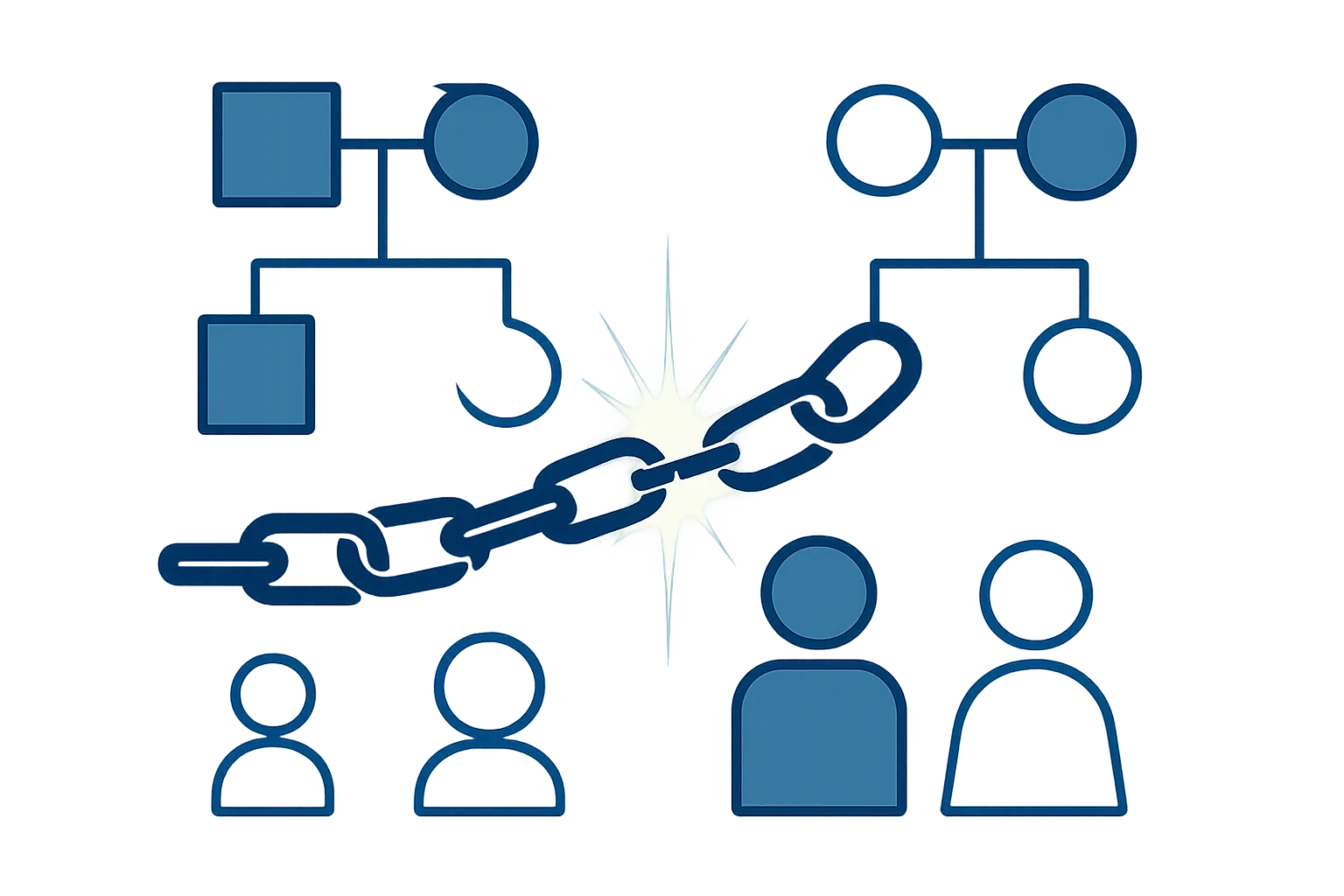
Addiction is best understood not as a failure of willpower but as a dysfunctional pattern transmitted across generations within a family system. Drawing on Murray Bowen's multigenerational theory, the genograms of addicted families show distinctive features: extreme swings between fusion and cutoff, entrenched triangulation, and closed boundaries built from secrecy and shame. Wegscheider-Cruse's survival roles—Hero, Scapegoat, Lost Child, and Mascot—give clinicians a framework for decoding a client's present-day relational patterns. To break the cycle, clinicians can externalize the problem while co-drawing the genogram, coach the client through Bowen's 'going home again' to raise differentiation of self, and reframe the family's survival resources through a strengths-based genogram.
"I Will Never Live Like My Father": Decoding the Addiction Genogram
"I will never live the way my father did." It is one of the most common things clients with alcohol dependence say in the consulting room. And yet, with painful irony, many of them eventually catch themselves unconsciously repeating the very behaviors they swore to escape—and sink into despair when they do. As clinicians, we understand that this is rarely a simple matter of weak will. More often, it is the visible end of a dysfunctional pattern that has been quietly flowing through the family system for generations.
Murray Bowen's multigenerational family systems theory invites us to widen the frame: addiction is not only an individual pathology but a relational one. The difficulty—even for experienced clinicians—is locating the point of therapeutic leverage inside a tangle of family dynamics. Within the flood of narrative a client brings, our task is to catch the load-bearing pattern and decode the invisible loyalty hidden inside it. That decoding is often what separates an effective addiction case from a stalled one.
This article looks at the features that distinguish the genograms of alcohol- and substance-affected families, and translates those observations into concrete strategies for opening a therapeutic path forward—so that a client's past becomes a resource for growth rather than a shackle on their future.
Reading the Addiction Genogram: Beyond Simple Heredity
When we build a genogram for a family touched by addiction, we are not merely tracing a history of alcohol or drug use. We are reading the way anxiety is metabolized and the patterns of relating that sit underneath it. In clinical practice, the addiction genogram tends to show several features that set it apart from other dysfunctional families.
1. Extreme oscillation between fusion and cutoff. The emotional climate of an addicted family is highly unstable. Members are often either over-enmeshed (fusion) or, to escape unbearable tension, sever the relationship entirely (cutoff). On the genogram this appears as densely overlapping lines or heavy cutoff bars. The adult child of an alcohol-dependent parent who has physically left home yet remains psychologically fixated on that parent's approval or recovery is a textbook example of an undifferentiated, fused position.
2. Entrenched triangulation. Triangulation occurs when the tension between two people (say, a couple) is lowered by pulling in a third party—a child, or the substance itself. In addicted families, alcohol is the most powerful third member. Every argument routes through drinking; or a daughter steps into a spousal role to care for an intoxicated father, producing the parentified child that often stands out clearly on the genogram.
3. Boundaries built from secrecy and shame. Pay attention to any family member the client avoids naming or describes only in vague terms. Addicted families tend to maintain a tightly closed boundary with the outside world in order to protect "the family secret." This shows up as resistance in session and as conspicuous gaps of information on the genogram itself.
Survival Roles in the Addicted Family: A Clinical Map
Children in addicted families—particularly those affected by alcohol dependence—adopt specific roles in order to survive. Mapping Wegscheider-Cruse's role model onto the genogram helps us make sense of a client's current relational patterns. The table below compares each role with its clinical entry points.
| Role | Function in the family | Inner experience | Clinical focus / therapeutic goal |
|---|---|---|---|
| Hero (often the eldest) | Compensates for the family's shame through achievement | Inadequacy, guilt, compulsive responsibility | Soften perfectionism; recognize the right to say no; attend to one's own needs |
| Scapegoat (the designated "problem child") | Diverts attention from the family's real problem (addiction) | Anger, alienation, rejection | Reconstruct a negative identity; channel anger healthily; surface latent potential |
| Lost Child (quiet, unnoticed) | Erases their own presence to avoid raising family tension | Loneliness, a sense of not mattering | Affirm presence; build self-expression; initiate relational connection |
| Mascot (often the youngest, the comic relief) | Uses humor to defuse tension and avoid pain | Fear, anxiety, insecurity | Face serious affect; address avoidant defenses; strengthen stress coping |
Table 1. Survival roles of children in addicted families and corresponding clinical strategies.
Practical Strategies for Breaking the Cycle
Once the genogram has mapped the terrain, the work shifts to charting a new route through it. The heart of the therapy is moving the client from self-blame—"Why am I like this?"—toward insight: "This was my family's pattern, and I can choose differently." Three concrete interventions support that shift.
1. Externalization through collaborative genogram work
Clients frequently internalize the family's problem as a personal defect. Co-drawing the genogram lets us objectify the problem instead. The clinician might say: "You don't drink because you're weak. Let's look at how the way of handling anxiety that runs back to your grandfather settled on 'alcohol'—a flawed tool—as its outlet." This mirrors the externalization technique of narrative therapy: it relieves the client's guilt and mobilizes motivation for change. Here, a visualized genogram becomes a powerful therapeutic instrument.
2. "Going Home Again" and raising differentiation of self
In this Bowenian technique, the clinician coaches the client to attempt a new way of relating to the family of origin. Crucially, it should only be attempted once the client has achieved a workable level of differentiation of self. Instead of the old reactive patterns—blaming or avoiding—the client practices stating their position calmly using I-statements. Rather than exploding at a drinking parent, for instance, the client learns to say: "When you drink, I feel frightened and so anxious I don't know what to do." As small successes accumulate, the intergenerational chain gradually loosens.
3. Surfacing resilience: the strengths-based genogram
In our focus on pathology, we often overlook the family's capacity for survival. The genogram should mark not only the alcohol problem but also the resources that carried the family through hardship. Reframing statements—"Your mother struggled with dependence, and yet she supported your education to the very end," or "Your grandfather had a drinking problem, but he also passed his remarkable craftsmanship on to you"—help the client integrate their roots in a more positive light.
Adding Clinical Depth While Working More Efficiently
Addiction-focused family work is demanding for the client and the clinician alike. Juggling a large cast of characters, contradictory statements, and a complicated chronology of events, we risk missing what matters most—the client's nonverbal cues and the transference/countertransference moving in the room. With addiction clients in particular, rambling or defended communication can make it slow work to grasp and document the core of a session.
To ease these practical burdens, many clinicians now use AI-assisted support tools. Beyond simply recording a conversation, AI transcription and session-note platforms—the global tools increasingly available to clinicians—can help in addiction work in a few specific ways:
- Assisting pattern recognition. By analyzing recurring phrases ("I had no choice," "because of him") or how often particular family members are mentioned, these tools can help surface triangulation or projection patterns a clinician might not have consciously registered.
- Anchoring the factual record. Narratives in addicted families are easily distorted. An accurate transcript helps you locate inconsistencies and check continuity across sessions—for example: "Last time you said your father stopped drinking three years ago, but today you said five years ago."
- Streamlining supervision prep. The more complex the case, the more essential supervision becomes. A quickly generated summary and transcript can dramatically cut preparation time, freeing the clinician to focus on the clinical questions that matter. (Always follow your jurisdiction's consent, privacy, and data-security requirements when using any such tool.)
Approached this way, Modalia AI—a security-first AI partner built for counselors, supporting transcription, case conceptualization, and documentation—can take some of the administrative weight off complex addiction casework so more of your attention stays with the client.
Closing: A Note for the Wounded Healer
Analyzing the genogram of an alcohol- or substance-affected family is like untangling a knotted skein of thread. It takes patience, and there are moments when it is genuinely hard to know where to begin. But each pattern we manage to surface becomes, for the client, a lamp that helps them find a path through what had felt like total darkness.
Breaking the intergenerational cycle is not about denying the past—it is about understanding and reframing it. I hope the clinical features and intervention strategies described here offer a small spark for your own practice.
Finally, preventing burnout and preserving clinical insight calls for the wisdom to use current tools well. Remember that the essence of counseling lies in human connection, and that technology is simply a means of making that connection deeper and more durable. If a complex case is weighing on you this week, why not open the genogram again in case consultation with colleagues, or try a new approach to your records? A small change can be the beginning of therapeutic expansion.
References
- 1.
- 2.
Frequently asked questions
What makes an addiction-affected family's genogram distinctive?
Three features tend to stand out: extreme oscillation between emotional fusion and cutoff, entrenched triangulation in which the substance itself functions as a powerful 'third member,' and closed boundaries built from secrecy and shame—often visible as gaps of missing information on the genogram.
What are the Wegscheider-Cruse survival roles?
Wegscheider-Cruse described four roles children adopt to survive in addicted families: the Hero, who compensates through achievement; the Scapegoat, who diverts attention from the real problem; the Lost Child, who disappears to avoid raising tension; and the Mascot, who uses humor to defuse pain. Mapping these roles clarifies a client's present relational patterns.
When is Bowen's 'going home again' technique appropriate?
It should only be attempted once a client has reached a workable level of differentiation of self. The clinician coaches the client to relate to their family of origin in a new way—using calm I-statements rather than reactive blaming or avoidance—so that small relational successes can accumulate and loosen the intergenerational pattern.
How can a strengths-based genogram help in addiction work?
A strengths-based genogram marks not only the addiction but also the resources that helped the family survive—loyalty, perseverance, skills passed down. Reframing these resources helps the client integrate their family roots in a more positive way and counters the tendency to internalize the family's problem as a personal defect.
This article was written and reviewed using Modalia AI's clinical guidelines, with professional human review before publication.
Related articles
 Case Conceptualization
Breaking the "Yes, But" Game: A Transactional Analysis Guide for Therapists
Every suggestion you offer gets met with "Yes, but..." Here's the TA structure behind that stall—and four clinical moves to break it.
7 min read Case Conceptualization
Yalom's The Gift of Therapy: Passages Every New Counselor Should Copy by Hand
Irvin Yalom's prescription for therapists who fear silence: meet your client as a "fellow traveler" and let the here-and-now become the heart of the work.
6 min read Case Conceptualization
Working With Silence in Therapy: What Client Silence Means and How to Hold It
Silence in session isn't empty space. Learn to read its clinical meaning, tell productive from defensive silence, and use it as a therapeutic tool.
6 min read