Coaching Adult ADHD Clients to Strengthen Executive Function: A Clinician's Guide to Timers and Planners
Why adult ADHD clients fail to act on their plans—and concrete timer and planner coaching strategies that build executive-function scaffolding and clinical efficacy.
Key takeaway
When adult ADHD clients make plans and then fail to execute them, the problem is rarely willpower—it's impaired executive function, especially time blindness and working-memory deficits. As Russell Barkley frames it, ADHD is a performance deficit, not a knowledge deficit, so the clinical goal is to scaffold what clients already know into action using external tools. Analog timers and simple planners function as a 'prosthetic frontal lobe,' and the right tool depends on the client's temperament. The deeper aim of coaching is to dismantle all-or-nothing thinking after a lapse and build the resilience to start again.
When Your Adult ADHD Client Keeps Forgetting and Procrastinating: A Coaching Strategy for Executive Function
"I really meant to use the planner this week, but I spent thirty minutes just trying to find where I'd put it, so I gave up."
If you see adult ADHD clients in your practice, you've almost certainly heard some version of this. Session after session, they arrive genuinely wanting change and leave with a concrete plan—only to return the following week, faces clouded with guilt, confessing that they "failed again." When the pattern repeats, it wears on the clinician too. Am I doing this right? Why isn't insight translating into action? Those doubts are easy to slip into.
But this is neither a failure of the client's will nor a gap in your clinical skill. It is a malfunction in the brain's command center—executive function—and specifically in two of its components: time blindness and working memory. A substantial body of research points to cognitive behavioral therapy (CBT) alongside medication, paired with concrete behavioral coaching, as the most effective approach to adult ADHD. The process of externalization—pulling the tangle of thoughts out of the client's head and onto an external tool like a planner or timer—is not optional here. It is foundational.
This article walks through an executive-function coaching approach you can bring into the room right away. We'll look at why your clients' past attempts with these tools collapsed, and how clinically grounded timer and planner strategies can rebuild both their function and your sense of efficacy as their clinician.
Understanding Executive Function: Why They Know What to Do but Can't Do It
The adult-ADHD researcher Russell Barkley describes ADHD not as a knowledge problem but as a performance deficit. Clients usually know exactly what to do; the difficulty is doing what they know at the moment it matters. That reframing changes the clinical goal entirely. The work is not to deliver new information—it's to build the scaffolding that lets clients convert what they already know into action.
In that frame, a planner and a timer are not stationery. They are a prosthetic frontal lobe—external supports that stand in for the executive functions that aren't firing reliably. Part of the clinician's job is psychoeducation: explaining, in neuropsychological terms, why these tools are needed, so the client can integrate them without resistance. That step matters because many clients carry shame or even something like trauma around these tools, having tried and "failed" with them before.
Making Time Visible: The Case for the Analog Timer
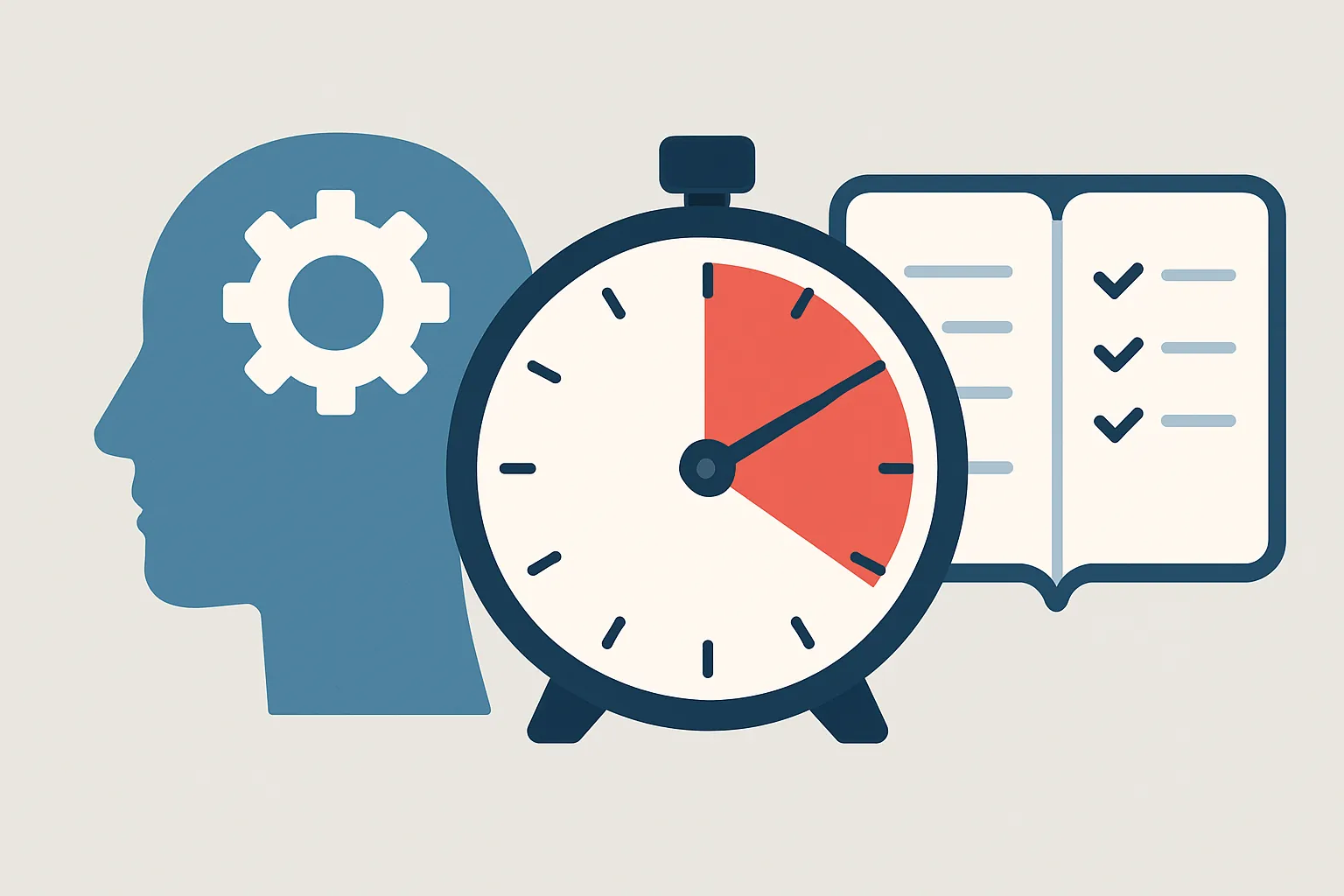
People with ADHD struggle to feel the passage of time—a phenomenon often called time blindness. A digital clock (2:30 p.m.) tells you the current moment but nothing intuitive about how much time has elapsed or how much remains. What helps instead is an analog timer that shows the volume of time visually—a shrinking colored wedge that makes "twenty minutes left" something you can see at a glance.
Two concrete techniques to coach:
- Estimated time vs. actual time. Have the client predict how long a task will take (washing the dishes, drafting a report), then run a timer and log the real duration. Most clients consistently under- or over-estimate. Closing that gap between prediction and reality is the heart of building metacognition.
- A modified Pomodoro. The classic 25-minutes-on / 5-minutes-off rhythm is often too long—or occasionally too short—for an ADHD client. Start where their attention actually lives, perhaps 10 minutes on / 2 minutes off, and lengthen the intervals gradually so each round delivers a genuine success experience.
Building an External Memory Store: How to Use a Planner Well
For a client with weak working memory, "just remember it" is closer to torture than instruction. Every piece of information needs to move immediately into an external store—the planner. But the elaborate planners sold in stores often add cognitive load rather than reducing it. Your job is to propose the simplest, most intuitive system the client can sustain.
The guide below maps tool choice to client temperament. Use it to explore, together, what actually fits.
| Tool type | Pros | Cons | Best fit & coaching point |
|---|---|---|---|
| Analog planner (bullet journal, etc.) | No battery; the act of writing reinforces memory; no notification interruptions | Can be lost; not always easy to carry; no automation of recurring events | Clients who respond to visual stimuli. Coach them to focus on recording rather than decorating, so the system doesn't become a craft project. |
| Digital app (Google Calendar, etc.) | Automatic reminders; easy recurring events; syncs across devices | Opening the phone invites distraction; alarm fatigue can set in | Mobile, phone-comfortable clients. Instead of enabling every alert, limit notifications to the few events they absolutely cannot miss. |
| Whiteboard (wall-mounted) | Powerful visual cue; continuous passive exposure in the space | Not portable; limited room for detail | Clients who struggle with household routines. Place it where it's most visible—the fridge, the front door—as a tool for environmental control. |
Table 1. Planning tools for adult ADHD clients: comparison and coaching strategy.
The Attitude Toward Failure: Letting Go of Perfectionism
The most important element of planner coaching isn't the technique—it's the attitude. ADHD clients slide easily into all-or-nothing thinking: "I used the planner for three days, then skipped one, so this whole month is blown." This is exactly where cognitive restructuring belongs.
Try offering something like: "A blank space in your planner isn't evidence of failure. It's a record that, on that day, you needed to live by the flow of things rather than the plan." Lowering the psychological barrier to restarting is among the most valuable things you can give a client. Remind them, repeatedly, that the goal is the resilience to come back—not a flawless record.
Conclusion: Becoming the Client's "Executive Assistant"
Strengthening executive function in an adult ADHD client doesn't happen quickly. The client is on a long road of trying, failing, and gradually finding the tools that fit. The clinician's role is to be the pacer who keeps them from getting lost, and the mirror that reflects back objective data.
ADHD clients in particular often lose the insights gained in session—and the action items you agreed on—the moment they walk out the door. Asking "weren't you going to do such-and-such?" the next week can land as interrogation rather than support.
This is one place where an AI-based session-recording and transcript tool can help. When the conversation is automatically captured as text, the action items a client committed to and the key sentences they discovered for themselves can be pulled out precisely, letting you give clearer, more objective feedback in the next session. Modalia AI, a security-first AI partner built for counselors, supports exactly this kind of transcription and documentation work.
This week, a few things to try in your own practice:
- At the end of a session, actually do it with the client: set a 10-minute timer and tidy up the session notes together. You're modeling tool use, not just describing it.
- Try the planner app or notebook your client uses yourself, so you understand its strengths and limits and can offer concrete tips.
- Consider whether an AI recording tool could make your documentation more efficient and help you track speech patterns (for example, how often a client says "I don't know" or "later").
Tools exist for people, in the end. When the right tool meets a clinician's warm coaching, the chaotic time of an ADHD client can finally settle into an ordered daily life.
References
- 1.
Frequently asked questions
Why do adult ADHD clients make plans but fail to follow through?
It's typically not a willpower problem but a performance deficit, as Russell Barkley describes it—impaired executive function, especially time blindness and weak working memory. Clients know what to do but struggle to do it at the right moment, which is why external scaffolding works better than more information.
Why recommend an analog timer over a digital clock for ADHD clients?
A digital clock shows only the current time, not how much has elapsed or remains. An analog timer makes the 'volume' of time visible at a glance, which directly addresses time blindness and helps clients build an intuitive sense of duration.
How should a clinician handle it when a client lapses in using their planner?
Use cognitive restructuring to interrupt all-or-nothing thinking. Reframe a blank planner entry not as failure but as a day that called for flexibility, and lower the psychological barrier to restarting. The goal is resilience and the ability to return, not a perfect record.
Which planning tool is best for an adult ADHD client?
It depends on temperament. Analog planners suit clients who respond to the act of writing and visual cues; digital apps suit mobile, phone-comfortable clients (with notifications limited to essentials); wall-mounted whiteboards suit clients who need strong, continuous environmental cues for routines.
This article was written and reviewed using Modalia AI's clinical guidelines, with professional human review before publication.
Related articles
 Case Conceptualization
Breaking the "Yes, But" Game: A Transactional Analysis Guide for Therapists
Every suggestion you offer gets met with "Yes, but..." Here's the TA structure behind that stall—and four clinical moves to break it.
7 min read Case Conceptualization
Yalom's The Gift of Therapy: Passages Every New Counselor Should Copy by Hand
Irvin Yalom's prescription for therapists who fear silence: meet your client as a "fellow traveler" and let the here-and-now become the heart of the work.
6 min read Case Conceptualization
Working With Silence in Therapy: What Client Silence Means and How to Hold It
Silence in session isn't empty space. Learn to read its clinical meaning, tell productive from defensive silence, and use it as a therapeutic tool.
6 min read