Adolescent Self-Harm: Why Understanding Its Function Matters More Than Stopping It
Stopping the behavior isn't the first step. Learn the four-function model of non-suicidal self-injury and three clinical strategies that open the door to change.
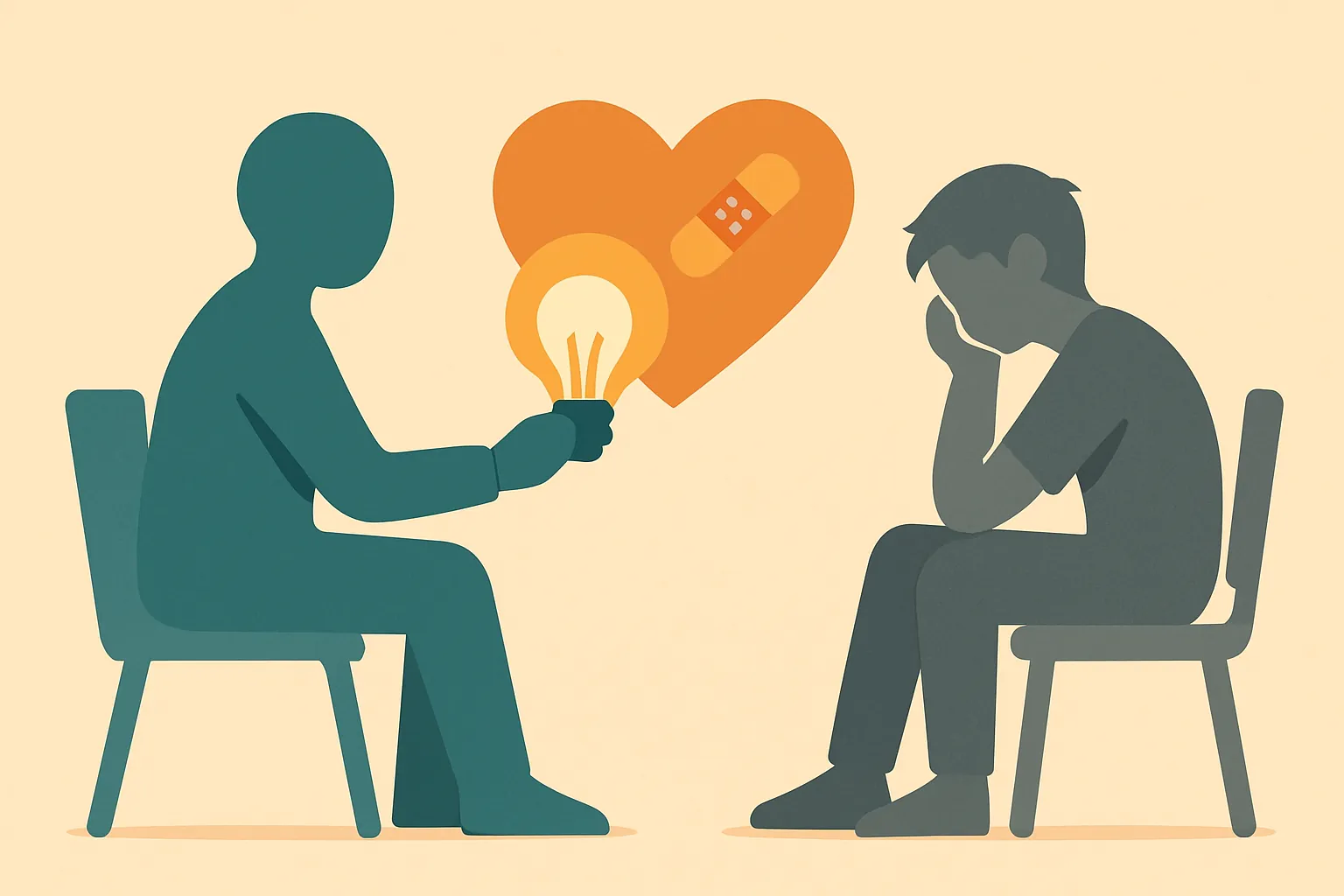
Key takeaway
Adolescent self-harm is best understood not as a problem behavior to be eliminated but as a functional strategy for regulating overwhelming emotion. Nock and Prinstein's (2004) four-function model frames non-suicidal self-injury (NSSI) as serving up to four reinforcing purposes: immediate relief from emotional distress, self-punishment or a return of sensation, escape from intolerable demands, and a bid for care or connection. Approaches built on safety contracts and behavioral control tend to deepen shame and rupture the alliance, while a function-informed approach grounded in DBT and ACT—using chain analysis and validation—helps clients feel understood and lays the groundwork for therapeutic collaboration.
"I did it again...": Why Self-Harm Asks to Be Understood, Not Just Stopped 🩸
When a young client walks in with a fresh bandage at the wrist, something in us drops. Few clinical situations carry the ethical weight and the personal pull that adolescent self-harm does. Our instinct—reinforced by a real sense of responsibility—is to reach for the no-harm contract and secure a promise that it won't happen again. But let's be honest with each other: how often has that promise actually held?
A large body of research and a great deal of clinical experience point the same way: pure behavioral control can amplify a client's guilt and quietly sever the relationship we depend on to help them. Self-harm is often not a "problem behavior" at all but a desperate survival strategy for managing pain that feels unmanageable. This article looks at why trying to stop the behavior first so often fails, and why analyzing the function of self-harm is the clinical key that unlocks everything else.
Self-Harm as a Solution, Not Just a Symptom: The Four-Function Model
The four-function model of non-suicidal self-injury (NSSI) proposed by Nock and Prinstein (2004) asks clinicians to change the frame entirely. The reasons adolescents injure their own bodies are far more complex—and far more functional—than the common assumption that they are "just looking for attention." Because self-harm temporarily resolves pain a young person cannot otherwise tolerate, it carries a powerful reinforcement effect.
The model maps two dimensions—automatic vs. social, and positive vs. negative reinforcement—into four functions:
-
Immediate relief from emotional distress (automatic negative reinforcement)
The most common pattern. The young person uses self-injury to quiet overwhelming anxiety, anger, or grief. Physical pain triggers endorphin release that numbs psychological pain. Telling a client in this state to simply stop is like asking them to endure surgery with no anesthetic.
-
Self-punishment or a return of sensation (automatic positive reinforcement)
The young person wants to feel "real" and alive when caught in dissociation, or seeks relief by punishing the "bad" self they believe themselves to be. Here self-injury becomes a way of filling an inner emptiness or confirming that they still feel something at all.
-
Escape from intolerable demands (social negative reinforcement)
Self-injury becomes a way out of social situations that feel unbearable—relentless parental expectations, bullying, crushing academic or performance pressure. It can carry an unspoken message: I'm hurting this much, so please stop pushing me.
-
Eliciting care and connection (social positive reinforcement)
Often dismissed as "attention-seeking," this is more accurately a distress signal from a young person who has no healthy channel left for asking for help. It is an SOS, not manipulation.
Behavioral Control vs. Functional Analysis: A Paradigm Shift
The central dilemma in self-harm work is the tightrope between securing safety and offering acceptance and empathy. Traditional approaches aim to extinguish the risky behavior; contemporary approaches rooted in dialectical behavior therapy (DBT) and acceptance and commitment therapy (ACT) put functional analysis first. When a clinician genuinely grasps the difference and applies it, the client finally feels, My counselor understands what I'm in pain about.
Table 1. Behavior-control approach vs. function-informed approach
| Dimension | Behavior-control (Traditional) | Function-informed (Functional) |
|---|---|---|
| Goal | Immediate cessation of self-harm (symptom-free) | Identify the function; build alternative skills |
| Core intervention | No-harm contracts, promises, persuasion, discipline | Chain analysis, validation |
| Client response | Guilt, shame, concealment, resistance | Feeling understood, collaboration, self-insight |
| Therapeutic message | "That behavior is dangerous and has to stop." | "What did that behavior do for you—and what did it cost you?" |
Note that safety is never abandoned in the functional approach. Risk assessment and crisis planning continue throughout; the shift is in sequence and stance—understanding precedes change, rather than replacing it.
Three Strategies You Can Apply in the Next Session
So what does this look like in the room? Three clinically grounded moves you can begin using right away.
-
Use behavioral chain analysis
Treat a self-harm incident as a single episode and slow it down frame by frame. Map the chain together with the client: [ trigger → vulnerability factors → thoughts and feelings → the self-harm behavior → short-term consequence (relief) → long-term consequence (shame) ] Instead of asking "Why did you do it?", try: "Let's rewind the tape—what thought, in that exact moment, carried you toward the behavior?" The shift from interrogation to curiosity is what makes the analysis possible.
-
Balance validation with change
Set the verdict "self-harm is bad" aside for a moment. Lead with validation of the depth of the pain: "You must have been hurting so much to keep going by hurting your own body. That makes sense to me." Only a client who feels accepted is ready to learn alternatives—distress-tolerance skills such as DBT's TIPP (e.g., gripping ice, splashing cold water on the face, paced breathing, intense brief exercise) that down-regulate arousal without injury.
-
Sharpen your records and track the pattern
In this work, the subtle verbal cues and nonverbal nuances are everything. Distinguish "I want to die" from "I want to disappear." Track the times of day and days of the week when the urge peaks. And be careful that note-taking during the session never pulls your eyes away from the trembling glance in front of you—the clinical signal often lives in what isn't said.
Closing: Treatment Begins When You Hold the Client's Own Language
Adolescent self-harm is, without question, a behavior that needs to stop—but before that, it is a text that needs to be read. When we accurately grasp the function and intent hidden behind the act, young people begin to express their pain in words rather than scars. Our job is to be the secure base that can tolerate and support that process.
What makes this possible is the density of the session. A precise chain analysis depends on capturing the client's account without losing a word—yet remembering and recording every exchange in a high-stakes session is nearly impossible. This is where a security-first AI partner for clinicians can change the equation: by lifting the documentation burden so you can give the client's eyes and emotions your full attention, and by surfacing patterns in the conversation—the trigger you might otherwise have missed—the quality of care can rise sharply. Modalia AI is built for exactly this: secure session transcription, case conceptualization support, and documentation that stays out of your way.
So ask yourself: are you reading your client's signals of pain as a mere symptom, or as a function that is keeping them alive? In your next session, before reaching for any contract, consider opening with a different question: "What comfort did that behavior give you?"
A note on safety: A function-informed stance does not replace risk management. If a young person is at risk of serious harm or suicide, involve your safeguarding protocols and direct them to your local or national crisis line or emergency services without delay.
References
- 1.
Frequently asked questions
What is the four-function model of non-suicidal self-injury?
Proposed by Nock and Prinstein (2004), it frames self-harm along two dimensions—automatic vs. social, positive vs. negative reinforcement—yielding four functions: relieving emotional distress, generating or confirming sensation (including self-punishment), escaping intolerable demands, and eliciting care or connection. The model reframes self-harm as a reinforced, functional behavior rather than a simple problem behavior.
Why can no-harm contracts backfire with adolescent clients?
Contracts focused on stopping the behavior often increase guilt and shame, prompt clients to conceal further self-injury, and rupture the therapeutic alliance. They also do little to address the underlying function the behavior serves, leaving the client without an alternative way to manage the original distress.
How is behavioral chain analysis used in self-harm work?
Chain analysis slows a single self-harm episode down step by step—trigger, vulnerability factors, thoughts and feelings, the behavior, short-term relief, and long-term consequences such as shame. Done collaboratively and with curiosity rather than interrogation, it helps both clinician and client see the precise points where alternative skills can interrupt the chain.
Does focusing on function mean ignoring safety?
No. A function-informed approach continues risk assessment, safety planning, and crisis referral throughout. The difference is one of sequence and stance: understanding and validating the function comes first and creates the conditions for change, rather than being replaced by it. Serious risk always warrants activating safeguarding protocols and local crisis or emergency services.
This article was written and reviewed using Modalia AI's clinical guidelines, with professional human review before publication.
Related articles
 Case Conceptualization
Breaking the "Yes, But" Game: A Transactional Analysis Guide for Therapists
Every suggestion you offer gets met with "Yes, but..." Here's the TA structure behind that stall—and four clinical moves to break it.
7 min read Case Conceptualization
Yalom's The Gift of Therapy: Passages Every New Counselor Should Copy by Hand
Irvin Yalom's prescription for therapists who fear silence: meet your client as a "fellow traveler" and let the here-and-now become the heart of the work.
6 min read Case Conceptualization
Working With Silence in Therapy: What Client Silence Means and How to Hold It
Silence in session isn't empty space. Learn to read its clinical meaning, tell productive from defensive silence, and use it as a therapeutic tool.
6 min read