How AI Augments the Counselor: Working Smarter Without Losing the Human Touch
Will AI replace counselors? No—but it can absorb the paperwork and sharpen your clinical insight. A practical guide to working with AI, ethically.
Key takeaway
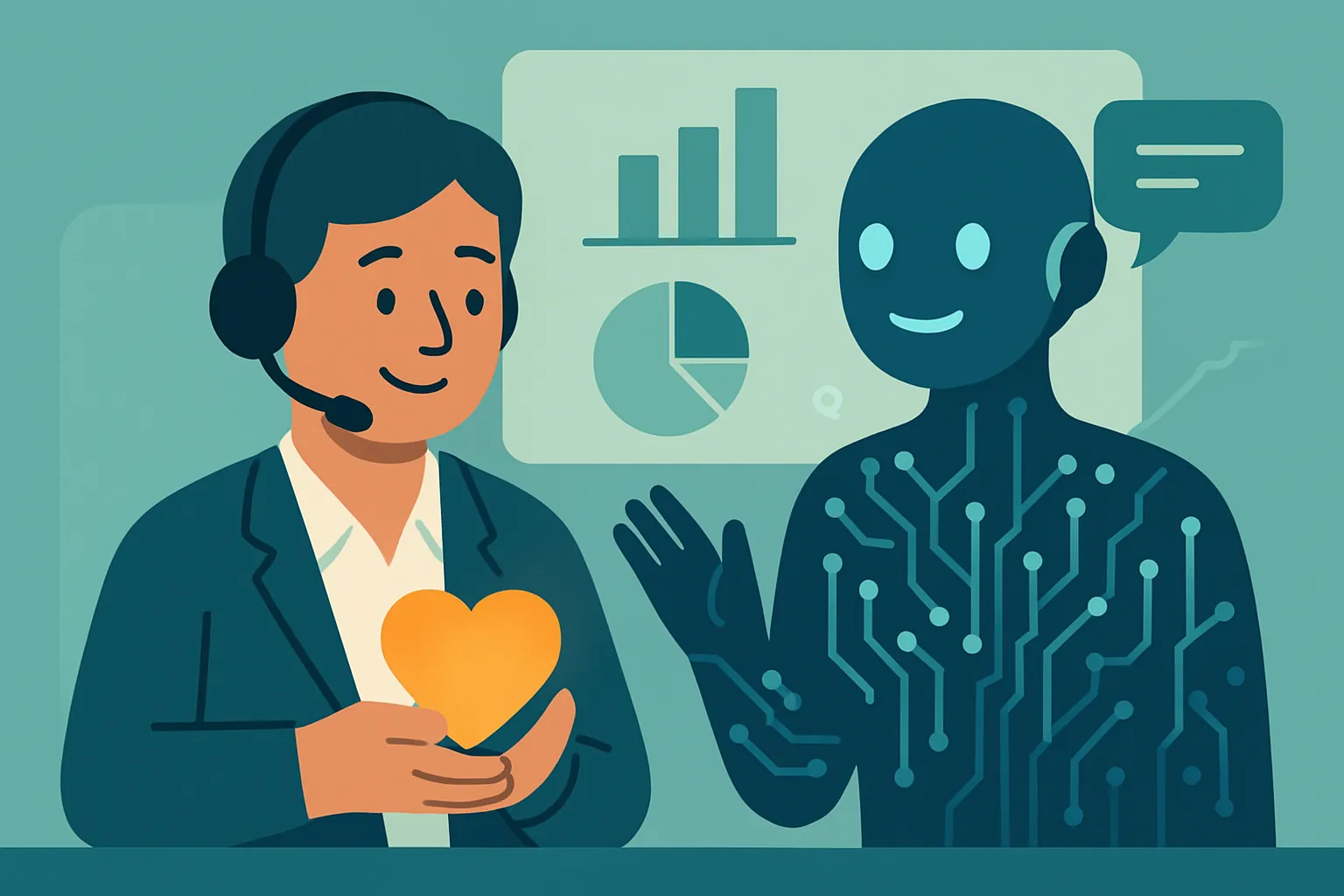
AI will not replace therapists, but it is already reshaping the work. Natural-language processing and digital phenotyping can quantify a client's language patterns, affect shifts, and micro-expressions, turning a clinician's intuition into verifiable data. Speech-to-text and generative tools draft transcripts and SOAP notes, freeing time for the therapeutic relationship itself. What technology cannot replicate is empathic holding and the clinical use of countertransference—the irreducibly human core of counseling—so data security, algorithmic bias, and HIPAA/GDPR compliance remain the clinician's responsibility.
From "Will AI Take My Job?" to "AI Helps Me Do Better Work"
When the office door closes after a session, what's left on your desk? Usually the emotional residue of everything your client just poured out—and a mountain of documentation waiting to be written, coded, and filed. Most of us went into this profession to build a working alliance, to be fully present with the person in the room. Yet the reality is too often a grind of transcripts and progress notes that eats the hours real therapeutic work deserves.
The rapid arrival of digital health tools and AI has reached clinical practice, and the reaction among counselors is split. Some see an intrusion into a uniquely human domain. But many researchers and front-line clinicians are reframing these tools as something else entirely: a way to extend professional capacity rather than threaten it. From sharpening case conceptualization, to catching nonverbal cues we routinely miss, to automating the records that drive burnout—the question worth asking is not whether AI can replace us, but how it can assist and enhance the work only a human clinician can do.
1. Data-Informed Insight: Beyond the Limits of Memory
Counseling is, at its core, a deeply human exchange. But relying solely on a clinician's memory and subjective read introduces bias. Digital phenotyping and natural language processing (NLP) can serve as a kind of "co-therapist," supplementing—never supplanting—clinical judgment.
Quantifying language and affect
Word frequency, sentence length, and shifts in vocal prosody can function as meaningful biomarkers for the severity of depression or anxiety. AI tools can surface, as visualized data, how often a client used negative self-referential language, or how their voice changed when a specific theme—family, work—came up. This doesn't override your judgment; it lets you test an intuitive hypothesis against objective evidence.
Catching micro-expressions and incongruence
Have you ever missed the flicker of sadness that crosses a client's face in the tenth of a second after they say, "I'm fine"? Advanced video-analysis models can flag micro-expressions that are nearly impossible to catch in real time. For working with defense mechanisms or incongruence between affect and content, that's a clinically valuable signal—one more data point for you to interpret, in context.
2. Reclaiming the Hour: From Note-Taker to Present Clinician
One of the most draining realities of practice is documentation—session transcripts and progress notes. A 50-minute session can demand two to three hours of typing. That inefficiency depletes clinicians and, ultimately, erodes the quality of care. Speech-to-text (STT) and AI summarization are changing the workflow substantially.
| Dimension | Traditional (Manual) | AI-Assisted |
|---|---|---|
| Time required | ~2–3× session length (replaying audio, typing) | Draft generated within minutes of session end |
| Accuracy | Vulnerable to memory distortion and omission | 90%+ of dialogue captured via speech recognition |
| Attention in session | Eye contact disrupted by note-taking | Fully present to affect and expression |
| Clinical usability | Flat text; not searchable | Affect-keyword extraction, summaries, tagging, structured data |
Real-time transcripts with speaker separation
Modern models use speaker diarization to distinguish the clinician's voice from the client's. When preparing for supervision, this is invaluable—it lets you objectively review your own talk-to-listen ratio and the timing of your interventions, rather than relying on a hazy recollection.
Tools built for this work—Nabla, Heidi, and general-purpose transcribers like Otter—differ in how they're built for clinical settings, so vet each against your confidentiality obligations before adopting one.
Auto-drafting SOAP notes
Beyond transcription, generative AI can propose a progress note structured as Subjective, Objective, Assessment, and Plan. You review the draft, apply clinical judgment, and revise—turning hours of writing into minutes of editing.
3. Ethics First: HIPAA, GDPR, and What Technology Cannot Replace
Adopting any of this responsibly demands rigorous ethical care. Data privacy and algorithmic bias are non-negotiable concerns for any clinician. These tools are aids—nothing more. They cannot replace the healing relationship that is the substance of therapy.
Practicing within an ethical and legal perimeter
Before choosing an AI tool, scrutinize how client data is encrypted, stored, and protected. In the US, that means a vendor willing to sign a Business Associate Agreement (BAA) and demonstrate HIPAA compliance; in the EU and UK, GDPR lawful-basis and data-residency requirements apply. Favor tools offering data minimization, zero-retention options, and transparent processing terms. And when an AI-generated analysis is shared with a client, weigh its psychological impact carefully—the interpreting authority must always be the qualified clinician, never the algorithm.
Empathy and intuition: the irreplaceable domain
AI can tell you a client used a sorrowful word fifteen times. It cannot feel the existential loneliness beneath that sorrow, or sit with it and hold it. Only a human clinician can do that. The time and energy these tools give back should be reinvested precisely there—in deep empathy and the clinical use of countertransference.
Conclusion: A Warm Clinician, Equipped
Digital health tools and AI are not competitors. At their best, they function as a tireless assistant—handling the repetitive, depleting administrative load so you can give your full attention to the person in front of you. Freed from that burden, we regain the capacity to truly read the tremor in a client's eyes and the meaning held inside a silence.
A few small, concrete steps to start:
- Trial a security-first documentation tool. Look beyond raw recording to transcription and summarization that captures context and extracts key themes—then confirm it meets your HIPAA/GDPR obligations before any client data touches it.
- Use your transcripts for self-monitoring. Analyze your own question types (open vs. closed) and the frequency of your empathic reflections.
- Build an ethics study group with peers. Discuss the dilemmas that surface when applying new technology to clinical work—privacy, consent, bias, and interpretation.
The technology is cold. The clinician using it can be warmer and more attuned than ever. Pick up the tool, and walk deeper into the work of healing.
Modalia AI is built for exactly this: a security-first AI partner for counselors—transcription, case conceptualization support, and documentation—designed so your data stays protected and your judgment stays central.
Frequently asked questions
Will AI replace counselors and therapists?
No. AI can quantify language patterns, draft notes, and flag nonverbal cues, but it cannot provide empathic holding or use countertransference clinically. It augments the clinician's judgment rather than replacing the therapeutic relationship.
Is it ethical to use AI transcription with client sessions?
It can be, provided you protect client data. Verify encryption, data-retention policy, and regulatory compliance—a signed Business Associate Agreement and HIPAA compliance in the US, or GDPR lawful basis and data residency in the EU/UK—and always obtain informed consent before recording.
How much time can AI documentation tools realistically save?
Traditional manual notes can take two to three times the session length. AI-assisted workflows generate a draft within minutes of the session ending, so your role shifts from writing to reviewing and applying clinical judgment—often cutting documentation time by half or more.
What is digital phenotyping in a counseling context?
Digital phenotyping uses data—word frequency, sentence length, vocal prosody, and micro-expressions—as objective markers of clinical states like depression or anxiety severity. It lets clinicians test intuitive hypotheses against measurable evidence, while interpretation stays with the therapist.
This article was written and reviewed using Modalia AI's clinical guidelines, with professional human review before publication.
Related articles
 Case Conceptualization
Breaking the "Yes, But" Game: A Transactional Analysis Guide for Therapists
Every suggestion you offer gets met with "Yes, but..." Here's the TA structure behind that stall—and four clinical moves to break it.
7 min read Case Conceptualization
Yalom's The Gift of Therapy: Passages Every New Counselor Should Copy by Hand
Irvin Yalom's prescription for therapists who fear silence: meet your client as a "fellow traveler" and let the here-and-now become the heart of the work.
6 min read Case Conceptualization
Working With Silence in Therapy: What Client Silence Means and How to Hold It
Silence in session isn't empty space. Learn to read its clinical meaning, tell productive from defensive silence, and use it as a therapeutic tool.
6 min read