Why ChatGPT Can't Replace the Clinician's Insight in Psychological Assessment
When clients arrive with AI self-diagnoses, what's our role? The clinical insight, contextual judgment, and therapeutic alliance no algorithm can replicate.
Key takeaway
Generative AI is changing the consulting room: clients increasingly type symptoms into a chatbot and arrive with a self-diagnosis. AI processes patterns across vast data quickly, but it cannot read nonverbal cues, transference and countertransference, or the client's lived context. Integrative case conceptualization, the interpretation of contradictory test data, cultural nuance, and the therapeutic alliance remain the clinician's domain—work no technology can replace. The wise path is to delegate repetitive administrative tasks to AI and reinvest the reclaimed time in sharpening clinical intuition.
"My AI Says I Have ADHD": Helping Clients Who Arrive Pre-Diagnosed 🧠
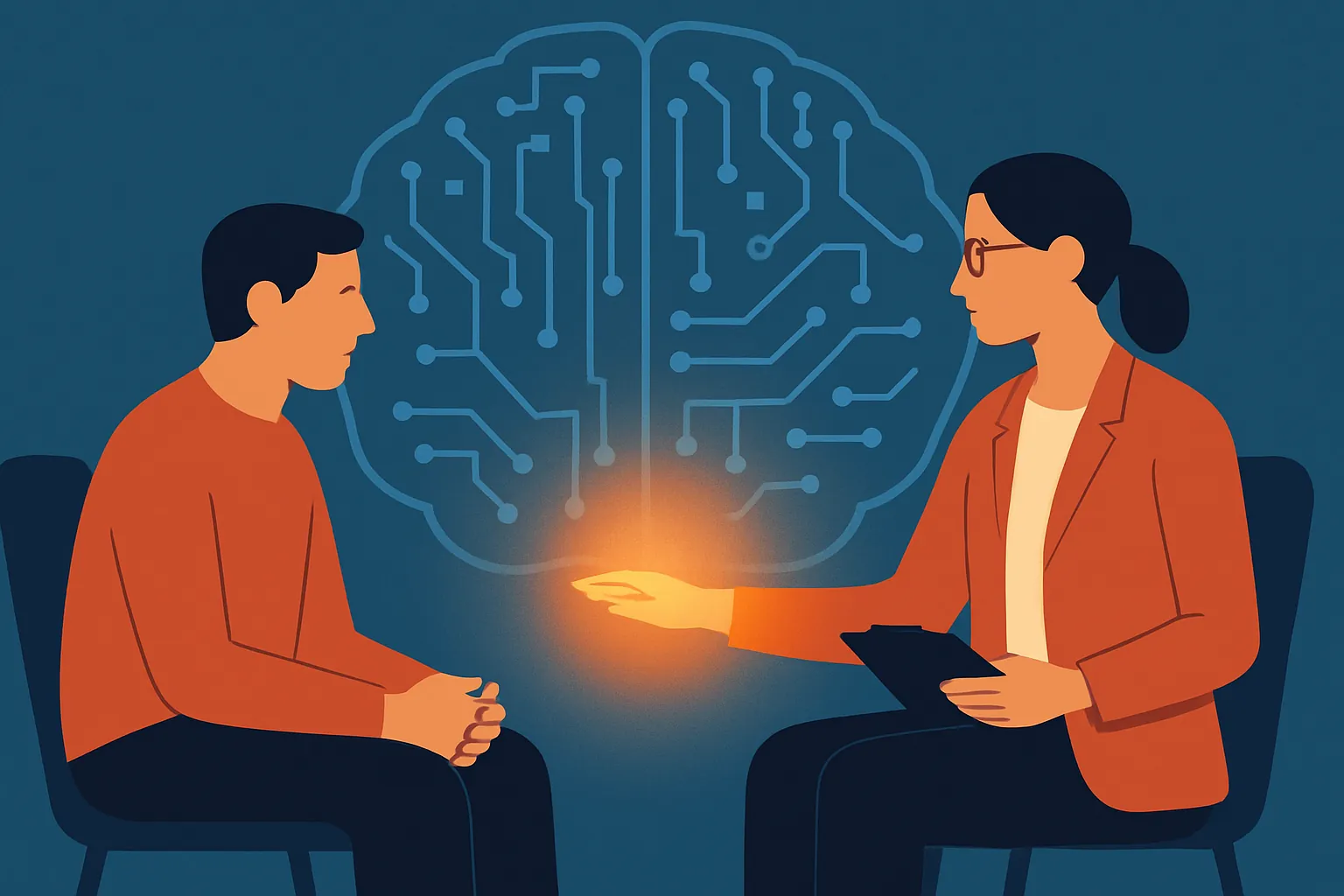
If you've practiced for any length of time recently, this scene may feel familiar. A client settles into the chair and opens with: "I described my symptoms to ChatGPT, and it told me I probably don't have depression—I most likely have adult ADHD." Generative AI has made self-diagnosis effortless. Anyone can search their symptoms and walk away with a confident-sounding label. So the question for our field is sharp: is this a threat to clinicians, or an opening?
Many colleagues worry that AI is creeping past test scoring and diagnostic classification into territory that has always been ours. And it's true—large language models process information at a speed no human can match. But here is the question that matters: can an AI read the tremor behind a client's voice, the nonverbal signal that contradicts the words, or the singular life context hidden between two test scores?
This piece is about the insight that cannot be automated—the part of psychological assessment that belongs to the human expert. The goal isn't to reject the technology. It's to draw a clear line around what only a clinician can do, and to use that clarity to deepen our therapeutic work. AI can produce an answer. Interpreting what that answer means in a person's life, and helping them heal, is still ours.
1. Data Reads Patterns; Clinicians Read Context
Large language models excel at text-based processing. Feed in MMPI-2 or TCI scores and you'll get a textbook interpretation in seconds. But the essence of psychological assessment was never the recitation of elevated scales. The expert's work lies in reading the white space—between the numbers, between the sentences.
Phenomenological understanding and nonverbal integration
An AI will likely process the typed words "I'm fine" as a positive signal. A seasoned clinician notices, in that same moment, the averted gaze, the faint tremor in the fingertips, the half-second of silence. These nonverbal cues—and the transference and countertransference that move through the room—are precisely what AI can never reduce to data. Assessment is not a score report; it is a total act that includes test-taking behavior and the whole arc of the interview.
Defense mechanisms and the architecture of personality
AI fixes on the surface symptom and proposes a label. The expert recognizes that the symptom may be the product of a defense mechanism protecting the client's ego. Consider an aggressive child: an algorithm might surface "conduct disorder," while the clinician reads the depression and abandonment anxiety underneath and builds an entirely different treatment plan. That is the gap between mechanical classification and clinical insight.
The table below contrasts AI's data-processing power with the clinician's professional judgment, to make plain where we should be investing our skill.
| Dimension | Generative AI (e.g., ChatGPT) | Clinical Expert (Human) |
|---|---|---|
| Core function | Pattern-matching and summary across vast data | Integrative interpretation of the client's lived, emotional context |
| Information gathered | Limited to entered text and numeric data | Includes nonverbal cues (expression, tone), test-taking behavior, behavioral observation |
| Diagnostic stance | Symptom-matching to DSM-5 criteria (flat) | Case conceptualization including developmental history, trauma, defenses (dimensional) |
| Ethical judgment | Algorithmic, boilerplate warnings | Immediate, accountable intervention for suicide/harm risk |
| Therapeutic relationship | Information provider (one-way) | Therapeutic alliance and emotional attunement |
Table 1. AI versus the clinical expert in psychological assessment.
2. Case Conceptualization: A Map of the Mind Only a Human Can Draw
The heart of assessment is not assigning a diagnosis—it is integrative case conceptualization. This is the demanding intellectual and emotional work of weaving a client's past (developmental history, trauma), present (precipitants, symptoms), and future (prognosis, treatment plan) into one coherent story. AI can lay out scattered puzzle pieces; only the expert can assemble them into a single, recognizable picture of a person.
Integrating and interpreting contradictory data
Assessment results often contradict one another. A self-report measure (MMPI-2) may land within normal limits while a projective measure (Rorschach) reveals serious deterioration in reality testing. AI is apt to dismiss the mismatch as "data error" or a "complex profile." The expert sees the discrepancy itself as masked distress—and interprets how hard the client is working to maintain social desirability. Interpreting the contradiction is exactly the insight AI cannot supply.
Cultural nuance and existential understanding
The constructs that shape distress are deeply cultural, and a model trained largely on aggregate, Western text struggles with the particulars. Think of the perfectionistic self-reliance bred by a "pull yourself up by your bootstraps" ethos; the loyalty conflicts inside an immigrant family straddling two value systems; the shame carried by a client raised in a strict religious community; the "be strong, don't complain" code that keeps many men out of treatment until crisis; or the chronic vigilance shaped by racialized or marginalized identity. A client's sociocultural world and existential concerns carry nuance that lives beyond the text. The clinician understands not just the client's words but the world those words come from—and from there points toward genuine empathy and healing.
The healing power of the relationship itself
Most important is the therapeutic alliance. Clients heal less from a flawless analysis than from being truly understood and held by someone willing to stay with their pain. However eloquent an AI's words of comfort, they remain the output of an algorithm. Eye contact, empathic listening, and serving as a secure base are irreducibly human.
3. Working With AI: Don't Compete—Deploy It
So how should we meet this wave? The conclusion is clear. Competing with AI on diagnostic recall is pointless. Instead, hire it as a capable assistant that makes your expertise shine. Hand off the repetitive, depleting tasks and concentrate on the higher-order clinical work only a human can do.
Streamlining documentation and records
Few things drain a clinician faster than writing session transcripts and progress notes. Reconstructing and typing up fifty minutes of session can take several times that long, and the energy it consumes is energy taken from case analysis and from the client relationship. This is where AI offers the greatest practical help.
A tool for data-driven hypothesis testing
When you're forming initial hypotheses about a complex presentation, AI can surface relevant literature or propose a differential list. The final judgment is always yours—but used as a checklist to catch possibilities you might have overlooked, AI can sharpen diagnostic accuracy.
Strengthening clinical intuition
While AI handles the basic information processing, reinvest the reclaimed time and mental bandwidth in honing clinical intuition. Watch your client's face more closely. Use supervision to examine your countertransference. Study the latest treatment methods. The further technology advances, the scarcer—and more valuable—human warmth and deep insight become.
Conclusion: Cool Tools, Warm Hearts
In the age of generative AI, the clinician's role isn't shrinking—it's being redefined. Where we once spent enormous time as record-keepers gathering and transcribing information, we are now free to focus on what matters most: integrating the data and tending to the person—as healer and designer of care.
Step away from depleting documentation and think about how to maximize your clinical insight. Security-first AI partners built for clinicians—handling accurate transcription, supporting case conceptualization, and easing documentation—can help you stay fully present with the client rather than the keyboard. Modalia AI is designed for exactly this: to give the administrative load to the machine so your attention can stay where only you can be.
AI is not our competitor. Let it carry the records and the data wrangling. You bring the warm attention and incisive insight that no algorithm can replicate—and that is the clinician this era truly needs.
References
- 1.
- 2.
Frequently asked questions
Can AI replace clinicians in psychological assessment?
No. AI is strong at pattern-matching and summarizing data, but it cannot read nonverbal cues, work with transference and countertransference, interpret contradictory test results, or form a therapeutic alliance. These remain the clinician's domain. AI is best used as an assistant, not a substitute.
How should I respond when a client arrives with an AI self-diagnosis?
Treat it as clinical material rather than a threat. Validate the client's effort to understand themselves, then explore what the label means to them and why it resonates. Use your full assessment—history, observation, and relationship—to develop an integrative conceptualization that an algorithm cannot produce.
What are safe, useful ways to incorporate AI into clinical work?
Delegate repetitive administrative tasks: drafting session transcripts and progress notes, surfacing relevant literature, and generating differential checklists to catch overlooked possibilities. Keep all clinical judgment human, choose security-first tools that protect client data, and reinvest the reclaimed time in supervision and clinical intuition.
Why does AI struggle with cultural nuance in assessment?
Models trained largely on aggregate, often Western text miss the lived particulars of distress—perfectionistic self-reliance, immigrant family loyalty conflicts, religious shame, masculine stoicism norms, or the vigilance shaped by marginalized identity. Clinicians interpret these constructs in context, which is essential to accurate conceptualization and genuine empathy.
This article was written and reviewed using Modalia AI's clinical guidelines, with professional human review before publication.
Related articles
 Case Conceptualization
Breaking the "Yes, But" Game: A Transactional Analysis Guide for Therapists
Every suggestion you offer gets met with "Yes, but..." Here's the TA structure behind that stall—and four clinical moves to break it.
7 min read Case Conceptualization
Yalom's The Gift of Therapy: Passages Every New Counselor Should Copy by Hand
Irvin Yalom's prescription for therapists who fear silence: meet your client as a "fellow traveler" and let the here-and-now become the heart of the work.
6 min read Case Conceptualization
Working With Silence in Therapy: What Client Silence Means and How to Hold It
Silence in session isn't empty space. Learn to read its clinical meaning, tell productive from defensive silence, and use it as a therapeutic tool.
6 min read