Cut Your Session Transcript Time in Half — Ethically Using AI Speech-to-Text
Halve the hours you spend on verbatim transcripts with AI speech-to-text — without compromising client confidentiality or clinical depth.
Key takeaway
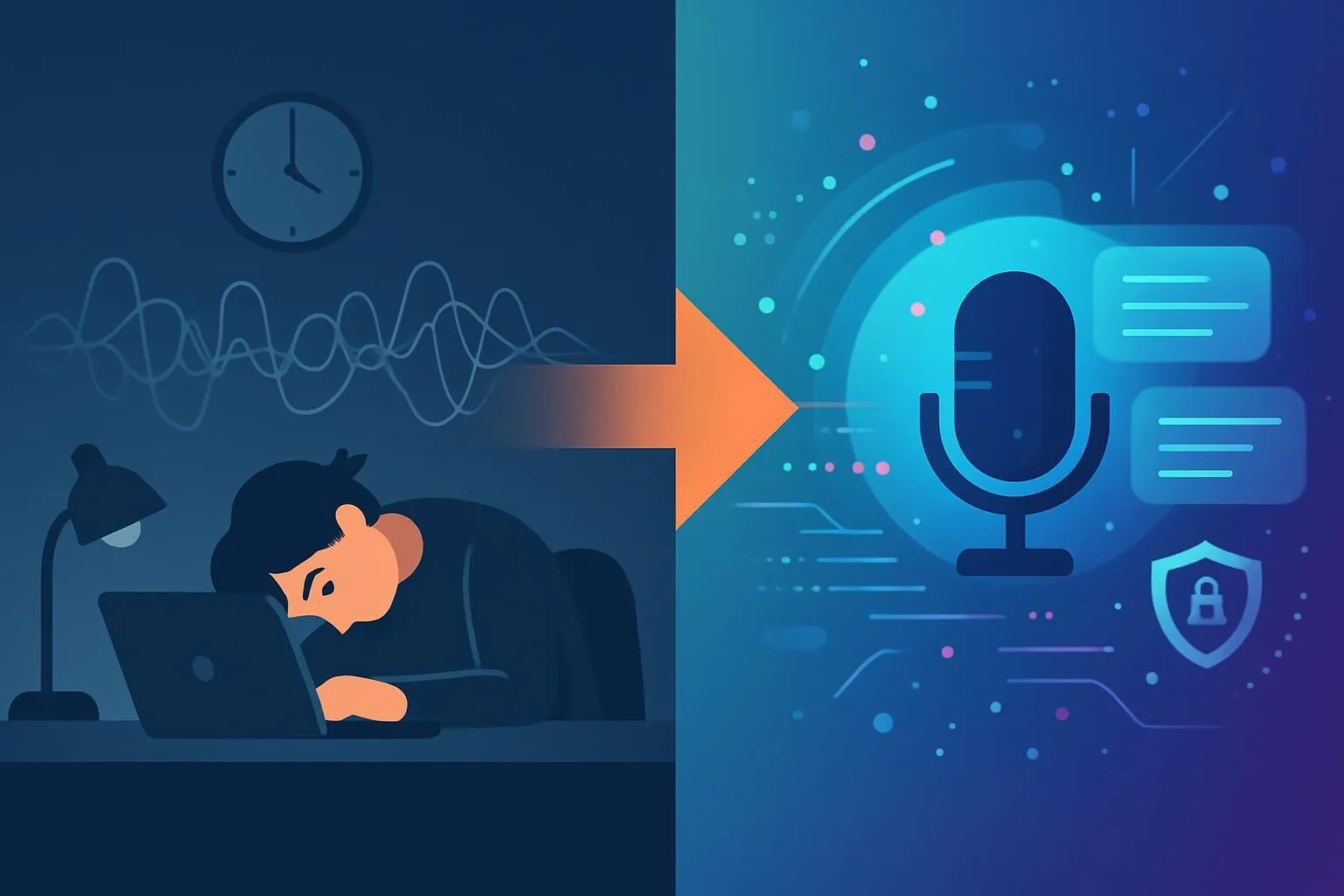
Producing a verbatim transcript of a single 50-minute session can take three to six hours and is a leading driver of clinician burnout. AI speech-to-text (STT) tools like Otter.ai, Whisper, and Fireflies can automate the first draft and cut that time by more than half — but because they handle highly sensitive client data, a three-step de-identification protocol (informed consent, file pseudonymization, and immediate deletion from the cloud) must come first. The editing pass that follows is not mere proofreading; it becomes a clinical re-experiencing of the session, freeing cognitive resources for case conceptualization and the analysis of transference and countertransference.
Still Typing All Weekend? A Practical Guide to Halving Your Transcript Time
Friday evening. The last client has left, the office lights are off — and yet the work isn't finished. For trainees and seasoned clinicians alike, few tasks are as draining as producing a verbatim session transcript. Turning 50 minutes of audio into accurate text can take anywhere from three to six hours, depending on skill and typing speed. The cost isn't just sore wrists and tired ears; this kind of repetitive labor is one of the quieter, more persistent contributors to clinician burnout.
We write transcripts for good reasons: to sharpen the quality of our work and to mine each session for clinical insight in supervision. But when all of our energy is spent on the mechanical act of typing, there's little left for what actually matters — case conceptualization and the close reading of a client's nonverbal dynamics. Recent leaps in speech-to-text (STT) technology have changed the picture. Accessible tools such as Otter.ai, OpenAI's Whisper, and Fireflies can now shoulder much of the transcription burden. And yet most of us hesitate at the threshold, stopped by a single ethical question: "Is it acceptable to upload my client's most sensitive disclosures to an AI server?" This article offers a clinician's answer — a realistic workflow that uses AI to dramatically shorten transcription time while holding the line on confidentiality and professional ethics.
1. What AI Transcription Can and Can't Do: Efficiency vs. Accuracy
The traditional approach to transcription is an exercise in patience: play three seconds, pause, type, rewind, repeat. STT services change the unit of work. Instead of starting from a blank page, you start from a generated draft and shift into an editing role. That single change — from producing to correcting — is where most of the time savings come from, and it frees attention for clinical judgment.
But no tool is flawless, and a therapy session is not an ordinary meeting. A client's tearful, unsteady voice, long silences, and the crosstalk that happens when two people speak at once are precisely the moments AI struggles to render. Treat STT as an assistant, not a replacement. The comparison below lays out the trade-offs.
| Dimension | Traditional Typing | AI Draft + Editing |
|---|---|---|
| Time (per 50-min session) | ~240–300 min | ~90–120 min (50%+ reduction) |
| Primary fatigue source | Wrist strain, listening fatigue, monotony | Cognitive load of verifying text, fixing errors |
| Accuracy profile | High (but listening errors possible) | Moderate–high (errors on accents, jargon, homophones) |
| Nonverbal capture | Entered manually — (silence), (sighs) | Mostly omitted; must be annotated by hand |
Table 1. Efficiency comparison: traditional transcription vs. an AI-assisted workflow.
2. The Heart of It Is De-identification: A Three-Step Ethical Firewall
For any clinician, efficiency matters less than the absolute duty of client confidentiality. The ethics codes of the American Psychological Association (APA), the British Psychological Society (BPS), and the British Association for Counselling and Psychotherapy (BACP) are unambiguous: recording or disclosing client information without consent is a serious breach. Most consumer AI services run in the cloud, and their terms of service may permit your data to be used for model training. Under frameworks like HIPAA in the US and the GDPR in the UK and EU, uploading identifiable client audio carries real legal and ethical weight. Before any AI touches your recording, build the following de-identification firewall.
-
Informed Consent
During the structuring phase of treatment, explain the purpose of recording (supervision and professional development) and obtain written consent. The safest practice is to state explicitly that "an automated transcription tool may be used as an aid to produce an accurate record, and that all personally identifying information will be removed," and to secure agreement on that basis.
-
Pseudonymizing the Recording Itself (Pre-processing)
The most secure option is to strip sensitive information before uploading. Audio editing is tedious, so a practical fallback is to never use the client's real name in the file name — use a non-identifying code instead of anything traceable to the person or the date in a guessable format. In session, when a client states a proper noun such as their name or employer, some clinicians lower their voice slightly or briefly cover the microphone — small physical habits that reduce what ends up on the recording.
-
Delete the Output Immediately and Store Locally
The moment the transcription is complete, permanently delete both the audio file and the text data from the platform. Move the transcript to offline local storage or a secured, institution-controlled server and do your second-pass editing there. Leaving data sitting in the cloud is the same as leaving a confidentiality breach waiting to happen.
3. "Smart Editing": Turning the Correction Pass into Clinical Insight
Once AI has produced the draft, this is where clinical expertise earns its keep. The editing pass should never collapse into mere proofreading. Use it instead to review the arc of the session and to re-experience it — paying particular attention to transference and countertransference.
First, try the "1.5× listening + eyes-on-text" technique. Pull up the AI transcript and play the recording at 1.5× speed while you follow along. Because the text is already there, your brain processes the content faster. More important than fixing typos is filling in the emotional nuance the AI missed, in parentheses. If the AI wrote "I see," but the actual voice was trembling, editing it to read "(in a trembling voice) I see" is far more clinically meaningful than any spelling correction.
Second, correct speaker diarization errors and analyze your own interventions at the same time. Even with current technology, when the counselor's and client's voices overlap or sound similar, speakers get swapped. As you fix those errors, ask yourself: "Was my intervention here appropriate? Did I interrupt the client?" The cognitive resources freed from rote typing get reinvested in genuine clinical analysis.
4. The Future of Clinical Records: Expertise Beyond the Technology
Shortening transcription time isn't about clocking out sooner. It's about reclaiming the margin of time we need to be more present with our clients, to protect our own mental health, and to do deeper case work. Tools like Otter.ai and Whisper can be excellent assistants — but ethical responsibility and clinical sensitivity remain entirely ours as professionals.
The next generation of clinical record-keeping will move beyond general-purpose speech recognition toward security-first AI built specifically for the counseling domain. Purpose-built clinical note services are beginning to emerge that offer encrypted records, automatic masking of client information, and even analysis of intervention types. Rather than fearing or rejecting this shift, the flexibility expected of a modern clinician is to adopt and use it deliberately, within clear ethical guidelines. This is precisely the space Modalia AI is built for — a security-first AI partner for counselors that handles transcription, case conceptualization, and documentation with confidentiality at its core.
So pull up a recording from a recent session. Run it through a sound de-identification process, then let AI lend a hand. For every hour you reclaim from transcription, your clinical insight has room to deepen.
References
- 1.
- 2.
- 3.
- 4.
Frequently asked questions
Is it ethical to use AI transcription tools for therapy sessions?
Yes, provided you follow a strict de-identification protocol. Obtain written informed consent that names the use of an automated transcription aid, pseudonymize the recording before upload, and delete both the audio and text from the cloud platform immediately after conversion. APA, BPS, and BACP codes — and HIPAA/GDPR — require that identifiable client information never be disclosed or stored insecurely.
How much time does AI speech-to-text actually save on a transcript?
Traditional manual transcription of a 50-minute session typically takes 240–300 minutes. An AI-assisted workflow, where you edit a generated draft instead of typing from scratch, usually takes 90–120 minutes — a reduction of more than 50%.
What are the limitations of AI transcription in a clinical setting?
AI tools struggle with the moments that matter most clinically: trembling or tearful voices, long silences, and overlapping speech. They also misattribute speakers when voices sound similar and frequently miss emotional nuance. Treat AI as an assistant that produces a first draft, not a replacement for clinical listening.
How should I store the transcript after the AI generates it?
Delete the audio and text from the AI platform immediately, then move the transcript to offline local storage or a secured, institution-controlled server for your editing pass. Leaving client data in the cloud is a standing confidentiality risk.
This article was written and reviewed using Modalia AI's clinical guidelines, with professional human review before publication.
Related articles
 Clinical Skills
How to Write Better Supervision Questions: Getting What You Actually Need from Your Supervisor
Stuck on what to ask in supervision? Use these structured question strategies to turn vague check-ins into focused clinical insight.
7 min read Clinical Skills
From "The Client Seems Depressed" to a Clinical Hypothesis: How Word Choice Elevates Your Case Reports
Turn vague observations into precise clinical hypotheses. A practical guide to terminology and sentence formulas that make your case reports read like expert work.
7 min read Clinical Skills
The Wounded Healer Trap: Why "I Want to Heal Myself" Sinks Your Counseling Grad School SOP
Why admissions faculty flinch at "I want to heal my own wounds"—and how to transform personal pain into a research-grade statement of purpose that gets you in.
6 min read