Mapping Attachment Across Generations: A Clinician's Guide to the Attachment-Based Genogram
Visualize how relational patterns pass down through families. A clinical guide to building attachment-based genograms and intervening to break the cycle.
Key takeaway
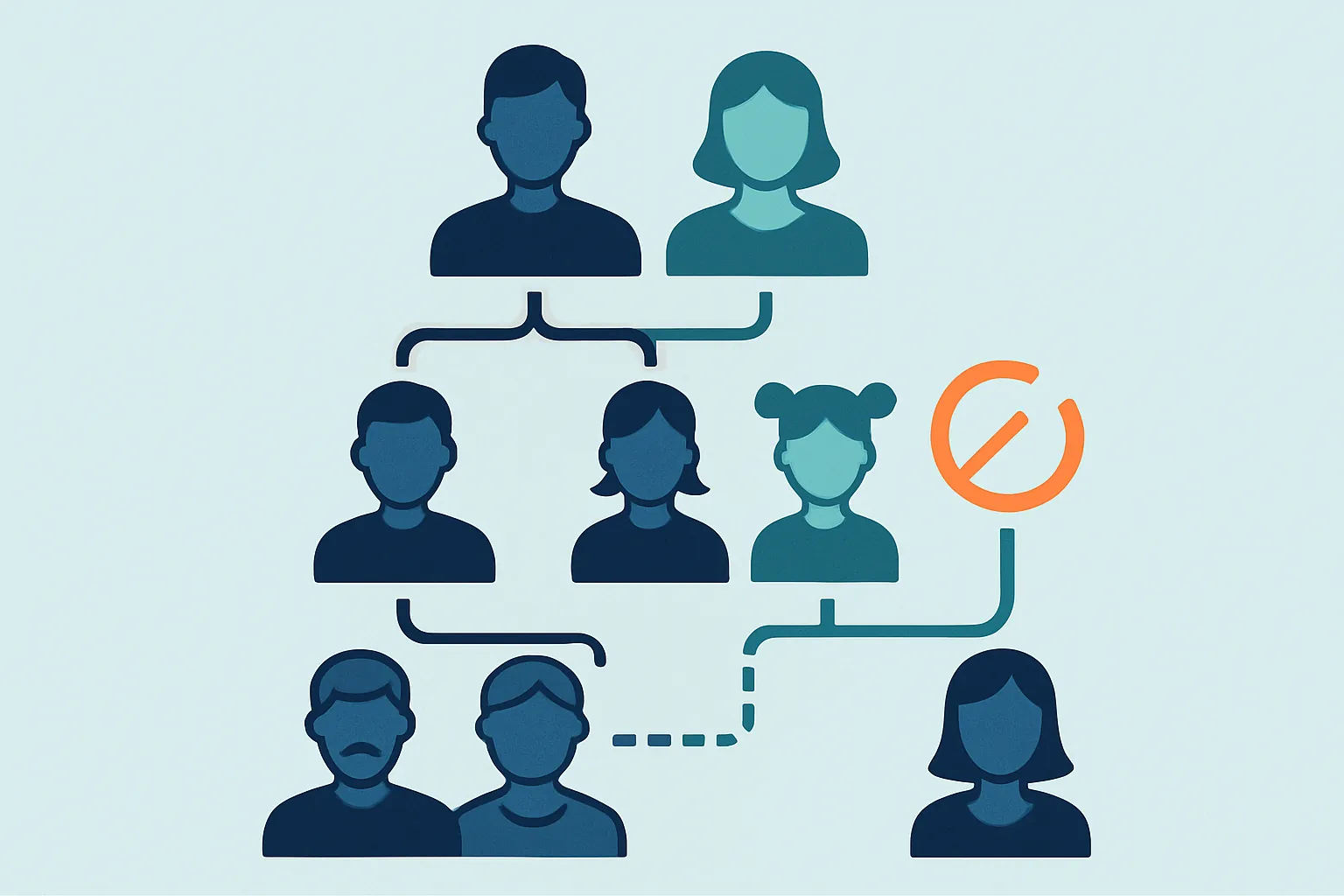
An attachment-based genogram merges Murray Bowen's family systems theory with John Bowlby's attachment theory to make intergenerational emotional patterns visible on a single map. Research on the Adult Attachment Interview (Main et al., 1985; van IJzendoorn, 1995) shows that a parent's attachment classification predicts the child's roughly 75% of the time. By charting secure, preoccupied, dismissing, and disorganized patterns with distinct relational symbols across three generations, clinicians help clients reframe their relational struggles not as personal defects but as a family-system current they can finally see—and change.
The Invisible Threads: Using an Attachment Genogram to Interrupt Inherited Relational Patterns
Many clients arrive in our offices having promised themselves, "I will never live the way my parents did"—only to find, with a sinking sense of despair, that they keep recreating the very relationships they swore to escape. If you have sat with a client's presenting problem long enough, you have likely felt that intuition yourself: this is not simply a quirk of personality. It is an emotional inheritance flowing through a much larger family system.
The trouble is that family dynamics are nearly impossible to convey through words alone. A client overwhelmed by their own pain rarely has the vantage point to see the objective pattern they are caught in. This is exactly where the attachment-based genogram earns its place in the clinical toolkit. By marrying Murray Bowen's family systems theory to John Bowlby's attachment theory, the approach renders invisible attachment injuries and their transmission routes into something a client can actually look at. This guide walks through how to build that map across generations and how to use it to surface clinical insight—turning what a client experiences as relational "fate" into a pattern that is open to change.
Why Put Attachment on the Genogram?
A traditional genogram excels at recording facts: structure, medical history, marriages, deaths. An attachment-based genogram shifts the focus to the quality of emotional connection between members. That shift matters clinically, because the mechanism of transmission is itself relational and largely out of awareness.
In their foundational Adult Attachment Interview research, Main, Kaplan, and Cassidy (1985) demonstrated that attachment is carried forward at "the level of representation"—through unconscious internal working models rather than conscious choice. A later meta-analysis by van IJzendoorn (1995) put a number on it: a parent's AAI classification predicts the child's attachment status roughly 75% of the time. Because this inheritance operates below awareness, the simple act of making it visible—lifting it to a conscious, shared object on paper—is in itself therapeutic.
Three clinical payoffs of combining attachment theory with the genogram
- Externalizing the pattern. Clients tend to read their relational struggles as personal failure. Locating the problem within "the flow of the family system" reduces shame and frees up curiosity, which is the precondition for insight.
- Surfacing hidden trauma. Tracing relational lines marked by cut-off or enmeshment often uncovers unspoken legacies—loss, abuse, migration, addiction—that were never put into words.
- Strengthening the alliance. The act of drawing the genogram together becomes a collaborative exploration in which the client experiences the therapy relationship itself as a secure base.
A Symbol Legend for Attachment Patterns
To use an attachment genogram well, you and the client need a shared visual vocabulary—a way to move beyond "close" or "distant" and depict the specific texture of insecure attachment. The conventions below build on standard genogram notation (McGoldrick, Gerson, & Petry) and map onto Adult Attachment Interview classifications.
Sample relational-line legend:
- ——— Single solid line → connected / supportive
- ═══ Triple solid line → fused / enmeshed
- – – – Dashed line → distant / emotionally cut back
- —/ /— Slashed line → cut-off / estrangement
- ∿∿∿ Jagged (zigzag) line → conflictual / abusive
- Bold weighting on any line → the pattern you are tracking as it travels down the generations
| Attachment style (AAI) | Genogram line & symbol | Intergenerational pattern | Where the clinician intervenes |
|---|---|---|---|
| Secure / Autonomous | Single solid line; comfortable distance; mutual connection | Flexible flow of emotional support; conflict is repairable; high resilience | Use as a resource. Explore positive exceptions and existing strengths. |
| Preoccupied (Anxious) | Triple solid / fused line; blurred boundaries | Over-involvement and guilt induction; the message "I can't survive without you" passes down | Support individuation. Practice setting emotional boundaries. |
| Dismissing (Avoidant) | Dashed (distant) or cut-off line; sparse connection | Suppression of emotional need; enforced independence and difficulty asking for help | Encourage emotion recognition and expression; revalue connection. |
| Unresolved / Disorganized | Jagged (conflict/abuse) line; irregular, chaotic | Fear and dependence coexist; elevated risk of transmitted abuse or neglect | Prioritize safety first. Trauma processing and self-regulation skills. |
Table 1. Attachment styles, their genogram notation, transmission patterns, and intervention focus.
Building and Reading the Genogram: A Four-Step Process
Once the theory and symbols are in hand, how does this translate into a live session? Drawing the genogram with a client should never be a dry intake exercise—it is a guided journey of exploration.
Step 1: Sketch three generations and gather the structural facts
Chart at least two generations above the client (parents and grandparents). As you do, record the transition points—deaths, divorces, remarriages, separations—with as much accuracy as possible. Attachment injuries frequently begin in unprepared partings and abrupt environmental change, so these moments are diagnostic gold.
Step 2: Color in the quality of each relationship
With the structure in place, ask questions that put emotion on each line. Move past "Did you get along?" toward specific, attachment-oriented prompts:
- "As a child, when you were frightened or hurt, who did you run to first?" (probing the secure base)
- "When your parents argued, where were you usually—and what did you do?" (probing triangulation)
- "Were there secrets or rules in your family that you were never allowed to talk about?" (probing family myths)
Step 3: Identify repeating patterns and key nodes
Step back and look for recurring symbols—cut-off lines with every male relative, say, or a fused mother–daughter dyad repeating across generations. Ask who carries the symptom for the system, and trace how that current reached the client. Thicken the relevant lines to make the flow unmistakable.
Step 4: Co-author a new narrative
The goal is the moment a client realizes, "I didn't pull away from my mother because I hated her—I was living inside a pattern of emotional suppression that started with my grandmother." That reframe stops the blaming and hands the client the power to reset the relationship on new terms.
Closing Thoughts—and Notes for Deeper Practice
An attachment genogram is more than a diagram. It is a map of the emotional history a client has lived and a compass for the path ahead. By making intergenerational patterns visible, we help clients step out of blind repetition and into agency. Real healing begins the moment a client looks at their own map and says, "This pattern ends here."
In practice, of course, executing all of this flawlessly is hard. Drawing a complex genogram while simultaneously tracking a client's subtle nonverbal cues and the flood of narrative they offer places an enormous cognitive load on the clinician.
The skill of capturing what matters
In attachment-focused interviews especially, how a client speaks about a parent—the hesitations, sudden silences, and shifts in vocal tone—is often as revealing as the content itself. If you are heads-down taking notes, you may miss the decisive moment that would have completed the picture.
This is where a security-first AI documentation partner like Modalia AI can help resolve the dilemma:
- Faithful narrative capture. Transcription converts a client's intricate family history into accurate text without losing a word, freeing you from the burden of writing so you can stay fully present with the genogram and with the client's eyes.
- Pattern-analysis support. Across long stretches of dialogue, the system can surface the frequency of recurring attachment keywords—"mother," "anxious," "escape"—helping you notice threads you might otherwise have missed.
- Richer supervision material. Bringing a visualized genogram together with a high-quality session transcript into supervision deepens the case conceptualization considerably.
My recommendation: pick up a pen, or open a whiteboard, and start sketching a client's attachment genogram this week. Let technology hold the record of the conversation, and give your full attention to following where the client's heart leads. The moment the invisible threads become visible, change has already begun.
References
- 1.
- 2.
- 3.
- 4.
- 5.
Frequently asked questions
What is an attachment-based genogram?
It is a clinical mapping tool that combines Bowen's family systems theory with Bowlby's attachment theory. Instead of recording only facts like births, deaths, and illnesses, it charts the quality of emotional connection between family members across three generations, using distinct relational symbols for secure, preoccupied, dismissing, and disorganized attachment patterns.
How strongly does attachment style pass between generations?
Research on the Adult Attachment Interview (Main et al., 1985) and van IJzendoorn's (1995) meta-analysis found that a parent's attachment classification predicts the child's attachment status roughly 75% of the time, largely through unconscious internal working models rather than conscious choice.
How do you depict different attachment styles on a genogram?
Use distinct relational lines: a single solid line for secure connection, a triple/fused line for preoccupied enmeshment, a dashed or cut-off line for dismissing distance, and a jagged line for the conflict or abuse often seen in disorganized attachment. Bolding a line tracks the specific pattern as it travels down the generations.
Why use a genogram instead of just discussing family history?
Talking through complex family dynamics has limits—an overwhelmed client struggles to see the objective pattern. Visualizing it externalizes the problem as a system-level current rather than a personal defect, reduces shame, surfaces unspoken trauma, and turns the drawing process itself into a collaborative, secure-base experience.
This article was written and reviewed using Modalia AI's clinical guidelines, with professional human review before publication.
Related articles
 Case Conceptualization
Breaking the "Yes, But" Game: A Transactional Analysis Guide for Therapists
Every suggestion you offer gets met with "Yes, but..." Here's the TA structure behind that stall—and four clinical moves to break it.
7 min read Case Conceptualization
Yalom's The Gift of Therapy: Passages Every New Counselor Should Copy by Hand
Irvin Yalom's prescription for therapists who fear silence: meet your client as a "fellow traveler" and let the here-and-now become the heart of the work.
6 min read Case Conceptualization
Working With Silence in Therapy: What Client Silence Means and How to Hold It
Silence in session isn't empty space. Learn to read its clinical meaning, tell productive from defensive silence, and use it as a therapeutic tool.
6 min read