How to Automate Psychological Assessment Reports Without Compromising Client Privacy
Cut full-battery report-writing time by up to 70% with a secure, ethics-first AI workflow that protects client data and preserves clinical judgment.
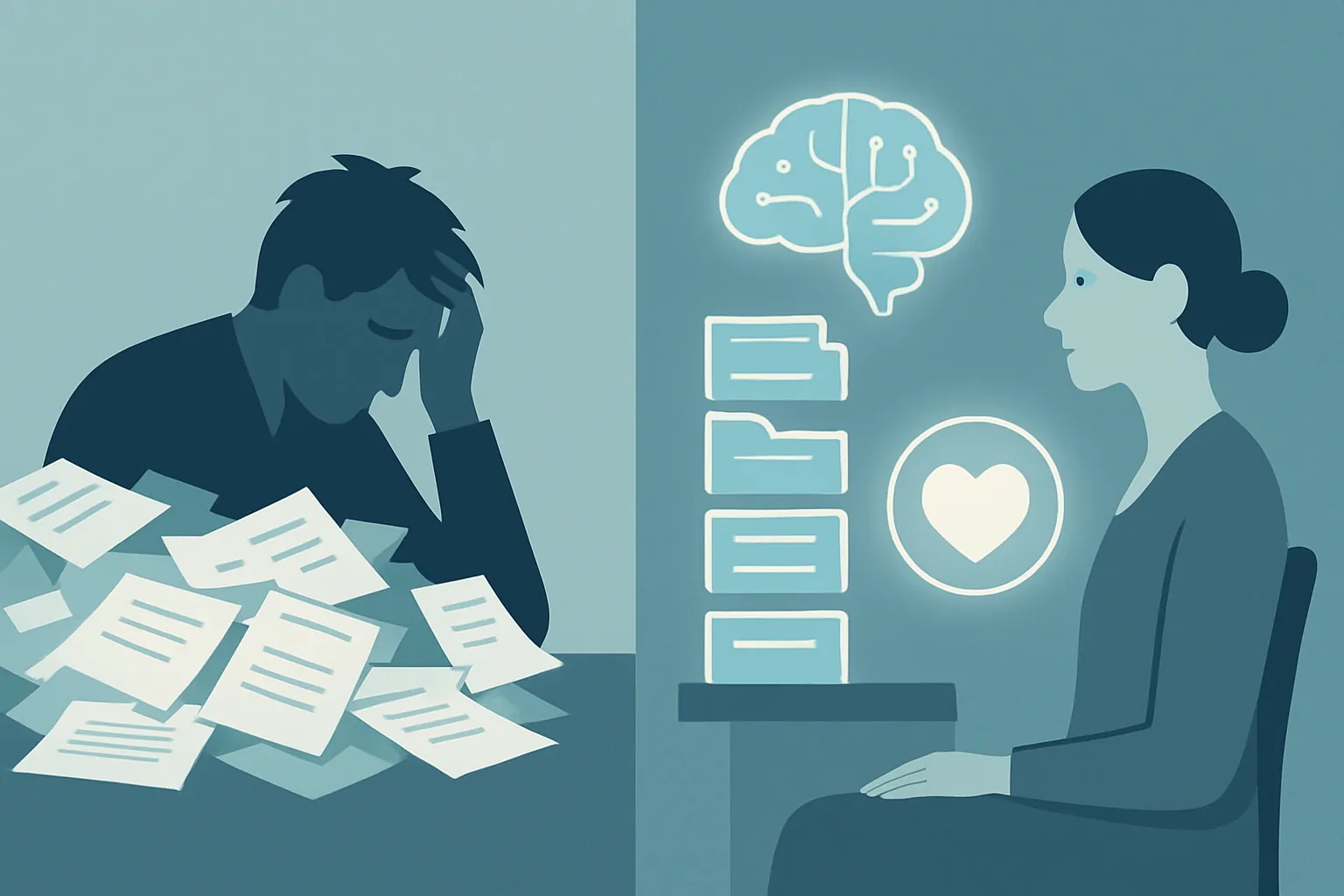
Key takeaway
A single full-battery psychological assessment report takes the average clinician three to five hours to write, and more than 70% of that time goes to translating raw scores into narrative prose and smoothing the prose itself. That documentation load is a leading driver of clinician burnout and degraded care. The two real barriers to using AI—risk of client data exposure and erosion of clinical insight—are controllable with rigorous de-identification and a closed, no-training AI environment. When AI drafts only the scaffolding and a clinician layers in nonverbal observation and session dynamics before final review, report time drops to roughly one to one-and-a-half hours with no loss in professional judgment.
The Report That Keeps You at the Office
Have you ever felt you spend more hours in front of a word processor than in the room with your clients? After administering a full psychological battery, integrating data from the MMPI-2, TCI, Rorschach, and WAIS into a single coherent interpretive report is cognitively demanding work—and it burns an enormous amount of administrative energy on top of the clinical reasoning. Across the field, counselors and clinical psychologists stay late writing reports, and that quiet, recurring overtime is a meaningful contributor to burnout.
As AI tools have matured, the paradigm for this repetitive, depleting documentation work is shifting. Understandably, many clinicians hesitate: Could a client's sensitive information leak? Will AI flatten or replace the depth of my clinical formulation? Those concerns are valid and deserve to be taken seriously as a matter of professional ethics. The goal here is not to hand the clinician's role over to a machine. It is to use AI as a capable research assistant inside a rigorously secured environment—one that builds the structural skeleton of an interpretation and sharply reduces administrative time, so your attention can return to the client.
Why Interpretation Always Takes Longer Than You Plan
The core reason assessment reports consume so much time is the work of translating and integrating data. Converting T-scores and raw scores into clinically meaningful narrative, then reconciling convergent and contradictory findings across instruments and tying them back to the client's presenting concern, carries a heavy cognitive load. Typing it out, selecting precise clinical terminology, and smoothing the prose can absorb more than 70% of the total time spent.
From any treatment-theory standpoint, a clinician's energy is best spent building the working alliance and using transference and countertransference clinically—not formatting paragraphs. Excessive paperwork drives burnout, which in turn lowers the quality of care. Many practices consider automating reports to relieve this, but stall over security, reluctant to route protected clinical data through consumer AI tools. The table below contrasts the traditional workflow with a security-conscious AI-assisted one.
| Dimension | Traditional report writing | Security-first AI-assisted writing |
|---|---|---|
| Time per full battery | 3–5 hours on average | 1–1.5 hours (≈10 min to draft + clinician revision) |
| Cognitive load | High, on low-value tasks: score lookup, sentence construction, typo fixes | Focused on clinical insight and reviewing the logic of the draft |
| Privacy & security risk | Lost paper files; weak security when stored on personal devices | Encrypted, cloud-based, de-identified handling |
| Clinician's primary role | Data-entry clerk and copy editor | Integrator of clinical context and final decision-maker |
Introduced correctly, AI lets you control the ethical risk of data exposure while reclaiming the clinician's real work: deep, contextual interpretation of the client.
Four Practical Strategies to Cut Report Time Securely
These strategies let you honor your ethical obligations and capture AI's efficiency immediately—no complex infrastructure required.
-
Establish a rigorous de-identification and pseudonymization protocol
Before any data touches an AI model, remove or pseudonymize every identifier: name, date of birth, employer, specific family constellation, and so on. For example, "a 35-year-old man employed at a major electronics firm" becomes "Client A, mid-30s male, office worker." This is the most basic and non-negotiable safeguard when handling clinical records.
-
Use a closed AI environment or a security-certified clinical tool
Open consumer chatbots (for instance, a free-tier general assistant) may use your inputs for model training, which makes them unsuitable for clinical data. Choose an API-based, no-training AI service or purpose-built clinical software that meets recognized privacy and security standards for health and counseling records—HIPAA in the US, GDPR in the EU/UK, PIPEDA in Canada, the Australian Privacy Principles, or your region's equivalent. That lets you analyze score-level data without the persistent fear of a leak.
-
Build standardized prompt templates that maximize clinical insight
Rather than throwing raw numbers at the model, create a structured query format that reflects your practice's philosophy and primary modality. A prompt such as: "Integrating an MMPI-2 2-7-0 codetype with the TCI Novelty Seeking (NS) subscale, describe the client's defense mechanisms and a direction for therapeutic intervention from an Acceptance and Commitment Therapy (ACT) perspective, in three paragraphs." yields a draft far closer to professional standard than an unstructured one.
-
Establish a human-in-the-loop review process
Treat the AI output as a draft, never a finished report. The clinician completes it by adding what the model cannot see: the client's nonverbal stance, the dynamics that surfaced in the room, and the particular nuances of the assessment interview. The machine compresses the time spent erecting the scaffold; the human supplies the clinical insight—efficiency without sacrificing quality.
Get Out of the Paperwork and Back to the Client
The ultimate point of bringing AI into clinical work is not time savings for its own sake—it is to spend the recovered time and energy on the client. Automating interpretive reports is a first step. With de-identified data, a secure AI environment, structured templates, and a clinician's final review, you can climb out of the administrative swamp and recover your identity as a clinician rather than a documentarian.
Assessment reports are only part of the load; managing the volume of session records generated every week is its own burden. Secure AI services that transcribe recorded audio into text and automatically surface key client data—session transcripts and progress notes—are drawing growing interest. Modalia AI is a security-first AI partner built for exactly this: transcription, case conceptualization support, and documentation that strengthen, rather than replace, clinical insight. Pairing report drafting with session summarization can raise a practice's operational efficiency well beyond what most clinicians expect.
Concrete next steps you can take today:
-
Draft a de-identification and security-ethics guideline your practice can actually apply
-
Request a clinician trial of a security-verified AI documentation and transcription service
-
Use peer supervision to cross-check the validity of an AI-drafted case formulation
Don't stay boxed in by paperwork and data. Use current technology wisely and ethically, so your warmth and your sharpest clinical insight stay aimed where they belong—on your client's growth.
Frequently asked questions
Is it ethical to use AI when writing psychological assessment reports?
Yes, when two conditions are met: client data is rigorously de-identified before it ever reaches the model, and the AI runs in a closed, no-training environment that meets recognized privacy standards (HIPAA, GDPR, PIPEDA, or your regional equivalent). The clinician remains the final decision-maker, using AI only to draft structural scaffolding.
How much time can AI realistically save on a full-battery report?
Most of the 3–5 hours a full battery takes is spent translating scores into narrative and polishing prose—often more than 70% of the total. With AI generating a structured draft and the clinician revising it, practices report dropping to roughly 1–1.5 hours per report without lowering quality.
Will using AI weaken the clinical quality of my reports?
Not if AI is confined to a draft-only role. The model cannot observe nonverbal behavior, in-room dynamics, or interview nuance. In a human-in-the-loop process, AI builds the skeleton and the clinician supplies the interpretive depth, so clinical judgment is preserved while administrative time falls.
Why can't I just use a free consumer chatbot?
Open consumer tools may use submitted inputs for model training, making them unsuitable for protected clinical data even after de-identification. Use an API-based service that contractually excludes training on your data, or purpose-built clinical software certified to the privacy standards governing your jurisdiction.
This article was written and reviewed using Modalia AI's clinical guidelines, with professional human review before publication.
Related articles
 Clinical Skills
How to Write Better Supervision Questions: Getting What You Actually Need from Your Supervisor
Stuck on what to ask in supervision? Use these structured question strategies to turn vague check-ins into focused clinical insight.
7 min read Clinical Skills
From "The Client Seems Depressed" to a Clinical Hypothesis: How Word Choice Elevates Your Case Reports
Turn vague observations into precise clinical hypotheses. A practical guide to terminology and sentence formulas that make your case reports read like expert work.
7 min read Clinical Skills
The Wounded Healer Trap: Why "I Want to Heal Myself" Sinks Your Counseling Grad School SOP
Why admissions faculty flinch at "I want to heal my own wounds"—and how to transform personal pain into a research-grade statement of purpose that gets you in.
6 min read