Automated Genogram Generation: A Clinician's Guide to Practice Use and Vendor Security Vetting
How automated genogram generation works, how to fold it into clinical practice, and the security checklist to run before your agency adopts it.
Key takeaway
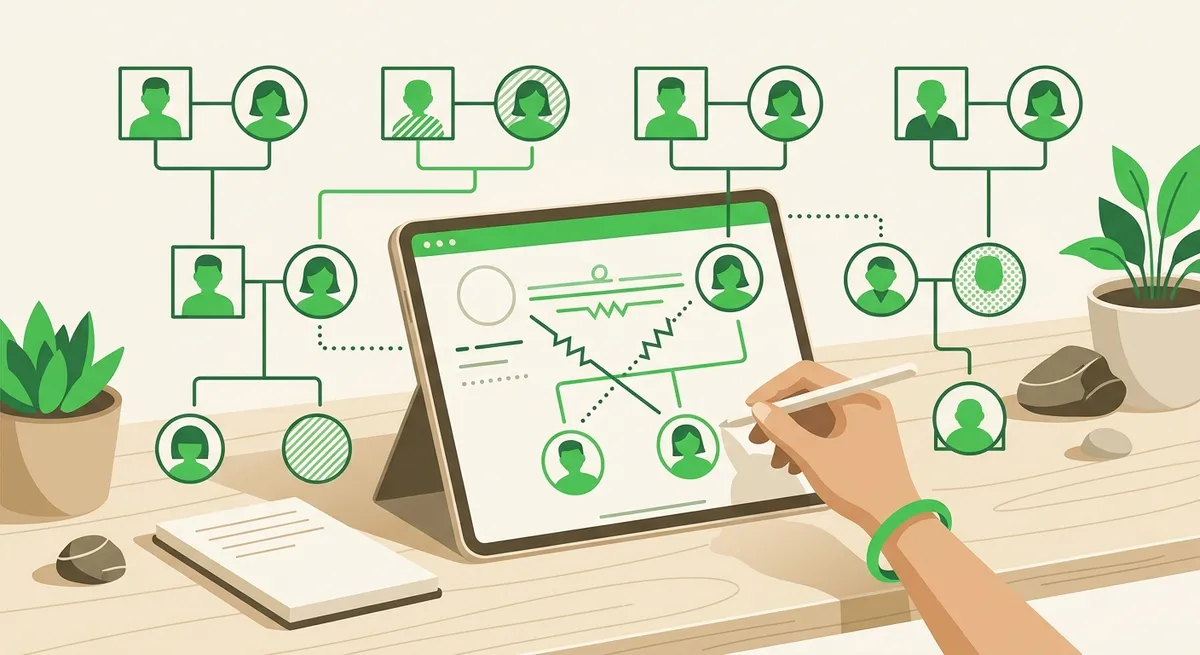
A genogram is a core family-therapy tool that maps at least three generations of family structure and relationship quality using standardized symbols. Automated genogram generation converts the family information gathered in session into a standard-symbol draft, freeing the clinician to spend time interpreting relational patterns rather than drawing them. This guide covers the clinical purpose of the genogram, how automated generation works, the security and data questions to vet before agency adoption, and a four-step rollout for integrating it into real clinical work.
How Automated Genograms Reshape the Opening Phase of Family Therapy
If you have ever spent the first part of a session hand-drawing a three-generation family map, you know the trade-off: every minute spent on the diagram is a minute not spent listening to the client's story. Automated genogram generation takes the family information you gather in session and renders it as a standard-symbol diagram, so you can put more of your attention on interpreting relational patterns. This piece walks through what a genogram is clinically, how automated generation actually works, and the security and operational questions an agency should ask before bringing such a tool in.
What a Genogram Is: Reading a Family System at a Glance
A genogram is a family diagram that captures at least three generations of family composition, the quality of relationships, and key life events using a standardized symbol set. It is rooted in Bowen's family systems theory, and the symbol conventions organized by McGoldrick and colleagues are widely used as the clinical standard (McGoldrick, Gerson & Petry, 2008).
Unlike a simple family tree, a genogram encodes the quality of relationships — emotional cutoff, enmeshment, conflict — through specific line types and symbols. Because it makes multigenerational patterns visible (difficulties with separation-individuation, for instance, or rigid role fixation), it is often the starting point for building case conceptualization hypotheses.
The Limits of Drawing Genograms by Hand
In day-to-day practice, genograms are still frequently drawn with pen and paper. That approach carries a few costs:
- Drawing in session pulls attention away from rapport-building and observation.
- When family composition is complex — remarriage, blended families, adoption — the symbols crowd together and legibility suffers.
- Paper records leave no revision history, making it hard to track a hypothesis as it is updated session over session.
At the agency level, there is an added problem: clinicians use symbols inconsistently, which introduces interpretive drift when cases are shared or brought to supervision.
How Automated Genogram Generation Works
These tools take interview content or structured family information as input and assemble the diagram according to standard symbol rules. A typical processing flow looks like this:
- Extract family members, relationships, and events such as births, deaths, and marriages.
- Place each generation and draw connecting lines according to standard symbol conventions.
- Mark emotional relationships (enmeshment, conflict, cutoff, and so on) using the appropriate line types.
- The clinician reviews, corrects, and updates the diagram each session.
The key thing to hold onto is that the generated output is a draft. The tool removes the drawing labor; interpreting what the relationships mean and forming hypotheses remains the clinician's clinical judgment. It is more accurate to say the AI is not "diagnosing" family dynamics — it is sketching the outline so you can move into interpretation faster.
Security and Data Questions to Vet Before Agency Adoption
A genogram contains a great deal of sensitive information: family composition, medical history, relational conflict. When an agency evaluates a tool like this, data protection deserves as much scrutiny as clinical utility. Useful questions to ask:
- Is data encrypted at rest, with role-based access controls in place?
- Is the family information you enter excluded from model training?
- Is there a clearly stated policy for retaining and disposing of the original data after analysis?
- Does the vendor offer a HIPAA Business Associate Agreement (BAA) — or, for clients under EU jurisdiction, a GDPR Data Processing Agreement (DPA) — that specifies the exact scope of personal data processing?
A security-first vendor should apply encryption at rest and role-based access separation, follow a policy of not using your input data for model training, and publish, on a dedicated security page, the items your agency's security team will want to confirm before adoption.
A Four-Step Rollout for Integrating It Into Practice
Bringing a tool in and actually embedding it in clinical work are two different things. For an agency-level rollout, this sequence works well:
- Have one or two clinicians pilot it on real cases (anonymized, with consent assumed).
- Compare the auto-generated draft against a hand-drawn genogram to check symbol accuracy.
- Review the auto-generated output together in supervision to reduce interpretive drift.
- Agree on agency-wide symbol and notation conventions to keep case-sharing consistent.
Working through this process reduces the problem of every clinician drawing genograms differently, and gives the team a shared visual language for case presentations and handoffs.
Closing
Automated genogram generation is more than a convenience feature that draws the family tree for you. It is a tool that gives clinicians back time to interpret family dynamics and update their working hypotheses. With the drawing burden lifted, the hope is that the reclaimed time goes back into client observation and your own reflective practice.
References
- 1.
Frequently asked questions
What is a genogram, and how is it different from a family tree?
A genogram maps at least three generations of family structure plus the quality of relationships — enmeshment, conflict, emotional cutoff — using standardized symbols and line types. Unlike a plain family tree, it makes multigenerational patterns visible, which is why it serves as a starting point for case conceptualization in Bowenian family work.
Does automated genogram generation replace the clinician's judgment?
No. The generated diagram is a draft. The tool removes the drawing labor, but interpreting what the relationships mean and forming hypotheses remains the clinician's clinical work. The AI sketches the outline so you can move into interpretation faster — it does not diagnose family dynamics.
What should an agency check for security before adopting a genogram tool?
Confirm encryption at rest and role-based access controls, that your input data is excluded from model training, that there is a stated retention and disposal policy for original data, and that the vendor offers a HIPAA Business Associate Agreement (or a GDPR Data Processing Agreement for EU-jurisdiction clients) specifying the scope of personal data processing.
How do we keep genograms consistent across clinicians?
Pilot the tool with one or two clinicians, compare auto-generated drafts against hand-drawn versions for symbol accuracy, review outputs together in supervision to reduce interpretive drift, and agree on agency-wide symbol and notation conventions so case-sharing stays consistent.
This article was written and reviewed using Modalia AI's clinical guidelines, with professional human review before publication.
Related articles
 Clinical Skills
How to Write Better Supervision Questions: Getting What You Actually Need from Your Supervisor
Stuck on what to ask in supervision? Use these structured question strategies to turn vague check-ins into focused clinical insight.
7 min read Clinical Skills
From "The Client Seems Depressed" to a Clinical Hypothesis: How Word Choice Elevates Your Case Reports
Turn vague observations into precise clinical hypotheses. A practical guide to terminology and sentence formulas that make your case reports read like expert work.
7 min read Clinical Skills
The Wounded Healer Trap: Why "I Want to Heal Myself" Sinks Your Counseling Grad School SOP
Why admissions faculty flinch at "I want to heal my own wounds"—and how to transform personal pain into a research-grade statement of purpose that gets you in.
6 min read