How to Identify and Reframe Automatic Thoughts: A 5-Step CBT Guide for Clinicians
A practical 5-step CBT framework for catching, testing, and reframing your clients' automatic thoughts—plus how to keep your attention on the room, not the notepad.
Key takeaway
In cognitive behavioral therapy, emotions are produced not by events themselves but by how clients interpret them—the automatic thoughts described in Aaron Beck's cognitive model. Because automatic thoughts sit closer to the surface than intermediate beliefs or core beliefs, they're the most accessible and fastest-responding target for early intervention. This guide walks through a five-step thought-record process—catching the hot thought, testing the evidence with Socratic questioning, naming the cognitive distortion, building a balanced alternative, and re-rating the emotion—and explains how AI-assisted transcription lets clinicians stay fully present instead of buried in note-taking.
The Loop Your Clients Can't Escape—and the Clinical Lever That Breaks It
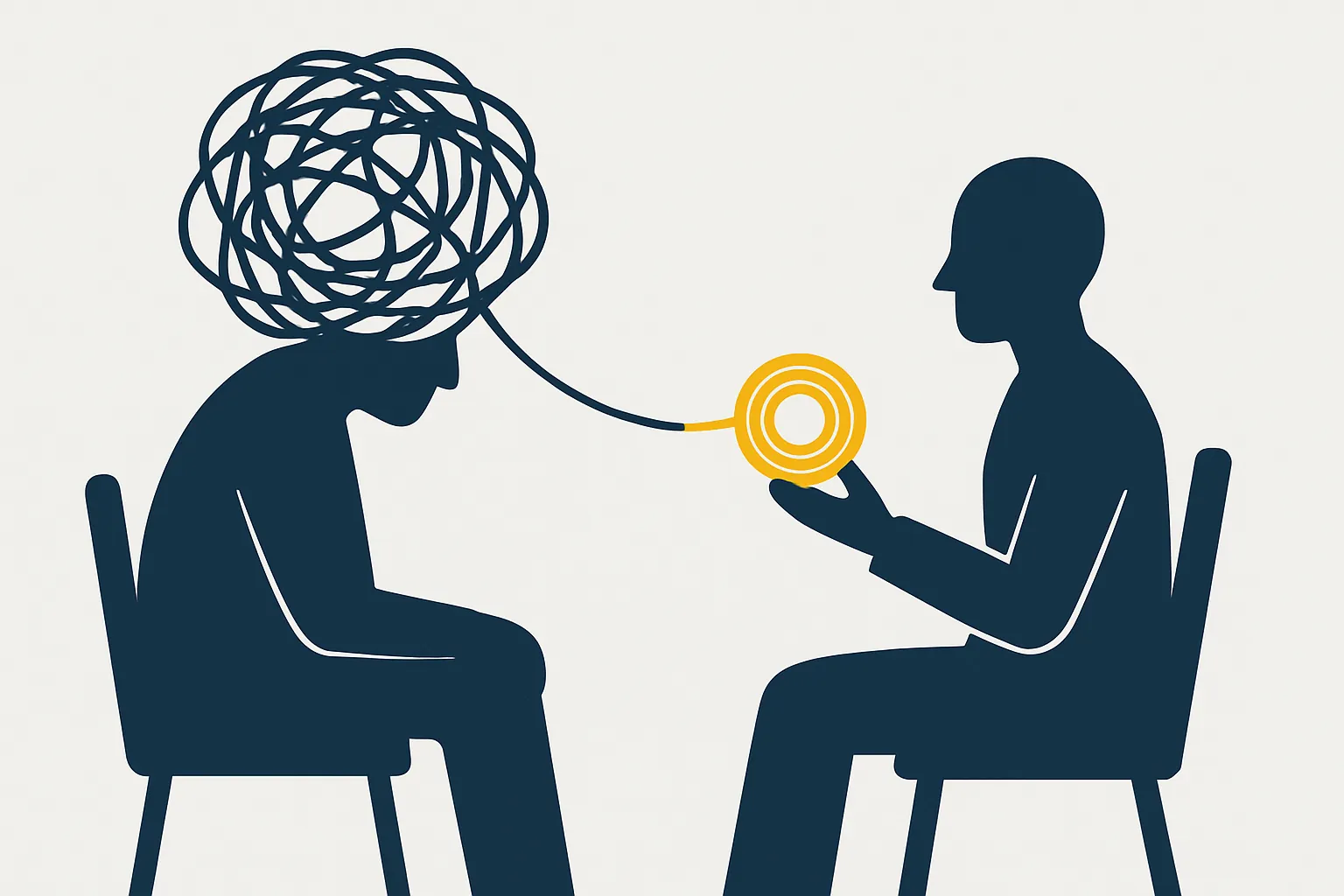
Every client who walks into your office brings a different presenting concern. One describes a heavy, immovable depression; another, an anxiety they can't switch off. But beneath the surface, many of us recognize the same engine at work: the principle, central to Aaron Beck's cognitive model, that it is not the event that creates the emotion, but our interpretation of it. Our job as clinicians is to look past the surface complaint and catch the automatic thoughts that quietly drive it.
In practice, this is harder than it sounds. Automatic thoughts flash by in an instant, and clients rarely experience them as thoughts at all—they experience them as facts. When a client says, "I'm not feeling like a failure, I am one. That's just reality," simple empathy isn't enough. Restructuring the underlying cognition so that real change follows is both a core clinical skill and an ethical responsibility.
The dilemma many early-career clinicians face is how to reach deeper beliefs efficiently within a single session. In the span of a 50-minute hour, you're working with defenses, building the alliance, and reshaping cognitive errors all at once—an exercise in sustained, divided attention. This article lays out a structured five-step process for working with automatic thoughts, the heart of CBT, and shows how to apply it in the room.
The Three Levels of Cognition: Where Should You Intervene?
Before the five steps, it helps to map the layers of cognition you'll be working across. Clinically, client cognition is usually described at three levels of depth. A common early-career mistake is to reach straight for the deepest core beliefs in the opening sessions—and to run headlong into resistance. Effective CBT starts at the surface, with automatic thoughts, and works downward over time.
| Level | Definition & Features | Example Client Statement | When to Intervene |
|---|---|---|---|
| Automatic Thoughts | Specific, reflexive thoughts or images triggered by a situation. Sit at the very surface of awareness. | "He ignored me." "I'm going to bomb this presentation." | Early to mid treatment (rapid symptom relief) |
| Intermediate Beliefs | Attitudes, rules, and assumptions. Bridge automatic thoughts and core beliefs. | "If I make a mistake, it means I'm incompetent." "I have to be liked by everyone." | Mid treatment (shifting behavioral patterns) |
| Core Beliefs | The most fundamental, absolute beliefs about self, others, and the world. Formed early in life and slow to change. | "I'm unlovable." "The world is dangerous." | Later treatment (deeper characterological change) |
As the table shows, automatic thoughts are the most accessible target and the one that responds most quickly. When a client reports feeling "depressed," your task is to catch the split-second thought that produced the feeling. Here's a concrete five-step process for doing exactly that.
A 5-Step Guide to Reframing Automatic Thoughts
This guide is built around the thought record, a structured tool you can model with a client in session or assign as homework between sessions.
Step 1: Catch the "Hot Thought"
Start by exploring the specific situation that triggered an emotional shift. What matters most here is locating the thought present at the moment of peak emotional intensity—the hot thought. Useful prompts include:
- "Just before your mood dropped, what went through your mind?"
- "What did that situation mean to you?"
Guide the client past a bare emotion label ("I was annoyed") toward the cognitive content stated as a concrete sentence ("I thought he was dismissing me").
Step 2: Examine the Evidence (Socratic Questioning)
Here you treat the automatic thought as a hypothesis, not a fact, and gather objective evidence for and against it. Through Socratic questioning, you help the client discover the logical gaps themselves rather than pointing them out.
- Evidence for: "What actual evidence supports this thought?" (Be explicit that a subjective feeling is not, by itself, evidence.)
- Evidence against: "Is there anything that contradicts this thought?" "If a friend were in this exact situation, what would you say to them?"
Step 3: Name the Cognitive Distortion
Next, label the type of distortion the thought reflects. Naming creates distance between the client and the thought—a defusion effect.
- All-or-nothing thinking: Seeing things in absolute, black-and-white terms.
- Catastrophizing: Predicting only the worst possible outcome.
- Mind reading: Assuming you know what others think, without evidence.
The therapeutic payoff is larger when the client recognizes the pattern from a list themselves—"Oh, I'm catastrophizing again"—than when you announce, "That's mind reading."
Step 4: Develop a Balanced Alternative
The goal is not a positive thought but a realistic, balanced one, built by integrating the evidence gathered in Step 2.
- Original: "I bombed the presentation. I'm a failure." (belief: 90%)
- Alternative: "I stumbled over a few words, but I delivered everything I'd prepared. It wasn't perfect, but it wasn't a failure." (belief: 80%)
Step 5: Re-Rate the Emotion and Belief
With the new alternative in place, re-measure the intensity of the original negative emotion on a 0–100 scale. Even a 10–20% reduction counts as a successful intervention. This closing step instills a crucial sense of agency: change the thought, and you can influence the feeling.
Accuracy in the Record: Where Clinical Insight Begins
What matters most across all five steps? Capturing the client's exact language. An offhand murmur—"It's not like it'll work out anyway"—may be the very automatic thought you're hunting for. But if you're heads-down taking notes and miss the micro-shift in expression or tone, you can lose a decisive clinical cue.
We all know the bind: you want to transcribe the client's automatic thoughts word-for-word for later analysis, yet you also need to hold eye contact and stay attuned. Session notes reconstructed from imperfect memory risk seeding a distorted case conceptualization.
This is where AI-assisted documentation and transcription tools have started to earn a place not as administrative gadgets but as genuine clinical assistants. When you can set down the burden of note-taking and give the interaction your full attention, the client's hidden automatic thoughts become far easier to see.
An accurate transcript also lets you review your own work after the session. Did I land the Socratic question at the right moment? Which words does this client return to again and again? Analyzing the session as text data sharpens your clinical craft—and it's an invaluable resource when preparing for supervision or writing up a case study. Modalia AI was built for exactly this: a security-first AI partner that handles transcription, case conceptualization support, and documentation so the clinical thinking stays yours.
Conclusion: Use the Tools to Protect the Work That Matters
Reframing automatic thoughts, the core of CBT, is a finely coordinated dance between clinician and client. Spotting cognitive errors and guiding the client toward healthier, balanced alternatives takes skill and depth of insight. Try the five-step guide in your next sessions. It may feel awkward at first, but with repetition your clients grow into something powerful: their own self-therapist.
It's also worth staying genuinely open to the tools that raise the quality of care. The essence of therapy is connection and healing—not transcription. Let technology absorb the tedious typing and the limits of memory, and reserve your full attention for the client in front of you. Sharp clinical insight, grounded in an accurate record, remains the most powerful instrument you have for changing a life.
Action Plan for Clinicians
- This week: Invite one client to complete a thought record, and work through it together once in session.
- Try the tech: With consent, record a session and convert it to text. Tracking the frequency of a client's recurring "negative vocabulary" can surface real insight.
- Peer supervision: Use a transcript to run a small study group analyzing the types of cognitive distortions in a client's speech.
References
- 1.
Frequently asked questions
What is an automatic thought in CBT?
An automatic thought is a specific, reflexive thought or image triggered by a situation that sits at the very surface of awareness. In Aaron Beck's cognitive model, these momentary interpretations—not the events themselves—generate our emotional reactions. Because they're the most accessible cognitive layer, they're the ideal early target for intervention.
What is a "hot thought" and how do I find it?
The hot thought is the cognition present at the moment of peak emotional intensity. To find it, explore the triggering situation and ask what went through the client's mind just before their mood shifted, and what the situation meant to them—guiding them from a bare emotion label toward concrete cognitive content.
How do I use Socratic questioning to test an automatic thought?
Treat the thought as a hypothesis rather than a fact and gather evidence for and against it. Ask what actual evidence supports the thought (noting that a feeling isn't evidence) and what contradicts it—for example, what the client would say to a friend in the same situation. The aim is for the client to discover the logical gaps themselves.
What counts as a successful reframing intervention?
The goal isn't a positive thought but a realistic, balanced one built from the evidence. After the client adopts the alternative, re-rate the original emotion on a 0–100 scale. Even a 10–20% reduction in intensity is considered a successful intervention and builds the client's sense of agency over their feelings.
This article was written and reviewed using Modalia AI's clinical guidelines, with professional human review before publication.
Related articles
 Case Conceptualization
Breaking the "Yes, But" Game: A Transactional Analysis Guide for Therapists
Every suggestion you offer gets met with "Yes, but..." Here's the TA structure behind that stall—and four clinical moves to break it.
7 min read Case Conceptualization
Yalom's The Gift of Therapy: Passages Every New Counselor Should Copy by Hand
Irvin Yalom's prescription for therapists who fear silence: meet your client as a "fellow traveler" and let the here-and-now become the heart of the work.
6 min read Case Conceptualization
Working With Silence in Therapy: What Client Silence Means and How to Hold It
Silence in session isn't empty space. Learn to read its clinical meaning, tell productive from defensive silence, and use it as a therapeutic tool.
6 min read