Reading the Avoidant Client: Catching the Moment They Push You Away
How to recognize deactivating strategies in avoidant clients, use your countertransference as data, and three clinical moves that build safety without chasing.
Key takeaway
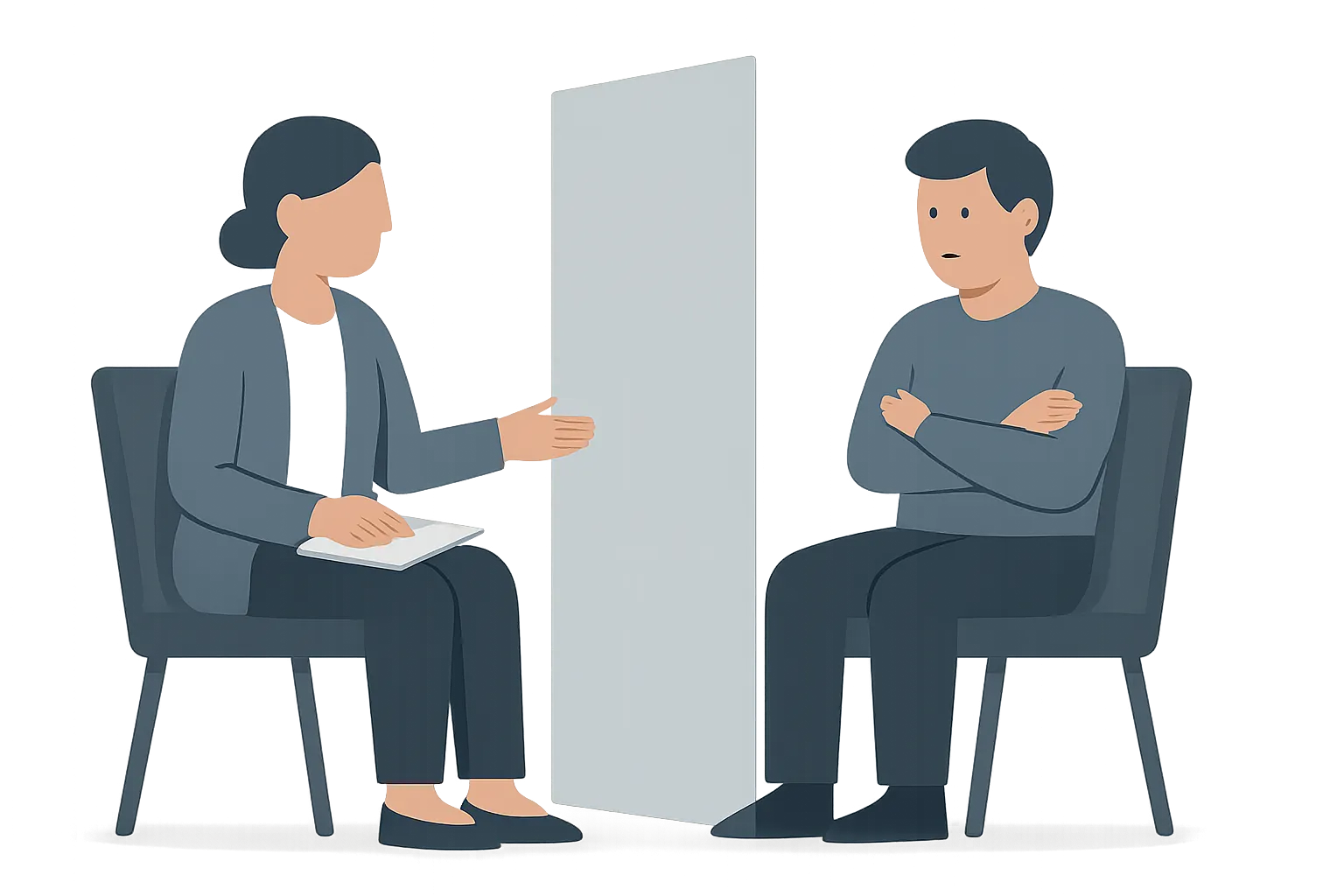
Clients with an avoidant attachment style tend to pull back precisely when intimacy in the therapeutic relationship rises—unconsciously emphasizing independence and shutting down connection through what researchers call deactivating strategies. Drawing on Bartholomew and Horowitz's model of adult attachment, this is a defense, not a failure of rapport; the unexplained boredom or sense of disconnection a clinician feels in the room can itself signal the client's detachment defense at work. The most effective response is indirect: approach through thoughts or bodily sensation rather than direct emotion questions, validate the defense as an understandable survival strategy, and hand control of the session's pace back to the client.
"I don't think that part really matters." Did you catch the moment your client closed the door?
Every clinician sits with silence. But silence with an avoidant client has a different texture. You feel rapport building—and then, in an instant, the client arms themselves with cool logic, or waves off an emotionally loaded topic as "not a big deal." If you've felt that, you've probably also felt the self-doubt that follows: Did I move too fast? Was I not empathic enough?
More often than not, this is not a lapse in your skill. It is a decisive moment in which the avoidant client's deactivating strategies have switched on. In Bartholomew and Horowitz's (1991) model of adult attachment, clients high in avoidance respond to rising closeness—the very thing that stirs the attachment system—by unconsciously reasserting independence and cutting the relationship short. Because this defense surfaces so subtly, even experienced clinicians miss it.
This piece looks at how to catch that split-second push-away and turn it into a therapeutic opening rather than a rupture.
When closeness feels like a threat: reading the avoidant client's defenses
For an avoidant client, the therapeutic relationship itself can register as a danger. Your warmth and support don't land as comfort; they trigger a fear of being encroached on, of losing the self inside the connection. To work with this, it helps to read the verbal and nonverbal signals precisely—and to remember that the push-away is paradoxical good news. It usually means the work is approaching a core affect.
Comparing how different attachment patterns react to emotional activation in session sharpens the picture:
| Avoidant | Anxious | Secure | |
|---|---|---|---|
| Core need | Maintain independence and control | Confirm closeness, quiet fear of abandonment | Mutual reliance, emotional exchange |
| When you offer empathy | "That's not really logical." (intellectualizing) | Becomes flooded, pulls for reassurance | Receives and explores the feeling |
| Form of resistance | Changes the subject, goes silent, minimizes affect | Repeated appeals, clinging | Names the discomfort directly |
| Your countertransference | Boredom, drowsiness, a sense of incompetence or rejection | Fatigue, difficulty structuring | Ease, curiosity |
The row worth watching most closely is countertransference. If you notice an unexplained wave of boredom mid-session, or a foggy sense that the connection has simply gone dead, treat it as evidence. A strong detachment defense is likely running: the client is working hard not to feel, and you are experiencing the resulting vacuum as flatness or helplessness in yourself.
Three clinical moves to draw in a client who's pulling away
When an avoidant client puts distance between you, the intuitive move—to lean in and close the gap—makes them retreat further. What's needed isn't pursuit but a safe distance and an indirect approach.
-
Validate the defense
When a client shuts an emotion down, confronting it—"Why are you avoiding the feeling?"—is risky. Instead, name and honor the protection: "It seems like talking about this feels pretty uncomfortable right now, and part of you wants to step back from it for a moment. That can be a completely natural way of protecting yourself in this situation." Once a client hears that their defense was a reasonable bid for survival, the need to stay armored begins to ease.
-
Route through the body or thoughts, not the feeling
"How are you feeling right now?" is one of the hardest questions you can ask an avoidant client. Try the cooler channels first: "Your shoulders look like they tightened a little as you said that" (bodily sensation), or "What was the first thought that crossed your mind in that moment?" (cognition). Starting in the cooler territory of sensation and thought, then gradually linking toward affect, is a far more workable path than opening with the hot territory of emotion.
-
Use the here-and-now—but let the client set the pace
When you catch the push-away, you don't have to seize on it immediately. Use it as metacommunication: "Just now, when I asked about your feelings, you shifted the topic. I'm wondering if it felt like I came at that too quickly." The key is handing control back to the client. When they feel they can regulate the speed of the work, safety returns.
Closing: the wall comes down through patience and precise attention
Working with an avoidant client can feel like scraping slowly at a thick wall of ice with a spoon. You have to catch the faint rejection signals and nonverbal cues that pass in an instant, while continuously monitoring your own countertransference. Inevitably, some signals slip by—in the flow of conversation it is genuinely hard to register, in real time, the exact pattern that triggered a client's defense or the words they reach for when they retreat.
That's where reflection after the session earns its place. Reviewing the session afterward—through your own notes, audio, or a transcript—lets you look back objectively at questions the live conversation didn't allow: Which topics made the client's output drop off sharply? Which questions pulled out avoidant, dismissing language? Seeing those patterns clearly is what sharpens your intervention for the next session.
Action items:
- With an avoidant-leaning client this week, open with a question about a thought or bodily sensation rather than a feeling, and note how the response shifts.
- After a session, revisit the moments where the client said "I don't know" or "It doesn't matter," and study the context just before and after to map what triggered the retreat.
- In peer supervision, name the boredom or drowsiness you feel with avoidant clients honestly, and use the group to work through the countertransference.
References
- 1.
Frequently asked questions
Why do avoidant clients pull away just as rapport seems to deepen?
Rising closeness activates the attachment system, which an avoidant client experiences as threatening. In Bartholomew and Horowitz's model, they respond with deactivating strategies—reasserting independence, minimizing affect, or changing the subject—to shut the connection down. The push-away often signals that the work is approaching a core emotion, not that rapport has failed.
What does my own boredom or drowsiness in session tell me?
Unexplained boredom, drowsiness, or a foggy sense of disconnection can be countertransference data. When an avoidant client works hard not to feel, the clinician often experiences the resulting affective vacuum as flatness or helplessness. Treat that internal state as evidence that a detachment defense may be active.
How should I respond instead of asking how the client feels?
Direct emotion questions are the hardest for avoidant clients. Start in cooler channels—ask about a thought ("What crossed your mind first?") or a bodily sensation ("Your shoulders looked like they tightened")—then gradually link toward affect. Also validate the defense as an understandable form of self-protection, and let the client control the pace.
This article was written and reviewed using Modalia AI's clinical guidelines, with professional human review before publication.
Related articles
 Case Conceptualization
Breaking the "Yes, But" Game: A Transactional Analysis Guide for Therapists
Every suggestion you offer gets met with "Yes, but..." Here's the TA structure behind that stall—and four clinical moves to break it.
7 min read Case Conceptualization
Yalom's The Gift of Therapy: Passages Every New Counselor Should Copy by Hand
Irvin Yalom's prescription for therapists who fear silence: meet your client as a "fellow traveler" and let the here-and-now become the heart of the work.
6 min read Case Conceptualization
Working With Silence in Therapy: What Client Silence Means and How to Hold It
Silence in session isn't empty space. Learn to read its clinical meaning, tell productive from defensive silence, and use it as a therapeutic tool.
6 min read