Best Podcasts for Therapists: Build Clinical Skills on Your Commute
Turn your daily commute into 30 minutes of clinical growth. Curated podcasts and channels for counselors, plus active-listening strategies that stick.
Key takeaway
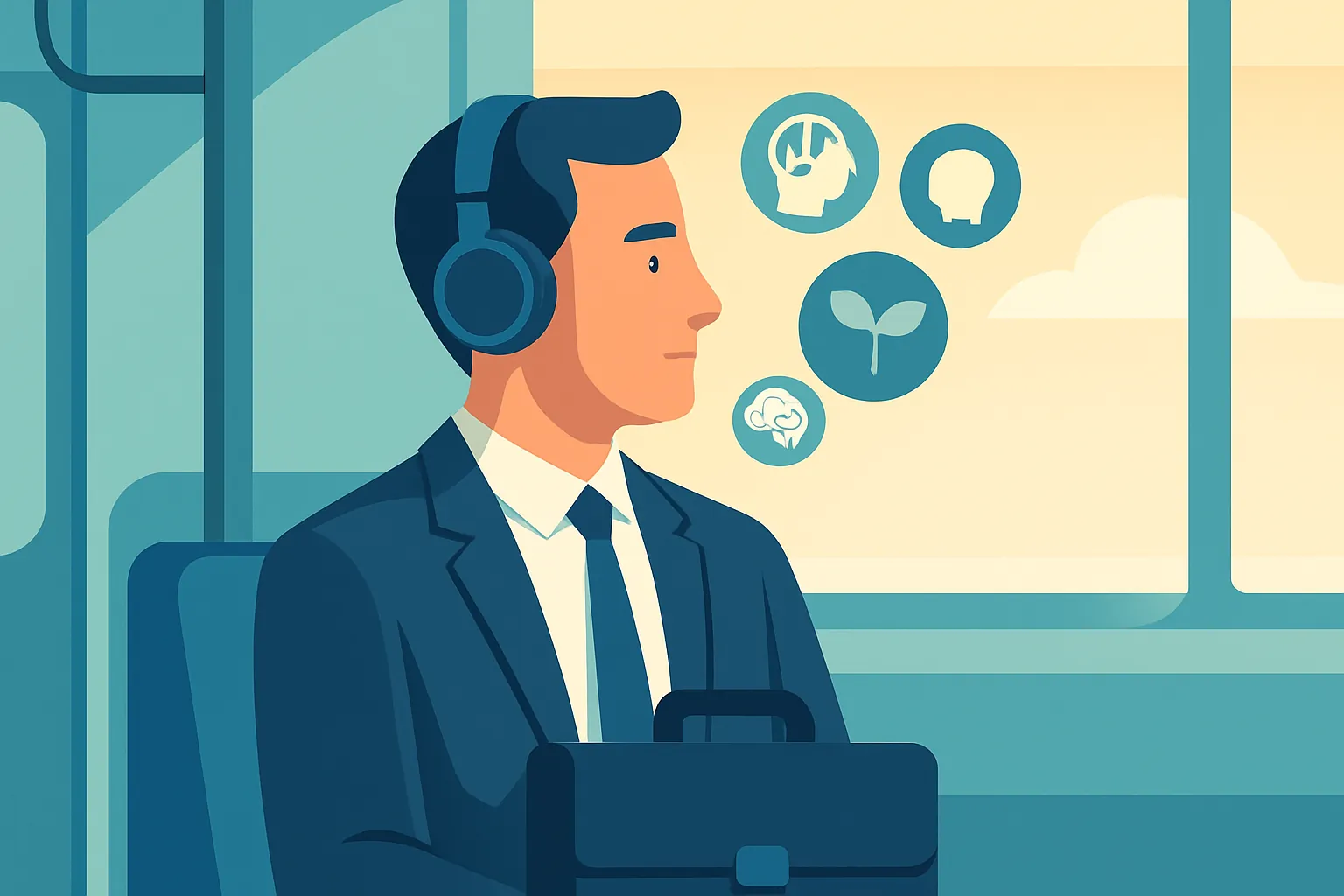
"No time to study" is one of the most common laments in our field—yet the 30 minutes you already spend commuting can become a real learning window. Audio content lets you absorb diverse therapeutic approaches without screen fatigue, ease the isolation of private practice, and stay current with research. Choose channels by clinical value—theory, case study, self-care, ethics—and pair them with active strategies like voice memos, peer sharing, and critical listening to convert passive audio into working clinical knowledge.
Your Commute Is 30 Minutes of Untapped Clinical Growth
Most mornings begin the same way: a fully booked caseload waiting, the emotional residue of yesterday's sessions still lingering, and a steady stream of new techniques and research you feel you should be keeping up with. "I know I need to study—I just don't have the time" may be the most common sigh in our profession. When you're wrestling with a difficult case conceptualization or preparing for supervision, twenty-four hours never feels like enough.
There's one window of time most of us let slip by, though: the commute. Thirty minutes on the train, the bus, or behind the wheel is prime real estate for reconnecting with your clinical identity and stretching your therapeutic thinking—no extra screen time required. This guide breaks down high-quality podcasts and channels that let you build expertise and guard against burnout using nothing but your ears. These aren't picks chosen for entertainment value; each one earns its place by offering something genuinely useful at the clinical coalface.
Why "Listening to Learn" Matters for Clinicians
As counselors, we are the instrument. Resting a brain that's saturated with visual processing while still feeding it new perspectives through audio isn't just convenient—it's an efficient learning strategy, neurologically speaking. Beyond simple knowledge acquisition, audio content delivers three distinct clinical benefits.
1. Vicarious learning across modalities
It's easy to get boxed in by our primary theoretical orientation. Hearing how other clinicians formulate a case, build rapport, and apply the nuance of a specific approach—ACT, DBT, schema therapy—stretches our flexibility. That elasticity becomes a real asset when a client in front of us needs an intervention tailored beyond our usual repertoire.
2. A felt sense of collegiality
Clinicians in private practice often work in relative isolation. Listening to other professionals talk through their dilemmas, their ethical gray areas, and yes, their missteps delivers a quiet reassurance: I'm not the only one who finds this hard. That sense of shared experience is a meaningful buffer against burnout and a way to restore professional confidence.
3. Staying current without drowning in journals
When there's no time to read a study end to end, channels that distill recent papers and emerging theory offer an excellent return on the minutes you invest. Catching the gist of a new trauma protocol or the latest discussion on neuroplasticity while you commute gives you a signpost—something to circle back to for deeper study when you do have time.
Curated Channels for Professionals: A Comparison by Type
Not every "psychology" channel serves a clinical audience. Content edited for mass appeal can, if anything, reinforce clinical misconceptions. So it's worth filtering for three things: clinical rigor, applicability to real practice, and ethical sensitivity. Use the table below to match a channel to your current need.
| Channel type | Recommended channels | What they offer | Best for |
|---|---|---|---|
| Theory & academic depth | Speaking of Psychology (APA), Therapy Chat | Briefings on recent findings; the theoretical mechanics of specific modalities (CBT, EMDR, and more) | Clinicians adopting a new approach; anyone tracking where the research is heading |
| Case study & supervision | Psychology in Seattle, Counselor Toolbox | Worked case conceptualizations, countertransference analysis, transcript-style breakdowns with feedback | Trainees struggling with formulation; early-career counselors who need a wider intervention toolkit |
| Therapist self-care | The Shrink Space, mindfulness & meditation channels | Burnout management, vicarious-trauma recovery, guided mindfulness | The drained drive home; any clinician who wants to tend to their own mind |
| Ethics & practice management | Private Practice Startup, Therapy Business Bootcamp | Navigating limits of confidentiality, dual-relationship issues, the business side of running a practice | Clinicians preparing to open a practice; anyone facing a thorny ethical dilemma |
Table 1. Audio content for counselors, compared by purpose and context.
Beyond Listening: Turning Audio Into Working Knowledge
Good content, passively consumed, isn't enough. To convert fleeting audio into working knowledge you can actually use in the room, you need an active listening practice. Here's how to get the most out of what you hear on the move.
1. Capture keyword voice memos
You can't take notes while driving or standing on a packed train—so use your phone's voice memo function instead. Something like, "From today's episode: the way they handled resistance—try this with client A next session" ties a short cue to a specific client. By the time you reach the office, it's ready to fold straight into your session planning.
2. Share in peer consultation
Rather than listening in a vacuum, trade a "this week's listening list" with colleagues. Discussing a specific point—"their explanation of projective identification in a client with borderline personality organization was unusually clear"—pushes auditory information into long-term memory and deepens the clinical insight for everyone in the group.
3. Keep your critical thinking switched on
Not everything a podcast says is gospel. Listen while continually asking: How would I have intervened there? What theoretical frame is this host's interpretation actually resting on? With popular channels especially, where editing may favor engagement over accuracy, the very act of filtering through a clinician's lens is excellent training in itself.
Conclusion: Smarter Tools, Better Care
For counselors, learning is a journey without a finish line. But it doesn't have to be a painful one, or a weight you can only lift by carving out scarce hours. A well-chosen podcast on the commute can spark your clinical imagination and breathe a little life back into a tired mind—a quiet pacemaker for your professional development. Subscribe to one of the channels above today and put your earbuds in. Small habits like this compound, and over time they show up in the depth and warmth you bring to the clients across from you.
One last thought. If podcasts are a tool for bringing outside knowledge in, then the technology that captures the valuable conversations happening in your own room matters just as much. Just as you might revisit an episode, accurately recording a client's words and the arc of a session can shape whether the work succeeds. AI-based session documentation and transcription tools have begun to ease that administrative load dramatically.
- Accuracy of the record: Instead of spending energy reconstructing what was said, you review an AI-generated draft and stay focused on clinical judgment.
- Surfacing insight: Much like replaying a podcast, reviewing AI-analyzed themes and emotional patterns can reveal client signals you might have missed in the moment.
Gather insight from podcasts on the move; lean on secure, purpose-built AI tools in the office to make your documentation more efficient. Modalia AI is a security-first partner built for exactly this—transcription, case conceptualization support, and documentation that gives you back time for the clinical work only you can do. That combination is one of the most practical ways for a modern clinician to maximize their expertise and stay fully present with the people they serve.
References
- 1.
- 2.Psychology in Seattle PodcastIndustry
- 3.The Private Practice StartupIndustry
Frequently asked questions
Are podcasts a legitimate way for counselors to build clinical skills?
Yes—when chosen with care. Audio content offers vicarious learning across modalities, eases the isolation of private practice, and helps you track emerging research. It works best as a complement to formal training and supervision, not a replacement, and is most effective when paired with active strategies like note-taking and peer discussion.
How do I choose a clinically credible channel over entertainment-focused content?
Filter for three things: clinical rigor (Is the content evidence-based and accurate?), applicability (Can you use it in real sessions?), and ethical sensitivity (Does it handle confidentiality and case material responsibly?). Channels hosted by licensed clinicians or professional bodies tend to meet this bar more reliably than mass-market psychology content.
How can I retain what I hear while commuting?
Use active listening. Record short keyword voice memos linking an idea to a specific client, share a 'listening list' in peer consultation to push the material into long-term memory, and keep questioning the host's reasoning rather than accepting it wholesale. These habits convert passive audio into working clinical knowledge.
This article was written and reviewed using Modalia AI's clinical guidelines, with professional human review before publication.
Related articles
 Clinical Skills
How to Write Better Supervision Questions: Getting What You Actually Need from Your Supervisor
Stuck on what to ask in supervision? Use these structured question strategies to turn vague check-ins into focused clinical insight.
7 min read Clinical Skills
From "The Client Seems Depressed" to a Clinical Hypothesis: How Word Choice Elevates Your Case Reports
Turn vague observations into precise clinical hypotheses. A practical guide to terminology and sentence formulas that make your case reports read like expert work.
7 min read Clinical Skills
The Wounded Healer Trap: Why "I Want to Heal Myself" Sinks Your Counseling Grad School SOP
Why admissions faculty flinch at "I want to heal my own wounds"—and how to transform personal pain into a research-grade statement of purpose that gets you in.
6 min read