Bender-Gestalt Collision and Rotation: Reading Brain vs. Mind in BGT Errors
Collision and rotation on the Bender-Gestalt Test can signal organic impairment or emotional dysregulation. Here's how to tell them apart in practice.
Key takeaway
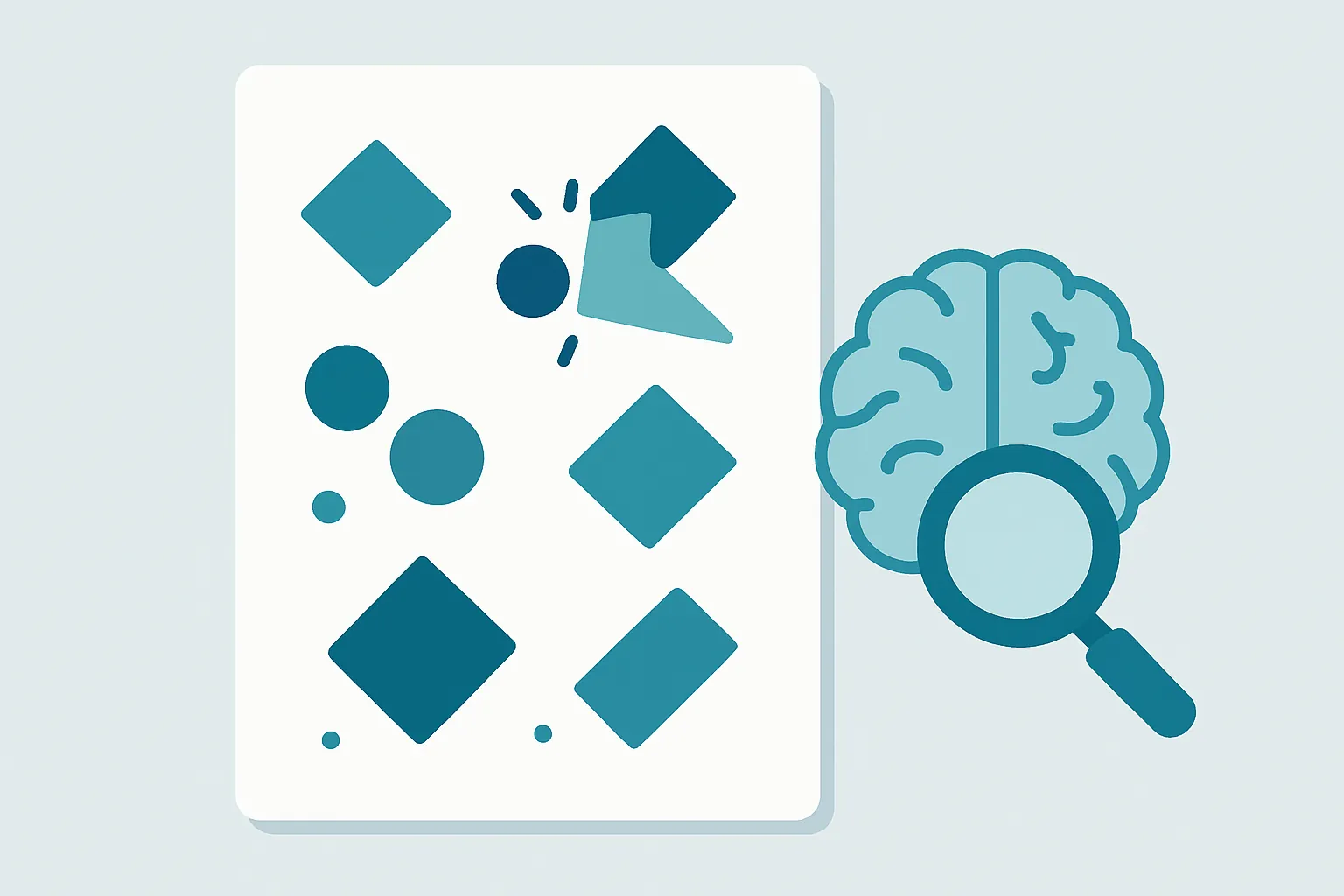
On the Bender-Gestalt Test, collision (figures touching or overlapping) and rotation (drawing a figure or page turned 45° or more) are among the most diagnostically weighty—and most ambiguous—indicators. Collision can reflect frontal-lobe executive decline or, alternatively, impulsivity and a collapse of ego boundaries; rotation can point to right-hemisphere visuospatial deficits and impaired reality testing or, instead, oppositional refusal. Accurate differential diagnosis hinges on whether the client recognizes the error, their answers during post-drawing inquiry, and cross-validation against intelligence testing and the Rorschach. Documenting the performance process—not just the product—is what separates an organic sign from an emotional one.
When Figures Overlap and Flip: What BGT Collision and Rotation Really Tell You
You hand a client a blank sheet and a pencil and begin the Bender-Gestalt Test (BGT). When does your clinical attention sharpen most? Often it's the moment a client runs out of room and starts crowding the figures together—or suddenly turns the page ninety degrees and keeps drawing as if nothing happened.
The nine-figure copying task looks deceptively simple, but it is a sensitive instrument that captures neuropsychological function and emotional dynamics at the same time. Plenty of clinicians administer the BGT comfortably. The difficulty arrives when a decisive scoring sign—collision or rotation—shows up and you have to decide: is this organic brain involvement, or serious emotional instability? Dismissing it as "poor drawing" undersells how strong the signal is. Is the client's frontal executive system faltering, or has an unregulated impulse breached the boundary of the self?
This article takes a close look at the two BGT signs that are hardest to interpret yet carry the most diagnostic weight—collision and rotation—and lays out a practical approach for the clinic.
1. Collision: Eroded Boundaries and the Breakthrough of Impulse
Collision occurs when one figure touches or overlaps another. In Koppitz's scoring framework this is more than a failure of spatial planning; it is a strong indicator that the client's psychological buffer zone has broken down.
Frontal-lobe decline and the loss of planning
From a neuropsychological standpoint, collision is closely tied to reduced executive function in the frontal lobe. Anticipating how much space a figure will need and adjusting placement accordingly is a higher-order frontal task. When figures collide, the client is struggling to predict or plan the consequences of an action—an important clue that warrants considering organic brain involvement. It appears frequently in clients with alcohol dependence and in the early stages of dementia.
Impulsivity and loss of ego control
On the emotional side, collision reads as an expression of impulsivity and aggression. The white space between figures symbolizes a psychological buffer between the self and the outside world. When that boundary collapses and figures intrude on one another, the client may be over-responding to external stimuli or acting out internal impulses they cannot contain. This is precisely why collision shows up often in children with ADHD and in clients with borderline personality disorder.
2. Rotation: A Tilted World and the Question of Reality Testing
Rotation refers to drawing a figure—or turning the page itself—45° or more off orientation. It is among the most pathologically significant signs on the BGT, and its appearance should immediately trigger a careful differential process.
Right-hemisphere damage and visuospatial deficits
Rotation has long been read as a strong indicator of organic brain involvement, particularly lesions of the right hemisphere. A client with impaired visuospatial perception fails to register the orientation of the figure in front of them. The decisive red flag is a client who does not even notice that they rotated the drawing. That absence of awareness should prompt serious concern about a neurological deficit.
Impaired reality testing and oppositional refusal
If an organic cause is ruled out, the next consideration is significant psychopathology. In schizophrenia, disorganized reality testing can lead a client to disregard a figure's orientation altogether. By contrast, an adolescent with oppositional defiant disorder (ODD) or conduct disorder may deliberately turn the page or invert a figure. Here the rotation is less a cognitive deficit than "emotional rotation"—a display of resistance to authority and refusal of the testing situation.
3. The Core Differential: Comparing Collision and Rotation
When collision or rotation appears, you need to decide quickly and accurately whether you are looking at a problem of the brain, a problem of the mind, or some combination of both. The table below clarifies the clinical meaning of each sign.
| Indicator | Neuropsychological suspicion (organic) | Emotional/characterological suspicion (psychogenic) | Essential inquiry question |
|---|---|---|---|
| Collision | • Reduced frontal executive function • Visual-motor coordination failure • Possible dementia or brain injury | • Impulse-control difficulty • Collapse of ego boundaries • Severe anxiety and confusion | "Did you think ahead about how much space you'd use?" |
| Rotation | • Right-hemisphere (parietal) damage • Visuospatial perception deficit • Failure of form constancy | • Impaired reality testing • Oppositional / refusing stance • Dissociative state | "Is the orientation the same as the original?" (check for awareness) |
Table 1. Differential points for BGT collision and rotation.
4. Practical Strategies for the Clinician
When collision or rotation appears, take the following steps to understand the client's state and fold it into your case conceptualization.
Probe carefully during post-drawing inquiry (PDI)
Always follow up after the test. If collision occurred, ask: "The figures bumped into each other here—how did it feel while you were drawing?" A client who answers "there was no room, I couldn't help it" is more likely showing a planning (cognitive) deficit; one who says "I felt frustrated, so I just drew over it" is more likely revealing impulsivity (emotional). For rotation, the key to the differential is confirming whether the client is even aware that the drawing is turned.
Cross-validate with a full battery
Never confirm organic brain involvement on the BGT alone. Compare the Block Design subtest of an intelligence measure such as the WAIS-IV to re-check visuospatial construction, and contrast the findings with Form Quality on the Rorschach. When collision is present, review color responses (C, CF) and the aggression Special Score (AG) on the Rorschach together, so you can assess the level of impulsivity from multiple angles.
Document the process, not just the product
For rotation especially, the process matters more than the drawing itself. Record precisely whether the client turned the page, twisted their body, or left the page in place and rotated only the drawing. Spontaneous remarks during the test—"this is so hard," "I'm running out of room"—are valuable qualitative data about how the client copes under demand. Capture them verbatim where you can.
Conclusion: Accurate Records Make Accurate Diagnoses
Collision and rotation on the BGT are not just traces of a drawing slip. They are a map of how the client perceives the world, regulates impulse, and functions neurologically. The clinician's job is to read the neurological and psychological distress hidden in the client's silence. When an organic cause is suspected, ethical, professional practice means referring promptly for a neurological evaluation rather than waiting.
Throughout a complex assessment, the thing not to lose is the record of the client's subtle verbal responses and performance process. An offhand "why does this keep overlapping?" mid-task can be the key that explains the collision. Reliable, detailed records of behavioral observation—page rotation, sighs, grip pressure on the pen—let you reconstruct the emotional context of the BGT later and interpret these signs with far greater confidence. Modalia AI, a security-first AI partner for counselors, can support that work by handling transcription and documentation so your attention stays on the client rather than on note-taking. The clearer your record of the moment, the clearer the signal that collision and rotation are sending.
References
- 1.
- 2.
Frequently asked questions
What does collision on the Bender-Gestalt Test indicate?
Collision—figures touching or overlapping—can reflect reduced frontal executive function and impaired planning (suggesting possible organic involvement such as early dementia or brain injury) or, alternatively, impulsivity and a collapse of ego boundaries seen in ADHD and borderline presentations. Post-drawing inquiry and a full battery are needed to tell them apart.
When is rotation on the BGT a neurological red flag?
Rotation is most concerning when the client does not realize the drawing is turned. This absence of awareness suggests a visuospatial perception deficit, often associated with right-hemisphere or parietal damage, and warrants a neurological referral. Deliberate, self-aware rotation is more likely oppositional or refusing in nature.
How do you distinguish an organic from an emotional cause for these signs?
Use the post-drawing inquiry to probe awareness and intent, then cross-validate: compare the Block Design subtest of the WAIS-IV for visuospatial construction and Rorschach Form Quality, color responses, and the aggression Special Score. Document the performance process—page turning, body twisting, verbalizations—not just the finished drawing.
This article was written and reviewed using Modalia AI's clinical guidelines, with professional human review before publication.
Related articles
 Case Conceptualization
Breaking the "Yes, But" Game: A Transactional Analysis Guide for Therapists
Every suggestion you offer gets met with "Yes, but..." Here's the TA structure behind that stall—and four clinical moves to break it.
7 min read Case Conceptualization
Yalom's The Gift of Therapy: Passages Every New Counselor Should Copy by Hand
Irvin Yalom's prescription for therapists who fear silence: meet your client as a "fellow traveler" and let the here-and-now become the heart of the work.
6 min read Case Conceptualization
Working With Silence in Therapy: What Client Silence Means and How to Hold It
Silence in session isn't empty space. Learn to read its clinical meaning, tell productive from defensive silence, and use it as a therapeutic tool.
6 min read