Where Does the Anxiety Go? Reading Bowen's Nuclear Family Emotional Process in Clinical Practice
Decode the hidden pathways family anxiety travels using Bowen's nuclear family emotional process — plus four intervention strategies you can apply this week.
Key takeaway
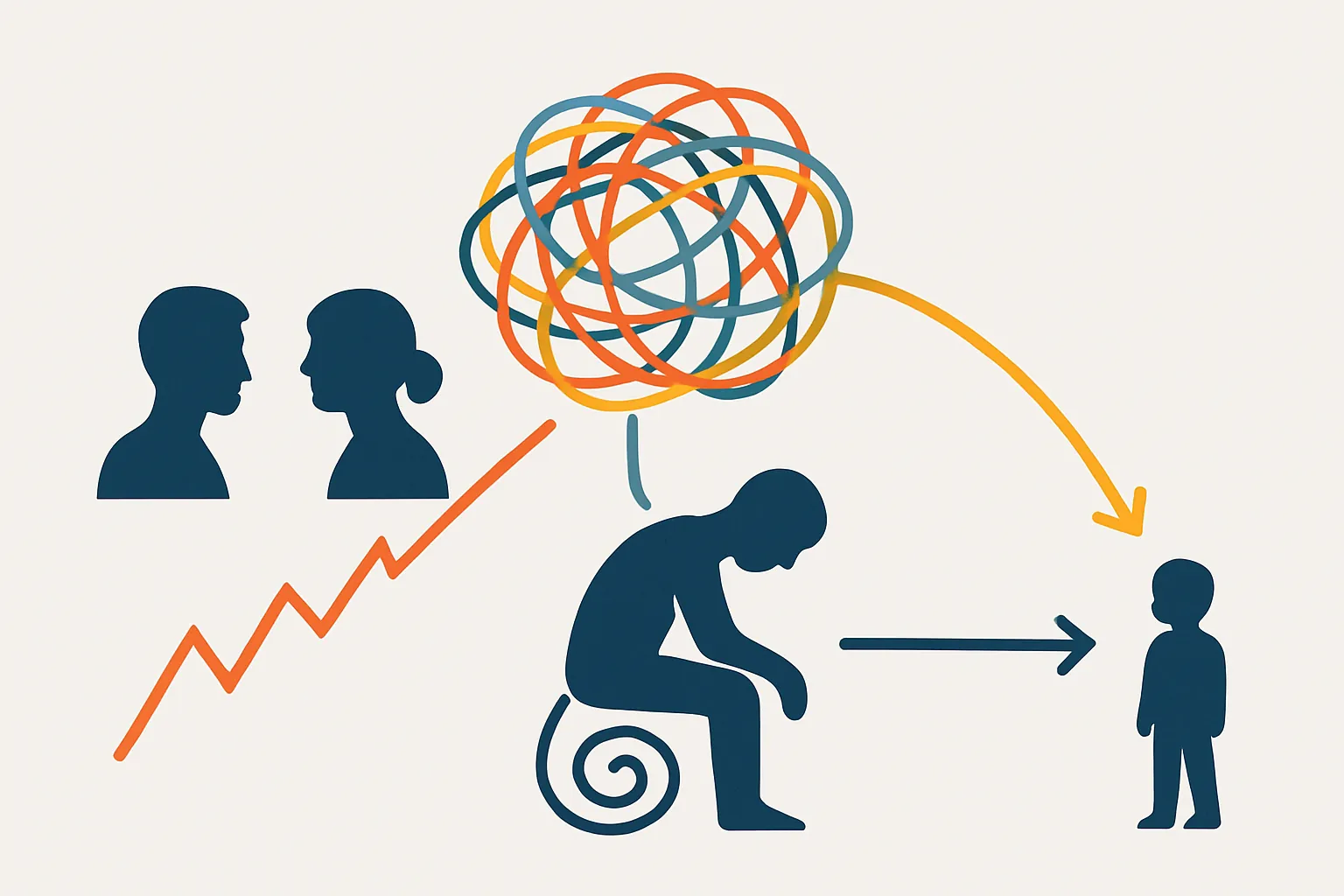
According to Murray Bowen's nuclear family emotional process, chronic anxiety in a family is absorbed through one of three pathways: marital conflict, dysfunction in one spouse, or projection onto a child. These patterns are not fixed — they shift fluidly with the family's anxiety level. By repeatedly asking 'whose anxiety is this symptom carrying right now?', clinicians can locate the systemic target of treatment and promote differentiation of self through genograms, I-position work, therapeutic neutrality, and careful review of session material.
The Presenting Problem Is Rarely the Whole Story
The complaints clients bring through the door look strikingly different on the surface. A couple locked in endless conflict. A wife sliding into depression. A teenager failing at school and withdrawing at home. Yet experienced clinicians sense something the intake form doesn't capture: these symptoms may not be isolated events at all, but the particular way anxiety is being managed inside a family as a living system.
Murray Bowen's family systems theory gives us a compass for this terrain. His concept of the nuclear family emotional process describes how chronic anxiety circulating in a family tends to settle into a symptom carried by one member rather than dissipating evenly. This reframes a question many of us wrestle with: Is this client's depression a discrete biochemical problem, or is it the cost of keeping a fragile family system in balance? The answer shapes the entire treatment plan. Determining whether a family discharges its anxiety through conflict, through dysfunction in a spouse, or through projection onto a child is the first step toward raising the client's level of differentiation and producing change that lasts.
Three Pathways for Chronic Anxiety
Bowen observed that when anxiety rises in a poorly differentiated family — an "undifferentiated ego mass," in his original language — the system reaches for predictable mechanisms to restabilize rather than fall apart. A client's suffering is usually the product of one of these pathways, or several operating at once. Our job is to read the pattern hidden beneath the chief complaint.
Distinguishing the patterns cleanly is essential to choosing a strategy. The table below summarizes the clinical signature of each and where to direct your attention.
| Dimension | Marital Conflict | Dysfunction in a Spouse | Impairment of a Child |
|---|---|---|---|
| Core mechanism | Collision between attempts to control and resistance to being controlled | One partner absorbs anxiety through chronic under-functioning | Couple's anxiety is displaced onto a third party (the child) to stabilize the marriage |
| Clinical signature | Cycles of intense fighting and emotional cutoff; blame and defense | One over-functions and over-takes responsibility; the other develops physical or emotional symptoms | A child's behavioral problems, academic decline, or symptoms over-occupy the parents |
| Treatment focus | Lowering emotional reactivity; I-statement work | Helping the over-functioner set down the load and restoring the under-functioner's autonomy | Dissolving the triangle; helping parents see their anxiety being projected onto the child |
Table 1. The three patterns of Bowen's nuclear family emotional process.
The crucial insight is that these patterns are not fixed — they shift fluidly with the level of anxiety in the system. When anxiety that had been routed onto a child loses its destination — for example, when that child leaves home — it does not vanish. It often returns to the marriage as renewed conflict or reappears as illness in a spouse. This is why the clinician keeps asking, session after session, a fundamentally systemic question: Whose anxiety is this symptom carrying right now?
Four Strategies for Clinical Intervention
Once you have identified the (largely unconscious) pathway a family uses to discharge anxiety, the work shifts to interrupting that pattern and promoting differentiation of self. Four interventions translate the theory into practice.
1. Make the emotional pattern visible with a three-generation genogram
Go beyond simply asking about relationships — map at least three generations together with the client. Questions like "When your grandmother was anxious, how did she treat your father?" help the client recognize that today's conflict or projection is a multigenerational transmission, not a personal failing or a one-time accident. Seeing the pattern on paper lets clients objectify their pain and take a step back from reflexive emotional responses — the beginning of de-triangulation.
2. Train the I-position
In fused, enmeshed relationships, emotions are contagious and it becomes hard to separate one's own thoughts and feelings from another's. When a client says, "My husband made me furious," gently and persistently invite a revision: "I felt shut out in that moment." This is the core work of withdrawing anxiety that had been projected outward and reclaiming responsibility for one's own emotional life. It is especially vital for clients caught in the dysfunctional-spouse pattern, where learning to put one's own needs into words is itself therapeutic.
3. Use the therapeutic triangle — and hold your neutrality
When family anxiety is high, clients will try to pull the clinician onto their side, recruiting you into a triangle. If you take sides or join the emotional charge, you reinforce the very pattern you're trying to loosen. Hold a firm, neutral position as a coach, and keep encouraging family members to speak directly to one another rather than through you. Your own calm under pressure is, in itself, a novel emotional experience for the family — a demonstration that the room can hold anxiety without anyone having to carry the symptom.
4. Identify the anxiety triggers in your session material
Family and couples work involves many voices at once, and it is easy to miss the fleeting nonverbal cue or the subtle language of projection in the moment. When does a client's tone sharpen? At what point does a parent suddenly pivot to the child's problems to change the subject (a tell-tale sign of projection)? Detailed session material is invaluable here. Relying on memory alone to reconstruct the dense relational dynamics of a session has clear limits; accurate records let you re-examine the case, bring it to supervision, and reconceptualize it with confidence.
Turning Anxiety Into Insight Through Careful Records
Applying Bowen's nuclear family emotional process is like tracing an invisible thread to find the knot it leads to. The moment we understand that a family's conflict, symptoms, and projections were a desperate effort to survive as a system, a genuine therapeutic alliance becomes possible. We are guides who help clients pause their reflexive emotional reactions and, through reasoned thought, choose lives of their own.
Leading this delicate process well takes clinical insight — and the supporting detail to back it up. In multi-voiced family work, or in cases dense with projective identification, the ability to reconstruct the exact context of an exchange matters enormously.
For that reason, it's worth building a deliberate record-keeping practice into your workflow: brief structured notes immediately after session, a reliable session-recording tool used with informed consent, and a habit of bringing annotated material to supervision. Reviewing an accurate log lets you surface patterns you'd otherwise lose — "there, the moment the father grew anxious, he redirected to the child's grades" — and turn them into the focus of the next session.
What patterns of anxiety are moving through your consulting room right now? This week, consider tracing the nuclear family emotional process hiding behind a client's presenting problem, using a genogram and careful records. Small fragments of insight accumulate into the larger picture that guides a whole family toward recovery.
References
- 1.
- 2.
- 3.
- 4.
Frequently asked questions
What is Bowen's nuclear family emotional process?
It is one of Murray Bowen's eight interlocking concepts. It describes how chronic anxiety in a poorly differentiated family is managed through one of three pathways — marital conflict, dysfunction in one spouse, or projection onto a child — so that the system stabilizes rather than collapses.
Are the three patterns fixed for a given family?
No. The patterns shift fluidly with the family's anxiety level. Anxiety routed onto a child can return to the marriage as conflict or reappear as illness in a spouse when its original destination changes, such as when a child leaves home.
How does a genogram help in this work?
A three-generation genogram makes emotional patterns visible and helps clients recognize that current conflict or projection is a multigenerational transmission rather than a personal failing. Externalizing the pattern supports objectivity and de-triangulation.
Why is therapeutic neutrality so important?
When anxiety is high, clients try to recruit the clinician into a triangle. Taking sides reinforces the pathological pattern. Holding a neutral coaching stance and staying calm under pressure offers the family a new emotional experience and encourages direct communication.
This article was written and reviewed using Modalia AI's clinical guidelines, with professional human review before publication.
Related articles
 Case Conceptualization
Breaking the "Yes, But" Game: A Transactional Analysis Guide for Therapists
Every suggestion you offer gets met with "Yes, but..." Here's the TA structure behind that stall—and four clinical moves to break it.
7 min read Case Conceptualization
Yalom's The Gift of Therapy: Passages Every New Counselor Should Copy by Hand
Irvin Yalom's prescription for therapists who fear silence: meet your client as a "fellow traveler" and let the here-and-now become the heart of the work.
6 min read Case Conceptualization
Working With Silence in Therapy: What Client Silence Means and How to Hold It
Silence in session isn't empty space. Learn to read its clinical meaning, tell productive from defensive silence, and use it as a therapeutic tool.
6 min read