Bowen's Nuclear Family Emotional System: Tracing a Client's Symptoms Back to Inherited Family Anxiety
How to read a client's anxiety as inherited family dynamics—using Bowen theory, the genogram, and three intervention strategies you can apply this week.
Key takeaway
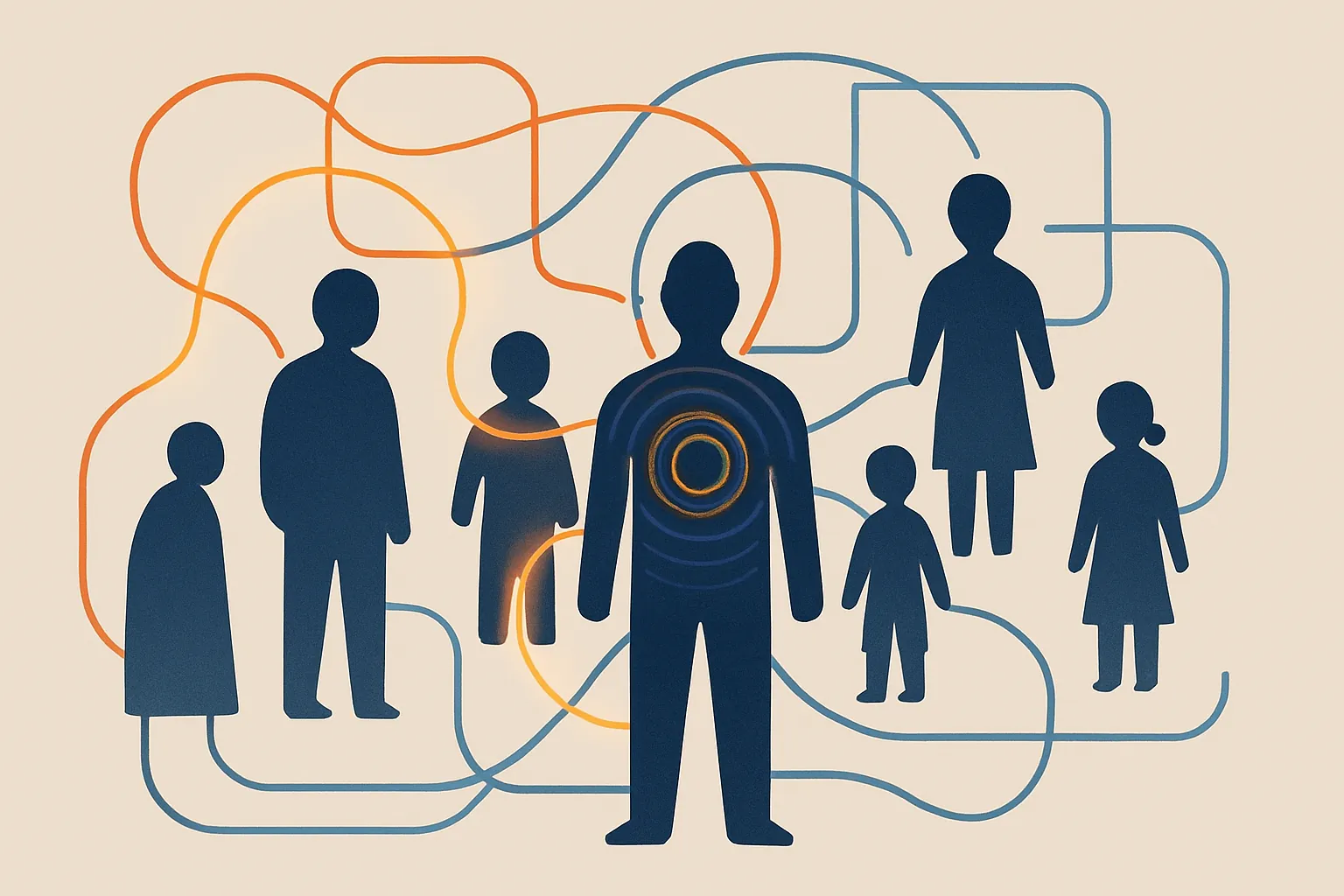
The depression, anxiety, and relational conflict a client reports may be more than an individual problem—it can be chronic anxiety transmitted across generations and now expressed within the client's current family system. Bowen's nuclear family emotional system theory describes how, when family anxiety reaches a tipping point, it gets channeled into one of four patterns: marital conflict, dysfunction in one spouse, impairment of a child, or emotional distance. Clinicians can intervene by mapping these patterns on a three-generation genogram, coaching de-triangulation, and helping clients hold an 'I-position'—raising differentiation of self over time.
Is Your Client's Anxiety Really Their Own?
Most of us have sat with this frustration in session: a client has genuine cognitive insight and strong motivation to change, yet at the decisive moment they snap back into an old pattern—as if some invisible thread were pulling them from behind. You approached the presenting problem as an individual issue, but it keeps behaving like something bigger than the person in the room.
Often it is. Many of the symptoms our clients bring are not just intrapsychic conflict; they are the surface expression of chronic anxiety circulating through the family system. Murray Bowen's multigenerational family systems theory—and specifically the concept of the nuclear family emotional system—gives clinicians a clinical compass for tracing how a client's present-day depression, anxiety, or relational conflict was transmitted from the family of origin.
The shift Bowen invites is significant. Instead of treating the presenting problem as a symptom to be removed, we can read it as a mechanism the system is using to manage its own anxiety—sometimes at the cost of one member who carries the load. This article walks through how to connect a client's current symptoms to family-of-origin anxiety, and offers three intervention strategies you can put to work right away.
How Anxiety Moves Through a Family
The nuclear family emotional system describes the patterns a family uses to absorb and discharge emotional tension. Bowen observed that as anxiety rises, families fall back on predictable maneuvers to manage it—and the clinically important point is that the client's presenting symptom is frequently a byproduct of that anxiety-management process.
When anxiety in a family crosses a threshold, the system tends to project it through one (or a combination) of four channels. Learning to hear these patterns inside a client's narrative is a core diagnostic skill.
1. Marital conflict
The couple discharges anxiety through conflict—each partner tries to control or blame the other, projecting internal unease outward in an attempt to regain a sense of stability.
2. Dysfunction in one spouse
One partner over-functions while the other under-functions and grows increasingly dependent. Over time, the under-functioning partner may develop physical or psychological illness, or a chronic sense of helplessness.
3. Impairment of a child
This is the family that most often walks into the consulting room. Parental anxiety is projected onto a particular child (the family projection process); the child develops behavioral or psychological symptoms that detour the parents' conflict away from the couple and onto the child.
4. Emotional distance
When anxiety runs too high, members manage it by cutting off or withdrawing from contact. The surface can look calm, but internal tension stays elevated.
Differentiation of Self: Reading Where a Family Sits
When you're estimating prognosis and setting treatment goals, the single most useful index is the client's level of differentiation of self—how independent they are from the emotional pressure of the family of origin, versus how fused they remain with it. That reading shapes the entire treatment approach.
As you listen to a client's family story, the table below summarizes the markers that distinguish an undifferentiated, fused system from a well-differentiated one. Use it to locate where your client currently stands.
| Dimension | Undifferentiated family (fusion) | Well-differentiated family |
|---|---|---|
| Handling anxiety | Immediate, emotionally reactive responses | Reflective coping; acts after thinking |
| Relationship style | Imposes individual thoughts/feelings under the banner of "we" | Holds an "I" position while respecting others |
| Under stress | High likelihood one member becomes symptomatic (the scapegoat) | Whole family adapts flexibly and cooperates |
| Triangles | Anxiety offloaded onto a third party; triangles become entrenched | Can recognize triangles and work to step out of them |
| Treatment goal | Reduce emotional reactivity; find the "I" position | Increase autonomy; deepen relationship quality |
Table 1. Emotional-system and clinical features by level of family differentiation.
Three Intervention Strategies for the Counselor
Once you've established that a client's symptoms are tied to the family-of-origin emotional system, the question becomes practical: what do you actually do? The work is not about excavating the past for its own sake—it's about changing how the client lives now. Three strategies do most of the heavy lifting.
1. Make the pattern visible with a three-generation genogram
A genogram is far more than a family tree. Early in treatment, draw it together with the client and use it to trace the path anxiety travels. Questions open the map:
- "When your mother was anxious, who did she usually call?"
- "As your father's drinking got worse, what role did you end up taking on at home?"
Seeing how a present-day symptom—panic, an exaggerated sense of responsibility—mirrors the role the client once played in absorbing family anxiety can be a powerful source of insight. The visual makes the inheritance undeniable in a way that talking alone rarely does.
2. Coach de-triangulation
Watch for the moments a client gets pulled in as the third point of a triangle—mediating their parents' fights, or venting their frustration with a spouse to a child. The therapeutic relationship itself is a working laboratory: use it to help the client practice staying emotionally neutral rather than getting drawn into the reactivity. Each repetition builds the client's capacity to self-regulate anxiety instead of discharging it through a third party.
3. Help the client take an "I-position"
This is not the communication-skills version of "I-statements." Bowen's I-position is the stance of holding to your own beliefs and principles even under intense emotional pressure. Instead of catching the family's anxiety and reacting—lashing out or capitulating—the client learns to state, calmly, "This is how I see this, and this is what I've decided to do." Cultivating that stance is the central goal of the work, and it is what raises differentiation over the long run.
Holding Complex Dynamics Without Losing the Thread
Working a Bowenian case can feel like navigating an enormous web. The clues to multigenerational anxiety are hidden in a single phrase, a silence, an offhand description of a relative—and reconstructing a client's symptoms within the family-of-origin context demands sustained cognitive effort and fine-grained observation.
Realistically, capturing and recording the volume of family material and the tangle of relational dynamics that surface in a 50-minute session—in real time, perfectly—is extremely hard. Tune fully into the client's face and affect, and you may miss a key family-pattern detail; focus on note-taking, and rapport suffers.
This is where a security-first AI partner built for clinicians can carry real weight, particularly in information-dense work like multigenerational family therapy where pattern analysis matters:
- Accurate factual capture: A reliable session transcript records the family members a client names, the sequence of events, and the context of each conflict—so you can give your full attention to building the genogram and reading the patterns rather than scrambling to write everything down.
- Surfacing patterns you missed: Reviewing the transcript afterward, you can re-spot recurring words and emotional threads you didn't catch live, and fold them into the next session's treatment plan.
- Faster supervision prep: Complex family cases all but require supervision. A clean summary and transcript cut the time spent assembling a case report, leaving more room to discuss the clinical substance with your supervisor.
A client's anxiety is never theirs alone. As you trace it back to its roots, the hope is that your own clinical insight—supported by tools that handle the documentation—lets you spend your energy where it belongs: on finding the key to healing hidden inside the family system.
How Modalia AI Supports This Work
Modalia AI is a security-first AI partner for counselors and therapists, designed to handle transcription, case conceptualization support, and documentation so clinicians can stay present with the client. In family-systems work, it captures the dense relational detail of a session into an accurate transcript, helps surface recurring patterns across sessions, and shortens the time needed to prepare case material for supervision—without pulling your attention away from the therapeutic relationship.
References
- 1.
- 2.
Frequently asked questions
What is Bowen's nuclear family emotional system?
It is a concept from Murray Bowen's multigenerational family systems theory describing how a family absorbs and discharges anxiety. When anxiety rises past a threshold, the system tends to channel it through one of four patterns—marital conflict, dysfunction in one spouse, impairment of a child, or emotional distance—and a client's presenting symptom is often a byproduct of that process.
How does differentiation of self affect treatment planning?
Differentiation of self indexes how independent a client is from the emotional pressure of their family of origin versus how fused they remain. Lower differentiation predicts more reactivity, entrenched triangles, and a higher chance one member becomes symptomatic, so early goals focus on reducing reactivity and finding an 'I-position'; higher differentiation lets you aim at autonomy and relationship quality.
Why use a genogram in Bowenian work?
A three-generation genogram makes the path anxiety travels visible. Drawing it with the client and asking targeted questions reveals how a present-day symptom mirrors a role the client once played in absorbing family anxiety—an insight that talking alone rarely delivers.
What is an 'I-position' and how is it different from an I-statement?
An I-position is not a communication technique. It is the stance of holding to your own beliefs and principles under intense emotional pressure—stating calmly 'this is how I see it and what I've decided to do' instead of reacting to the family's anxiety. Cultivating it is central to raising differentiation over time.
This article was written and reviewed using Modalia AI's clinical guidelines, with professional human review before publication.
Related articles
 Case Conceptualization
Breaking the "Yes, But" Game: A Transactional Analysis Guide for Therapists
Every suggestion you offer gets met with "Yes, but..." Here's the TA structure behind that stall—and four clinical moves to break it.
7 min read Case Conceptualization
Yalom's The Gift of Therapy: Passages Every New Counselor Should Copy by Hand
Irvin Yalom's prescription for therapists who fear silence: meet your client as a "fellow traveler" and let the here-and-now become the heart of the work.
6 min read Case Conceptualization
Working With Silence in Therapy: What Client Silence Means and How to Hold It
Silence in session isn't empty space. Learn to read its clinical meaning, tell productive from defensive silence, and use it as a therapeutic tool.
6 min read