Case Note Documentation: 10 Legal and Ethical Checks Every Clinician Should Run
A 10-point legal and ethical checklist for counseling case notes, plus a SOAP workflow that protects you and your client without draining your week.
Key takeaway
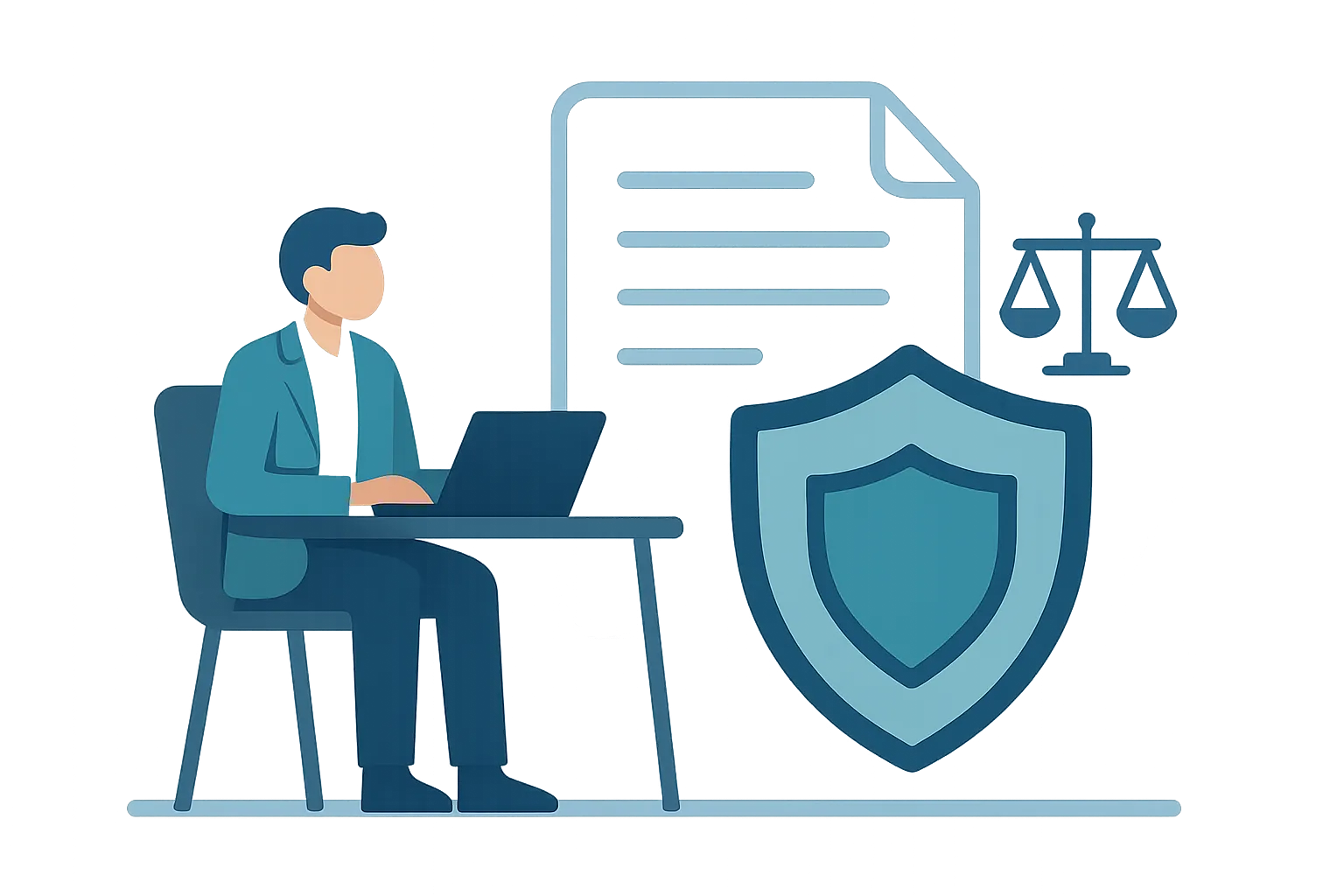
A case note is far more than a memory aid—it is a clinical instrument that supports your reasoning and, in a dispute, often your only line of legal defense. This guide organizes ten essential checks into three categories—legal defensibility, ethical responsibility, and clinical accuracy—anchored by core principles like separating observation from interpretation, using value-neutral language, and documenting promptly. It then offers three field-ready strategies: a structured SOAP format, direct client quotation, and peer review through supervision.
Your Case Notes Are Not Just Memos. They Are Your Strongest Shield. 🛡️
After a full day of back-to-back sessions, most clinicians face one more demanding task: writing the case notes. If you have ever sighed at a backlog of unwritten notes—or hesitated, unsure how much of a client's complex situation to commit to the record—you are in good company. "What if this note becomes a legal problem later?" "Could my own interpretation end up working against my client?" Those worries are not paranoia; they reflect the real stakes of clinical documentation.
A case note is not a private scratchpad for analysis or a simple recall aid. It is a clinical tool that safeguards the quality of care, an ethical artifact that protects client rights, and—when an unexpected dispute arises—frequently the only legal defense a clinician has. As public attention to mental health services grows across every English-speaking market, so do subpoenas for clinical records and the ethical dilemmas that come with them. In that climate, professionals need a systematic approach to documentation that preserves clinical insight while minimizing legal and ethical exposure.
The Line Between Clinical Insight and Legal Defense: 10 Essential Checks ⚖️
Effective, defensible documentation hinges on one discipline: cleanly separating objective observation from the clinician's subjective judgment. Grounded in widely shared ethics codes and legal standards, the checklist below sorts ten essential items into three categories. Use it to audit your current habits.
[Case Note Legal & Ethical Checklist — 10 Essentials]
| Category | Checklist Item | Why It Matters |
|---|---|---|
| Legal defensibility | 1. Separate fact from interpretation | When a client's actual words and behavior (objective data) blur into your clinical inference (subjective interpretation), the record loses credibility as evidence. |
| 2. Document risk assessment and response | When risk of suicide, self-harm, or harm to others surfaces, record the assessment performed, the safety plan created, and any referral or coordination steps in detail. | |
| 3. Stay within informed consent | Confirm that what you record falls within the limits of confidentiality the client agreed to at intake. | |
| 4. Make edits transparent | If you amend a note later, never overwrite the original. Mark the date and reason for the change so the record cannot be mistaken for falsification. | |
| Ethical responsibility | 5. Use value-neutral, respectful language | Favor person-first language ("a client diagnosed with schizophrenia") over labeling or stigmatizing terms ("a schizophrenic"). |
| 6. Minimize third-party information | De-identify or limit details about family, friends, or others the client mentions, protecting their privacy. | |
| 7. Avoid gratuitous detail about private life | Record intimate or legally sensitive disclosures only to the extent clinically relevant—capture the core context, nothing more. | |
| Clinical accuracy | 8. Tie interventions to treatment goals | Show how each session's work connects to the case conceptualization and goals set at the outset. |
| 9. Track client response and progress | When you apply a specific technique (e.g., CBT, EMDR), describe the client's response and symptom trajectory objectively. | |
| 10. Document promptly (timeliness) | Complete notes within 24–48 hours, before memory distorts, to keep clinical data accurate. |
Know Your Jurisdiction: HIPAA, GDPR, and PIPEDA 🌐
The principles above are universal, but the legal floor beneath them varies by where you practice. A few anchors worth knowing:
- United States — HIPAA. Clinical records are protected health information. HIPAA also recognizes "psychotherapy notes"—your private process notes kept separate from the formal record—which receive heightened protection and generally require specific client authorization to disclose. Keeping process notes physically and logically separate from the official chart is good practice.
- EU / UK — GDPR (and UK GDPR). Mental health data is a "special category" requiring an explicit lawful basis for processing, data-minimization by design, and defined retention limits. Clients hold rights of access and rectification, so legibility and accuracy are legal obligations, not just courtesies.
- Canada — PIPEDA (and provincial health-privacy statutes). Consent, purpose limitation, and safeguarding apply; several provinces add their own health-information acts that may govern in clinical settings.
Wherever you sit, two habits travel well: collect and retain only what serves the clinical purpose, and document consent and its limits explicitly.
Field-Ready Strategies for Safe, Efficient Notes 💡
Consciously running a ten-point checklist on every note is a heavy time tax. Here are three concrete practices that raise quality and cut administrative stress in real time.
1. Lean on a structured format like SOAP
A structured template keeps your notes consistent and prevents legal or ethical omissions. The classic SOAP format breaks the note into S (Subjective: the client's report), O (Objective: your observations), A (Assessment: your clinical analysis), and P (Plan: next interventions). Because the structure itself splits fact from interpretation, it satisfies Checklist Item 1 almost automatically.
2. Use direct quotation
When documenting acute symptoms or conflict, quote the client's actual words rather than paraphrasing in your own. Instead of "client appeared depressed," write: Client stated, "Last night I just wanted to end it all," while tearful. The direct quote strengthens both legal defensibility and clinical accuracy at once.
3. Cross-review notes in supervision
It is hard to spot your own documentation blind spots—embedded bias, ethical gray zones—on your own. Bring de-identified sample notes to peer consultation or supervision and review them together. Exchanging feedback on whether the language stays value-neutral and whether third-party information is overexposed sharpens clinical judgment faster than solo reflection.
Expertise and Efficiency, Together: AI-Assisted Documentation 🚀
Case notes protect clinician and client alike, but distilling objective facts from a long, layered conversation and layering clinical assessment on top burns real energy. The good news: recent technology is starting to ease that load.
Used carefully, AI transcription and documentation tools can support compliance with the checklist above. When AI converts a session into accurate text, you are no longer relying on memory that can distort the facts. You can lift the client's key statements directly into your Objective (O) data and focus your effort where it belongs—on professional Assessment (A) and Plan (P). That improves timeliness and deepens case conceptualization.
One caveat: in mental health, the tool's security posture is non-negotiable. Before adopting anything, confirm it meets the privacy standard for your jurisdiction—a HIPAA-compliant option with a signed Business Associate Agreement in the US, or GDPR/PIPEDA-aligned data handling elsewhere. Modalia AI is built as a security-first partner for counselors, supporting transcription, case conceptualization, and documentation so the convenience never comes at the cost of confidentiality.
Growth as a clinician never ends. Audit the note template you are using today and consider upgrading to a structured format like SOAP. And as you look to reclaim time from administrative work for the heart of the clinical encounter, evaluating a rigorously secure AI transcription solution is a worthy next step. Here's to a safe, professional, and sustainable practice.
Frequently asked questions
What is the difference between objective and subjective content in a case note?
Objective content is what you can observe or verify—the client's actual words, behaviors, and measurable data. Subjective content is your clinical interpretation or inference. Keeping them clearly separated (the SOAP format does this structurally) protects the note's credibility if it is ever used as evidence.
How soon should I write my case notes after a session?
Aim to complete notes within 24–48 hours, before memory fades or distorts. Prompt documentation improves accuracy and supports both clinical decision-making and legal defensibility.
Are psychotherapy process notes treated differently from the official record?
In the US, HIPAA distinguishes 'psychotherapy notes'—your private process notes kept separate from the formal chart—and gives them heightened protection, generally requiring specific client authorization to disclose. Keep them physically and logically separate from the official record. Other jurisdictions vary, so check your local health-privacy law.
Is it safe to use AI transcription tools for clinical documentation?
It can be, provided the tool meets your jurisdiction's privacy standard—for example, a HIPAA-compliant service with a signed Business Associate Agreement in the US, or GDPR/PIPEDA-aligned handling elsewhere. Verify the security posture before adopting any tool, and continue applying the same legal and ethical checks to AI-assisted notes.
This article was written and reviewed using Modalia AI's clinical guidelines, with professional human review before publication.
Related articles
 Clinical Skills
How to Write Better Supervision Questions: Getting What You Actually Need from Your Supervisor
Stuck on what to ask in supervision? Use these structured question strategies to turn vague check-ins into focused clinical insight.
7 min read Clinical Skills
From "The Client Seems Depressed" to a Clinical Hypothesis: How Word Choice Elevates Your Case Reports
Turn vague observations into precise clinical hypotheses. A practical guide to terminology and sentence formulas that make your case reports read like expert work.
7 min read Clinical Skills
The Wounded Healer Trap: Why "I Want to Heal Myself" Sinks Your Counseling Grad School SOP
Why admissions faculty flinch at "I want to heal my own wounds"—and how to transform personal pain into a research-grade statement of purpose that gets you in.
6 min read