When CBT Falls Flat: Adapting Cognitive Therapy for Clients with Borderline Intellectual Functioning
"They said they understood—so why hasn't anything changed?" Why standard CBT misses clients with borderline intellectual functioning, and field-ready adaptations you can use now.
Key takeaway
Clients with borderline intellectual functioning (BIF)—roughly one in seven people, by the statistical definition of the IQ 71–84 band—rarely qualify for an intellectual disability diagnosis, yet they struggle with the metacognition and abstract reasoning that standard CBT demands. An adapted approach built on concretization, repetition, and simplification works better: visualizing emotion with a "traffic-light" model, self-instruction training, and breaking social skills into micro-steps with role-play and video feedback. The clinician acts as an auxiliary ego that scaffolds frontal-lobe functions, and precise session documentation is what makes small wins visible enough to reinforce.
"But They Said They Got It": Why Standard CBT Stalls with Clients Who Have Borderline Intellectual Functioning
Most clinicians have sat across from a client who shows no clear intellectual disability, yet responds slowly to standard interventions—someone for whom insight-oriented dialogue seems to slide off the surface. "I understand what you mean," they say, and then nothing changes in daily life, or the work you did together in session evaporates by the next week.
Many of these clients fall into the band known as borderline intellectual functioning (BIF)—IQ roughly 71 to 84. By the statistics of the normal distribution alone, this band covers something close to one in seven people, which makes it one of the most common—and most overlooked—presentations in a general caseload.
This creates a genuine clinical dilemma. These clients usually don't qualify for an intellectual disability diagnosis, so they fall through the gaps in disability services and accommodations. At the same time, they struggle with exactly what conventional psychotherapy—especially cognitive behavioral therapy (CBT)—asks of them: high-order cognitive restructuring and metacognitive monitoring. What does an effective treatment goal even look like for these clients? How do we meet them at their level and still move them toward change? This post lays out concrete, field-tested ideas for building a cognitive therapy program tailored to how slower-processing clients actually learn.
1. Why Standard CBT Has to Be Modified: Understanding the Cognitive Profile
Before building a program, it helps to be precise about why the standard model is a poor fit. Conventional CBT asks the client to observe their own thinking objectively (metacognition), to dispute irrational beliefs (abstract reasoning), and to generate and apply alternative thoughts across situations (generalization). Clients in the IQ 71–84 range typically have limited working-memory capacity and real difficulty making abstract concepts concrete.
The practical implication is a shift in emphasis: away from cognitive restructuring and toward cognitive skills training and behavioral activation. The table below contrasts the standard approach with a modified one. Use it to recalibrate the direction of your program.
Table 1. Standard CBT vs. Modified CBT for Slower-Processing Clients
| Dimension | Standard CBT | Modified CBT (BIF clients) |
|---|---|---|
| Core technique | Socratic dialogue, cognitive disputation | Self-instruction training, modeling, rehearsal |
| Materials | Thought records (DTR), text-based worksheets | Visual aids (pictures, cards), diagrams, traffic-light model |
| Clinician's role | Collaborative empiricist (guide) | Active coach, supportive educator (scaffolding) |
| Session structure | 50 min, weekly, independent homework | Shorter or with breaks, more frequent, caregiver involvement |
2. Putting It Into Practice: Concrete Program Components
So which techniques actually belong in the program? The three organizing principles are concretization, repetition, and simplification. Here are three strategies you can use right away.
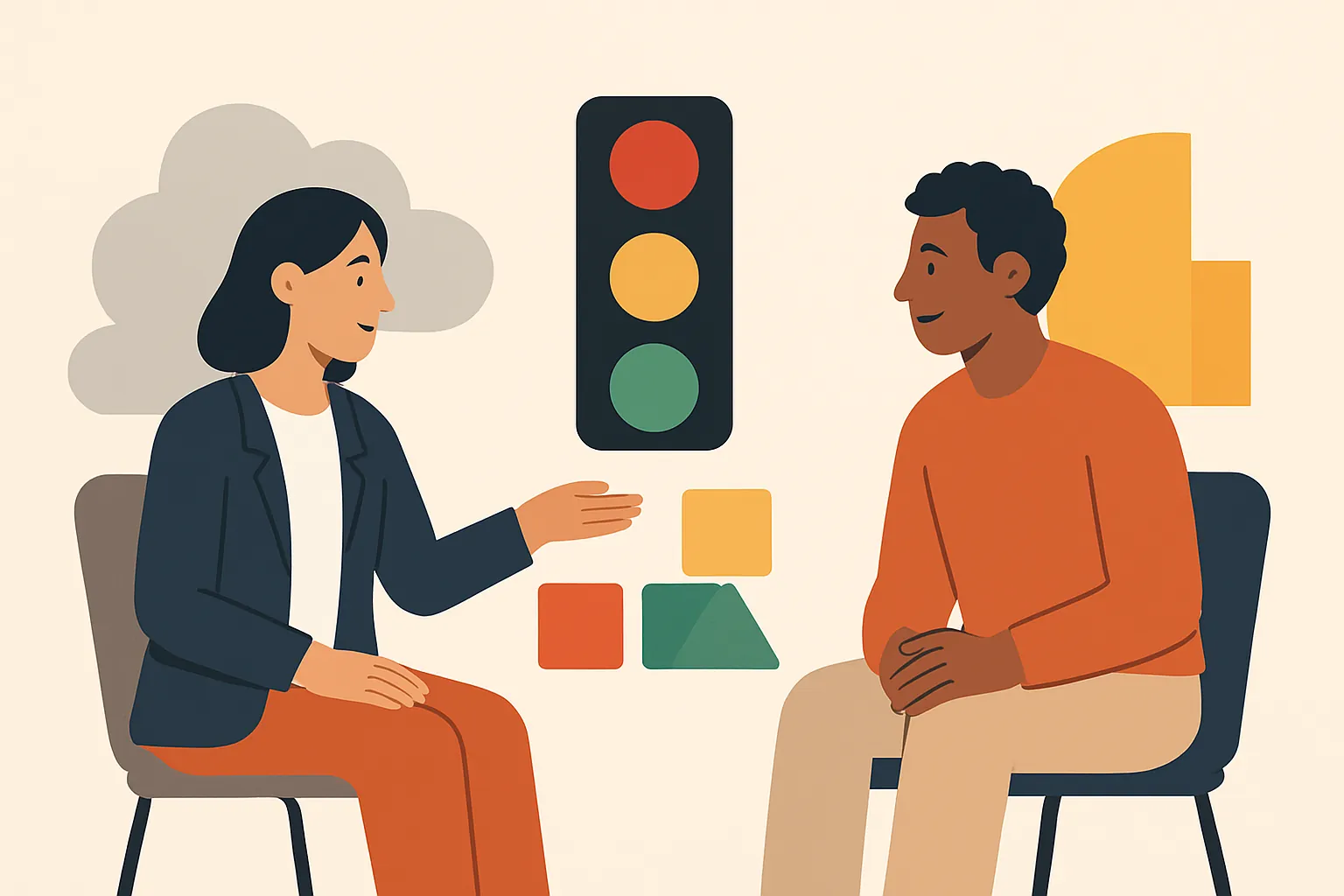
2.1. Making Abstract Emotion Visible: The "Emotion Traffic Light" and Thermometer
Instead of the vague "How are you feeling?", translate emotion into an intuitive image. For an anger-management module, for example, introduce a traffic-light model:
- Red light: Stop. Anger has hit the ceiling. (Action: take three slow breaths.)
- Yellow light: Caution. Irritation is building. (Action: say "Give me a second.")
- Green light: Safe. Calm and steady.
The goal is to let the client monitor their internal state instantly by mapping it onto a color or a temperature. Handing them a color card is far more effective than any verbal explanation—it externalizes a state that abstract language can't reliably reach.
2.2. Simplifying Complex Reasoning: Self-Instruction Training
In place of elaborate cognitive disputation, develop a short, clear coping statement (a coping mantra) the client can say to themselves in the problem situation, then drill it through graded practice:
- Step 1 — Cognitive modeling: The clinician performs the task while thinking aloud ("Okay, this is hard. But if I go slowly, I can do it.").
- Step 2 — Overt external guidance: The client performs the task while the clinician gives the instructions aloud.
- Step 3 — Overt self-instruction: The client performs the task while talking themselves through it aloud.
- Step 4 — Covert self-instruction: The client performs the task while saying the instructions silently.
This sequence—drawn from the classic self-instructional training tradition—reduces working-memory load and is especially effective at reining in impulsivity.
2.3. Breaking Down Social Skills: Role-Play and Video Feedback
Slower-processing clients often miss social cues, so social skills have to be taught in very small units (micro-skills). The target isn't "make friends"—it's make eye contact, say hello, nod while listening. Then record the practice on a phone and review it together: video modeling is a powerful way to help a client see and objectify their own behavior, which verbal feedback alone rarely achieves.
3. Redefining the Clinician's Role—and Why Documentation Matters
Work with BIF clients demands more energy than typical sessions, because the clinician is more than a facilitator: you function as an auxiliary ego, temporarily standing in for the frontal-lobe functions—planning, inhibition, self-monitoring—that the client can't yet fully marshal alone. Repeated explanation, concrete examples, and catching and praising the smallest changes aren't optional extras; they're the mechanism of treatment.
3.1. Accumulating Success and Working From Data
These clients usually arrive with a long history of failure and a corresponding sense of learned helplessness. So the clinician's job is to not miss the small steps the client does manage—and to reinforce them. That depends on precise session documentation and analysis.
The specific word a client used, a subtle behavioral shift, which visual tool they responded to best—recording these details is what gives you the raw material to design the next session's strategy. But running repetitive in-session drills while taking meticulous notes is, realistically, very hard to do at the same time.
4. Letting Tools Free You to Be Fully Present
A cognitive therapy program for slower-processing clients comes down to two things: patient repetition and sensory, concrete framing. The clinician sets aside the scaffolding of complex theory and becomes a translator—rendering the world in the simplest, clearest language possible, at the client's eye level. The work is slow and effortful, but the moment a client takes a step on their own is worth all of it.
A few concrete action items for running an effective program:
- Build a visual library: Keep emotion cards and situation-specific coping cards on hand in the room.
- Connect with parents and teachers: Share a simple manual so the skills practiced in session carry over into home and school.
- Adopt smarter record-keeping: To stay fully present for repetition and interaction, consider a tool that captures the session for you automatically.
For slower-processing clients in particular, shifts in sentence construction and word choice are meaningful indicators of progress. A secure, AI-assisted documentation partner like Modalia AI lets you keep your eyes on the client and model behavior, rather than splitting attention to write. Over time, the accumulated record makes it easier to spot changes in a client's language patterns and recurring cognitive errors—and to visualize that progress as feedback for the client or their caregivers. Let the room the technology gives you flow back to the client as warmth, patience, and encouragement.
Note on data: Because BIF is defined by a score band on a standardized IQ distribution, its population prevalence is essentially fixed by that definition (roughly 13–14%). If you cite a specific figure in your own materials, confirm it against current epidemiological data for your region rather than assuming a single global number.
References
- 1.
Frequently asked questions
What is borderline intellectual functioning (BIF)?
BIF describes cognitive ability in the IQ 71–84 band—below average but above the threshold for an intellectual disability diagnosis. Because it's defined by a score range on the normal distribution, it captures roughly one in seven people, many of whom never receive formal accommodations.
Why doesn't standard CBT work well for these clients?
Standard CBT relies on metacognition, abstract reasoning, and generalization across situations. Clients with BIF typically have reduced working-memory capacity and difficulty making abstract concepts concrete, so cognitive restructuring and Socratic disputation tend to fall flat.
What should I emphasize instead of cognitive restructuring?
Shift toward cognitive skills training and behavioral activation, organized around three principles: concretization, repetition, and simplification. Practical techniques include the emotion traffic-light model, self-instruction training, and breaking social skills into micro-steps with video feedback.
What does the clinician's role look like with BIF clients?
You function as an auxiliary ego—temporarily scaffolding the planning, inhibition, and self-monitoring the client can't yet sustain alone. That means repeated explanation, concrete examples, and consistently catching and reinforcing small successes.
How does documentation support this kind of treatment?
Progress shows up in subtle signals—a new word, a small behavioral shift, which visual tool landed best. Capturing these details lets you reinforce small wins and plan the next session. Secure AI-assisted documentation frees you to stay present and model behavior instead of splitting attention to take notes.
This article was written and reviewed using Modalia AI's clinical guidelines, with professional human review before publication.
Related articles
 Case Conceptualization
Breaking the "Yes, But" Game: A Transactional Analysis Guide for Therapists
Every suggestion you offer gets met with "Yes, but..." Here's the TA structure behind that stall—and four clinical moves to break it.
7 min read Case Conceptualization
Yalom's The Gift of Therapy: Passages Every New Counselor Should Copy by Hand
Irvin Yalom's prescription for therapists who fear silence: meet your client as a "fellow traveler" and let the here-and-now become the heart of the work.
6 min read Case Conceptualization
Working With Silence in Therapy: What Client Silence Means and How to Hold It
Silence in session isn't empty space. Learn to read its clinical meaning, tell productive from defensive silence, and use it as a therapeutic tool.
6 min read