Using ChatGPT for Counseling Notes Without Compromising Client Privacy
A clinician's guide to safely using ChatGPT for progress notes: de-identification, data fragmentation, and theory-driven prompts that cut documentation time.
Key takeaway
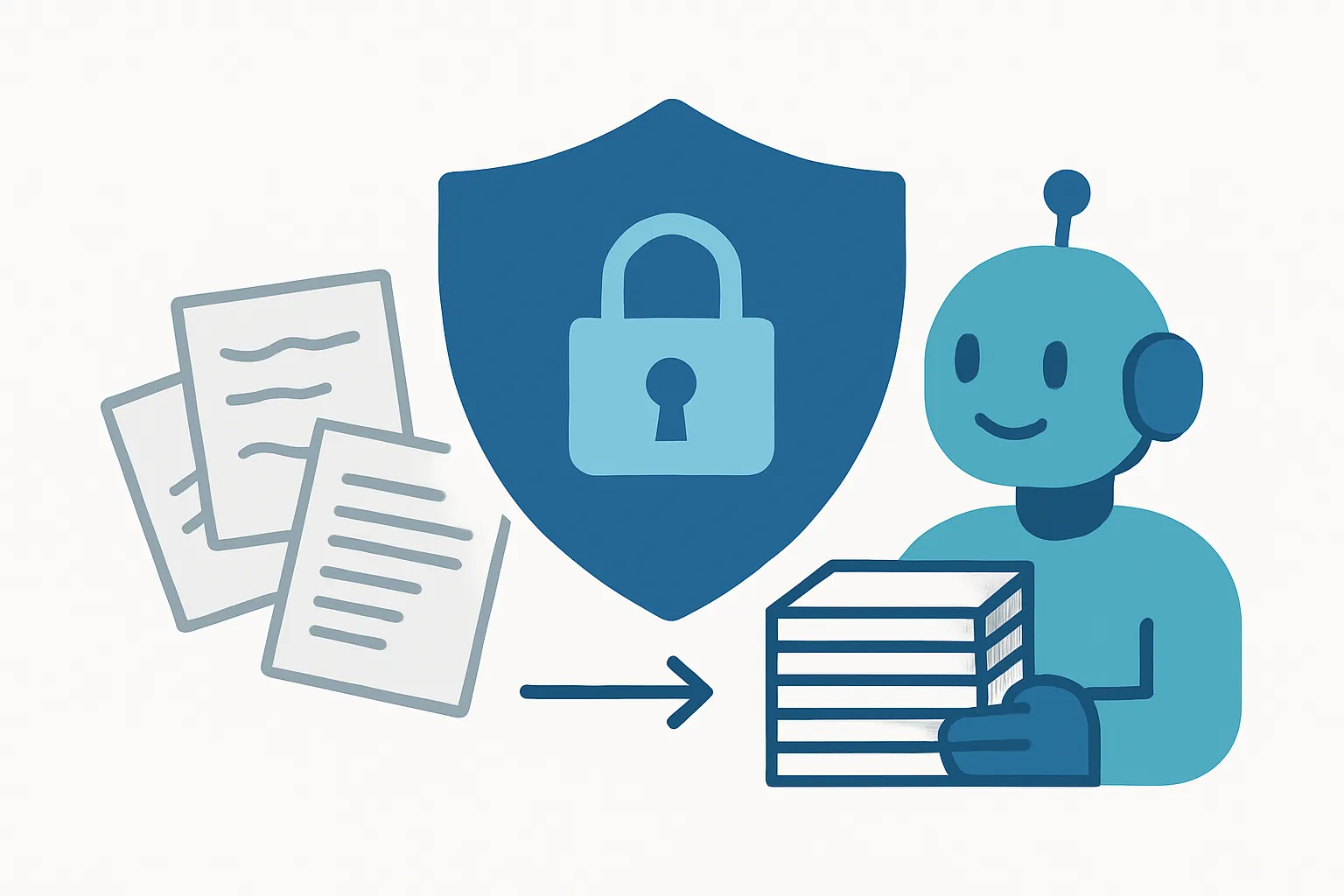
General-purpose AI tools like ChatGPT can speed up clinical documentation, but they may reuse your inputs for training, creating re-identification risk that conflicts with APA and other confidentiality obligations. The safest workflow is rigorous de-identification—stripping not only names and locations (PII) but also quasi-identifiers like a distinctive occupation or a highly specific trauma event—combined with data fragmentation, where you never paste a whole session into a single prompt. Applied this way, AI can draft theory-based case conceptualizations, SOAP notes, and empathic-response options, often cutting documentation time by half or more.
The After-Hours Paperwork Problem
You've spent the day sitting with clients in pain, holding space, attuning, staying present. Then the office door closes—and what waits for you isn't rest, but a stack of progress notes and session documentation. Almost every clinician has had the thought: "I just want to do the therapy. Could someone else handle the paperwork?"
Generative AI tools like ChatGPT have made that wish feel suddenly plausible. But for those of us in mental health, two non-negotiables stand in the way: client privacy and our duty of confidentiality. Because we handle people's most intimate disclosures, one anxious question tends to stop us before we start: "What if the session content I type in gets absorbed into the model's training data and leaks?"
This article walks through how to use AI as a smart clinical assistant—drastically reducing documentation time—while staying squarely inside your ethical and clinical obligations. From complex case conceptualization to fast session summaries, here's how to bring AI into your workflow safely.
1. Before You Type Anything: Data Safety and the Ethical Dilemma
Before feeding any clinical content into an AI tool, you need a clear picture of how that tool handles your data. By default, many consumer generative-AI products may reuse user inputs as training data. That possibility runs directly into the confidentiality principle at the heart of the APA Ethics Code and the codes of bodies like the ACA and BACP.
Training-data risk
Typing a client's real name and specific circumstances into a free ChatGPT account—or any general large language model (LLM)—is, in effect, like posting their story in a public square. Even when data is anonymized for training, re-identification remains a live risk: combine enough contextual details and a "de-identified" record can point back to a single, identifiable person.
The clinician's responsibility
Convenience can never outrank client safety. When using AI, hold to a minimum-necessary-input principle, and keep a clear working definition of what counts as sensitive information in your practice. The tool serves the client's interests—never the other way around.
A note on tooling: Consumer accounts and enterprise/API tiers often have very different data-retention and training policies, and these change over time. Before you adopt any tool, read its current data-usage and retention terms, and confirm whether a Business Associate Agreement (or your region's equivalent) is available for protected health information. When in doubt, assume your input may be retained.
2. The Practical Method: Pseudonymization and Context Separation
So is AI simply off-limits in clinical work? Not at all. The key is rigorous de-identification. This goes well beyond deleting a name: the expert move is to remove or transform every identifier that could single out a client, so the AI analyzes only the structure and pattern of the material—never the person.
Strip and substitute PII
Names, home location, employer, specific family configurations, and dates must always be removed. Go a step further with quasi-identifiers—a distinctive occupation or a highly specific traumatic event—and generalize them. For example, "a touring concert violinist" becomes "a professional with an irregular, high-pressure schedule." A unique event becomes a category of event.
Fragment the data
Never paste a client's full history or an entire session into one prompt. Break the material into context-separated pieces, and the AI's ability to assemble a full, identifying picture drops sharply. Ask for an analysis of the presenting problem in one chat, then open a separate chat to examine defense-mechanism patterns on their own.
| Element | Risky input (never do this ❌) | Safe input (recommended ✅) |
|---|---|---|
| Basic details | "James Carter, 28, software engineer at Microsoft, lives in Seattle" | "Male client, late 20s, office-based professional at a large firm, urban area" |
| Specific event | "Argued with his girlfriend outside the downtown mall on Dec. 25" | "Conflict with a romantic partner in a crowded public place around a recent holiday" |
| Proper nouns | "His manager, Mr. Davis, shouted 'You're useless'" | "A workplace supervisor used harshly critical, demeaning language" |
| Symptom description | (copy-pasted verbatim) | Summarized around core affect and cognitive-distortion patterns |
3. Prompt Engineering That Maximizes Clinical Efficiency
Once your data is safely processed, you can put AI to work as a capable co-therapist. Instead of a flat "summarize this," assign it a specific role grounded in clinical theory and terminology—that's when the output gets genuinely useful.
Request a theory-based case conceptualization
Name the framework explicitly: "Analyze this client's stated patterns from a cognitive behavioral therapy (CBT) perspective and identify three primary cognitive distortions," or "From an object-relations standpoint, propose a hypothetical formulation of this client's transference." Used this way, the output becomes a useful prompt for self-supervision—a second set of eyes on blind spots you might otherwise miss.
Automate the SOAP-note draft
Working from de-identified session content, ask the model to "organize this into Subjective, Objective, Assessment, and Plan format." Letting AI generate the first draft and then reviewing and revising it yourself can cut documentation time by 50% or more.
Explore empathic responses and metaphor
When you feel stuck, try: "A client described feeling 'like I'm sinking into a swamp.' Suggest therapeutic responses or extended metaphors that could deepen empathy and reflection." A model with rich linguistic range can surface creative angles for an intervention you can then shape to fit the client.
How Safer Tools Protect Your Clinical Presence
AI will never replace clinical intuition or the therapeutic relationship. What it can do is lift the documentation load—buying back the time and mental bandwidth to be fully present with the person in front of you. The goal isn't fear; it's controlled, intentional use. Holding firmly to de-identification, a general-purpose tool like ChatGPT can be a cost-effective starting point.
That said, if manually de-identifying and reformatting every record feels tedious—and still leaves you uneasy—a purpose-built AI documentation service for clinicians is a strong alternative. Security-first solutions in this space:
- Automatically mask sensitive information (PII) so identifying data never leaves a protected boundary.
- Use speech-recognition models tuned to clinical language, improving transcript accuracy.
- Generate analysis aligned to clinical-psychology standards in a single step.
This is the design philosophy behind Modalia AI—a security-first partner for counselors, built to handle transcription, case conceptualization, and documentation without putting client confidentiality at risk.
Technology doesn't have to threaten our ethical responsibilities. Used wisely, it can make care more ethical and more effective. Start small and safe—a single session summary—and grow into a clinician who practices well in the digital age. Preventing your own burnout, after all, is the first step in protecting your clients.
References
- 1.
- 2.ACA Code of EthicsIndustry
- 3.
Frequently asked questions
Is it ethical to use ChatGPT for clinical documentation?
It can be, provided you rigorously de-identify all content first and understand the tool's data-retention policy. The APA, ACA, and BACP ethics codes center on confidentiality, so any workflow that could expose identifiable client information—including through model training—would violate those obligations. Use a minimum-necessary-input approach and, where protected health information is involved, confirm whether an appropriate data agreement is available.
What is the difference between PII and quasi-identifiers?
PII (personally identifiable information) includes direct identifiers like names, addresses, employers, and dates. Quasi-identifiers are details that don't name a person but can single them out when combined—such as a distinctive occupation, a rare diagnosis, or a highly specific event. Both must be removed or generalized to prevent re-identification.
What is data fragmentation and why does it help?
Data fragmentation means never entering a full session or client history into a single prompt. Instead, you split the material into context-separated pieces—analyzing the presenting problem in one chat and defense patterns in another. This makes it far harder for an AI to assemble a complete, identifying picture of any one client.
Can AI replace clinical judgment in case conceptualization?
No. AI can surface alternative hypotheses and check for blind spots, functioning like a self-supervision aid, but it cannot replace clinical intuition, the therapeutic relationship, or the clinician's responsibility for the formulation. Treat its output as a draft to be critically reviewed and revised, never as a final clinical product.
This article was written and reviewed using Modalia AI's clinical guidelines, with professional human review before publication.
Related articles
 Clinical Skills
How to Write Better Supervision Questions: Getting What You Actually Need from Your Supervisor
Stuck on what to ask in supervision? Use these structured question strategies to turn vague check-ins into focused clinical insight.
7 min read Clinical Skills
From "The Client Seems Depressed" to a Clinical Hypothesis: How Word Choice Elevates Your Case Reports
Turn vague observations into precise clinical hypotheses. A practical guide to terminology and sentence formulas that make your case reports read like expert work.
7 min read Clinical Skills
The Wounded Healer Trap: Why "I Want to Heal Myself" Sinks Your Counseling Grad School SOP
Why admissions faculty flinch at "I want to heal my own wounds"—and how to transform personal pain into a research-grade statement of purpose that gets you in.
6 min read