Circular Questioning in Couples Therapy: Helping Partners See Their Mutual Influence
Learn how circular questioning breaks the blame cycle in couples therapy, with three practical question types that shift clients from linear blame to relational insight.
Key takeaway
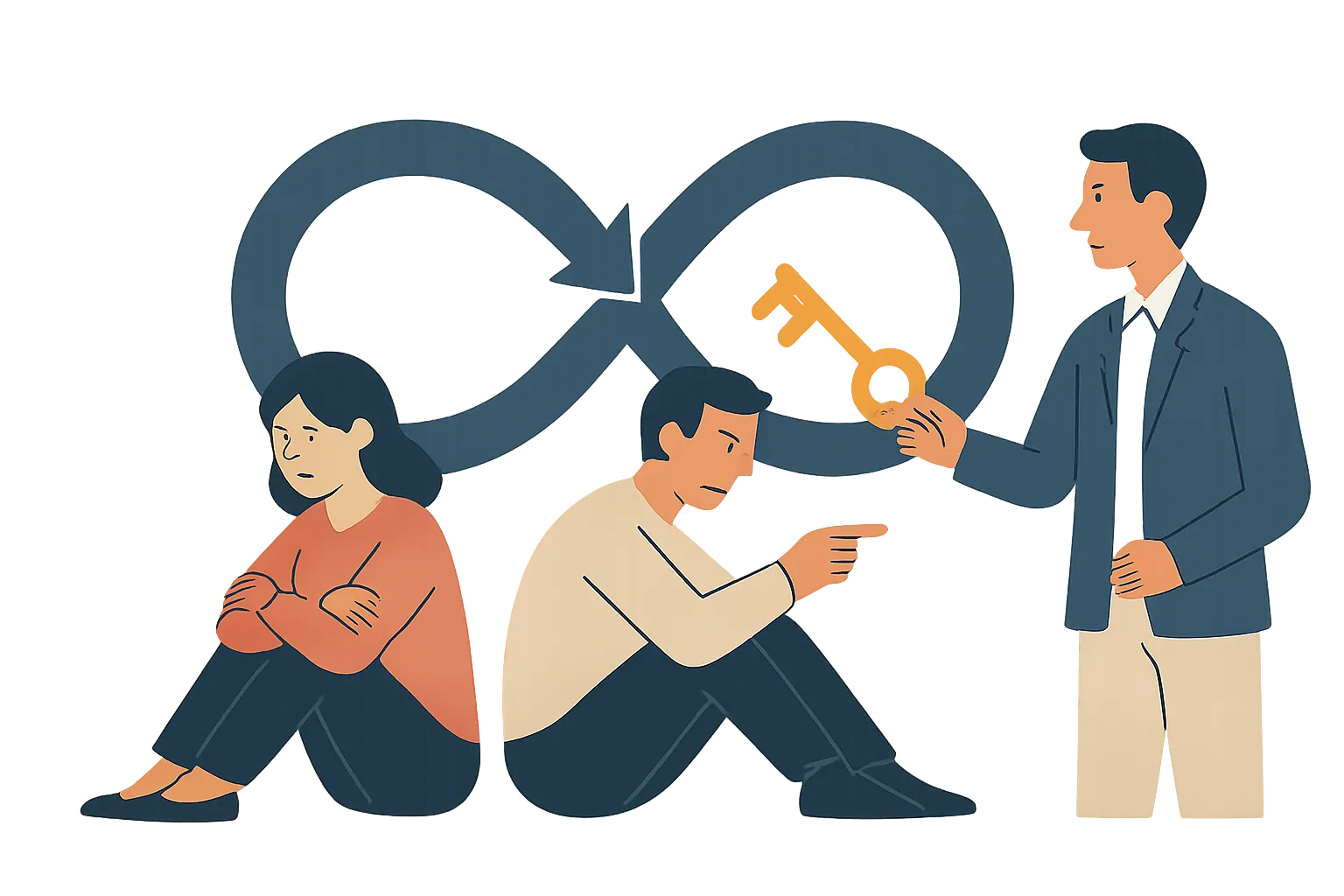
In couples work, partners often locate the problem in each other's personality and get trapped in a cycle of mutual blame. Circular questioning—developed by the Milan school of family systems therapy—is the core tool for interrupting that pattern, guiding clients out of linear cause-and-effect thinking so they can observe their own interactional loop from a third-person vantage point. It works through three question types: difference questions that compare the intensity and perception of conflict, behavioral-effect questions that trace the interaction loop, and hypothetical questions that explore future possibilities. Because the clinician must track two clients' verbal and nonverbal signals at once, sustained attention is essential—and reliable session documentation frees that attention for the relational dynamics in the room.
"Why does my partner even do that?" — The key to breaking the blame cycle
If you've run couples sessions, you know the moment: you start to feel less like a therapist and more like a judge. "Listen, he raised his voice first." "No—she uses this dismissive tone, of course I get angry." Each partner works to prove the other one is at fault, and you're left trying to hold neutrality and intervene clinically inside a flood of accusations.
Many clinicians get stuck inside this trap of linear causality—the assumption that A caused B. That framing is good at identifying a culprit, but it's a major obstacle to repairing a relationship. What helps here is a tool from family systems theory, specifically the circular questioning developed by the Milan school.
Circular questioning helps clients locate the problem in the pattern of the relationship rather than in their partner's character. It's more than a questioning technique; it's a powerful intervention that lets clients view their own interaction loop through a third person's eyes. This article looks closely at the core principles and practical application of circular questioning—how it breaks the deadlock in couples work and helps partners discover their own influence on each other.
From linear thinking to circular awareness: redrawing the map of the relationship
Circular questioning matters clinically because it reorganizes how clients perceive their situation. Most high-conflict couples believe something like: "He drinks (cause) → so she nags (effect)." From a circular perspective, however, the same events form a loop that feeds itself: "He drinks → she nags → he feels stressed and drinks again."
The clinician's job is to make this feedback loop visible through questions. Doing so invites each client to reflect on: "How does my behavior affect my partner, and how does that response come back around to me?" The table below compares how traditional linear questions and circular questions differ in clinical effect.
| Dimension | Linear questioning | Circular questioning |
|---|---|---|
| Focus | Pinning down the cause, establishing facts | Relational patterns, interaction, exploring difference |
| Example | "Why did you get so angry?" "Who started the fight?" | "When he gets angry, how do you respond?" "Who is more troubled by this problem?" |
| Client response | Defensiveness, blame, self-justification | Adopts an observer stance, recognizes mutual influence |
| Therapeutic effect | Gathers information (little therapeutic change) | Generates new information, restructures perception |
Table 1. Clinical comparison of linear and circular questions and their therapeutic effect
As the table shows, circular questioning does more than collect information—the question itself becomes the intervention. Through it, you guide a couple to see each other not as "perpetrator and victim" but as partners who continually shape each other.
Three types of circular questions you can use right away
Understanding the theory is one thing; knowing exactly what to ask in the room is another. Here are three core question strategies that adapt Milan-school theory to contemporary couples work. They're effective for breaking through impasses and prompting client insight.
1. Difference questions: sorting the intensity and perception of conflict
People understand a situation better through comparison than through absolute measures. Difference questions explore differences in perception between partners, or change over time. They turn a vague, diffuse conflict into something concrete.
- Ranking: "Of the two of you, who worries more about this problem?"
- Comparison over time: "Compared with your arguments early in the marriage, are the fights now worse, or about the same?"
- Third-person vantage point: "If your kids were watching this scene, who would they say was angrier—Mom or Dad?"
These questions help clients step out of being submerged in their own feelings and view the situation against a more objective scale.
2. Behavioral-effect questions: connecting the interaction loop
This type traces how A's behavior affects B, and how that comes back around to A. It's especially useful with couples caught in a pursuer–distancer pattern.
- Exploring direct impact: "When he goes silent, what thoughts come up for you? And because of those thoughts, what do you find yourself doing?"
- Tracking the response to the response: "When she raises her voice, what decision do you make inside in that moment—for example, 'I need to get out of here' or 'I have to fight back'?"
Through these questions, a client moves from "I raise my voice because he goes silent" to the circular realization, "When I raise my voice, he goes even more silent."
3. Hypothetical / future questions: searching for new possibilities
By stepping out of the present deadlock and into future or imagined scenarios, these questions surface resources for solving the problem and sidestep client resistance.
- A variation on the miracle question: "If this conflict pattern disappeared overnight, how would your relationship be different? What would the two of you be saying to each other then?"
- Imagining the worst case: "If you keep talking to each other the way you do now for five more years, what would the relationship look like?"
Questions like these powerfully signal the need for change, or let a couple share a positive vision of the future that strengthens motivation for treatment.
Protecting your attention so insight can surface
Circular questioning is powerful, but it demands a high level of sustained attention. By its nature, couples work means processing the verbal and nonverbal signals of two clients at once and catching the complex pattern between them in real time. You can only ask a precise circular question if you don't miss the subtle cues—"A moment ago, when he said that, your face fell…"
The difficulty is that when you're absorbed in taking careful notes or building a verbatim record, it's easy to miss the very interactional moments that matter most. The quality of a session depends on how fully you can stay in the here-and-now with your clients.
This is where session documentation deserves deliberate thought. Whatever method you use—structured note templates, a post-session debrief, or a secure clinical recording or transcription tool used with informed consent—the goal is the same: to lower the in-session documentation burden so your attention stays on the couple's dynamics. A reliable, speaker-separated record of the conversation can support your work in concrete ways:
- Easier pattern analysis: Reviewing an organized transcript lets you notice recurring keywords or see who spoke more on a given topic (a marker of dominance) as observable data rather than impression.
- Visualizing the loop: Going back over a written log, you can spot subtle causal links you missed live and use them to shape the treatment strategy for the next session.
- Faster supervision prep: Accurate transcripts are essential for supervision. Reducing the manual work of producing them frees more of your time for case analysis and your own development.
Ultimately, documentation tools exist to support the clinician's insight, not replace it. When you're freed from the pressure of record-keeping and can capture the tension and emotional patterns flowing between two partners with a well-aimed question, that's when clients finally stop pointing fingers and start facing each other. In your next session, why not try a single difference question? A small change in how you ask can shift the larger current of a relationship.
References
- 1.
Frequently asked questions
What is circular questioning in couples therapy?
Circular questioning is a systemic interviewing technique developed by the Milan school of family therapy. Instead of asking who caused a problem (linear questions), it asks clients to describe differences, interactions, and effects—so they observe their relationship as a self-reinforcing loop rather than a chain of blame.
How is circular questioning different from ordinary clinical questions?
Ordinary linear questions ('Why are you angry?' 'Who started it?') tend to gather facts and trigger defensiveness. Circular questions ('When he goes silent, what do you do, and how does he respond to that?') generate new information and shift clients into an observer stance, making the question itself a therapeutic intervention.
When should I use hypothetical or future-oriented circular questions?
Use them when a couple is stuck in a present-tense impasse or when direct questions provoke resistance. Future and 'miracle' variations ('If this pattern vanished overnight, what would you be saying to each other?') help clients access resources and motivation without having to defend their current position.
Does circular questioning require special documentation support?
Not strictly, but couples work is attention-intensive because you track two clients at once. Reducing the in-session note-taking burden—through templates, post-session debriefs, or a secure transcription tool used with consent—frees your attention for the relational moments that make precise circular questions possible.
This article was written and reviewed using Modalia AI's clinical guidelines, with professional human review before publication.
Related articles
 Case Conceptualization
Breaking the "Yes, But" Game: A Transactional Analysis Guide for Therapists
Every suggestion you offer gets met with "Yes, but..." Here's the TA structure behind that stall—and four clinical moves to break it.
7 min read Case Conceptualization
Yalom's The Gift of Therapy: Passages Every New Counselor Should Copy by Hand
Irvin Yalom's prescription for therapists who fear silence: meet your client as a "fellow traveler" and let the here-and-now become the heart of the work.
6 min read Case Conceptualization
Working With Silence in Therapy: What Client Silence Means and How to Hold It
Silence in session isn't empty space. Learn to read its clinical meaning, tell productive from defensive silence, and use it as a therapeutic tool.
6 min read