When Clients Are Chronically Late or No-Show: A Therapeutic Structure Script for New Counselors
Chronic lateness and no-shows are rarely just rudeness — they're clinical material. Here's how to hold the frame without shaming the client.
Key takeaway
Client lateness and no-shows are best understood not as disrespect or low motivation but as nonverbal communication carrying clinical meaning — resistance, acting out, or boundary testing. New clinicians who tolerate these patterns indefinitely in the name of building rapport actually weaken the therapeutic frame and leave the client feeling less safe. A non-judgmental but firm response that names the pattern, explores its meaning, and upholds clear policy is what gives the client a genuine sense of containment and safety.
"Is My Client Testing Me?" Handling Chronic Lateness and No-Shows Like a Professional 🕰️
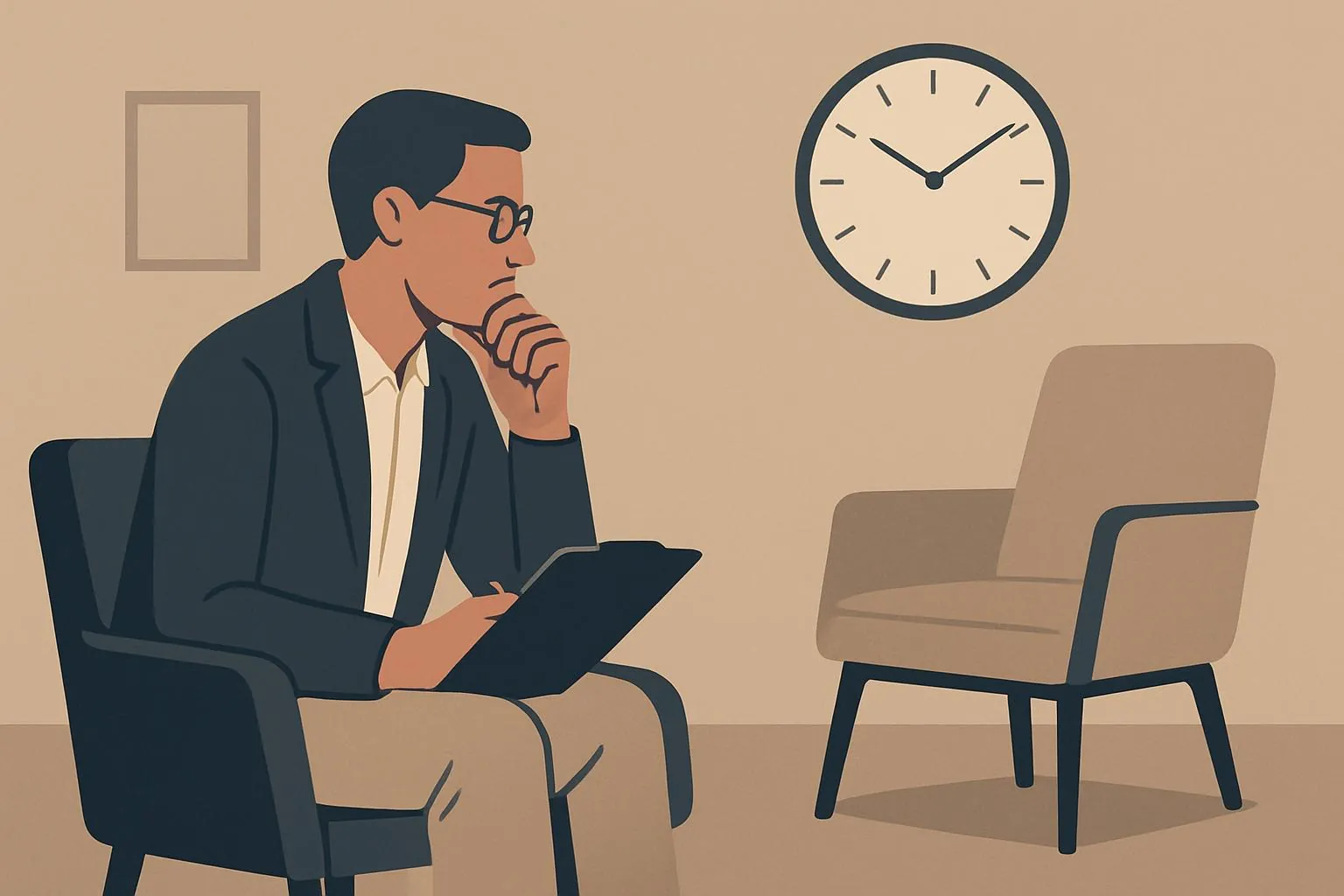
The clock in your office is now ten, fifteen minutes past the start of the session. The client hasn't arrived, and there's no text. For a newer clinician, the mind starts racing: Did I say something wrong last week? Is this client even motivated? Should I call now, or keep waiting?
Lateness and no-shows are among the most common situations you'll face in clinical practice — and among the most psychologically demanding to handle well. Less experienced clinicians tend to swing between two unhelpful reactions: dismissing the behavior as plain rudeness, or absorbing it as evidence of their own incompetence. From a clinical perspective, neither is accurate. A client's relationship to time is rarely "just an attitude problem." It is meaningful clinical material — a window into resistance, acting out, and the testing of relational boundaries. This article breaks down what the behavior may be communicating and gives you concrete language for holding a steady therapeutic structure without panicking.
1. Lateness and No-Shows as Nonverbal Communication 🧠
When a client breaks an appointment, we feel it — a flicker of irritation, worry, or rejection. The skill is to recognize that reaction in ourselves as countertransference, set it to one side, and stay curious about the dynamics underneath the client's behavior. Lateness is often a feeling that hasn't yet found words.
What time violations can mean clinically
- Passive-aggressive resistance: A client who can't yet voice anger or disappointment directly may express it indirectly — by keeping you waiting, they exert a measure of control they don't feel they have inside the room.
- Fear of change: As therapy deepens and approaches painful core material, avoidance can surface as a defense mechanism. Arriving late shortens the exposure to what feels threatening.
- Boundary testing: "If I do this, will you still accept me?" Especially for clients with attachment wounds, missing or shortening sessions can be a way of checking whether you are a safe, reliable object.
So rather than taking it as a personal slight, treat it as an opening to ask the most useful question available: "What is happening right now between this client and the therapy?"
2. Permissiveness vs. Therapeutic Structure: What Actually Damages the Work ⚖️
The most common mistake new clinicians make is tolerating time violations unconditionally in the name of "building rapport." Waving it away with "Traffic, no problem at all" avoids friction in the moment, but over time it erodes the frame that makes therapy safe. The client may unconsciously register the office as a place with no rules — and you as a therapist who isn't strong enough to hold them.
The table below contrasts an avoidant response with a structured, therapeutic one.
| Dimension | Avoidant / Unprofessional ❌ | Therapeutic / Structured ✅ |
|---|---|---|
| Focus of the response | Not upsetting the client | Exploring the meaning of the behavior and reaffirming the agreement |
| Message conveyed | "It's fine, these things happen." (rules dissolve) | "Our time together matters, and there's likely a reason behind this." |
| Fee / policy handling | Waiving the no-show fee out of guilt | Applying the agreed policy clearly and consistently |
| Outcome | Repeated lateness; clinician burnout | Client recognizes the pattern; a stable, contained environment |
Table 1. Comparing clinician responses to time violations.
3. A Step-by-Step Script for Newer Clinicians 📝
Knowing what to say in the moment is hard. Here are concrete scripts for each scenario. The throughline is one principle: firm but non-judgmental.
Step 1 — First or occasional lateness (explore and empathize)
When a client rushes in fifteen minutes late, settle them first, then name it.
- Clinician: "Take a breath — sounds like getting here was a scramble." (pause) "You're about fifteen minutes late today. I'm wondering if something came up on the way, or what was going on for you before you came in — would you be willing to share?"
- Point: Leave room for both external factors (traffic, a late meeting) and internal ones (ambivalence about coming).
Step 2 — Recurring lateness (name the pattern, make meaning)
Three or more late arrivals is no longer coincidence.
- Clinician: "I've noticed that across our last three sessions we've been starting ten to twenty minutes late. To me, that almost feels like a signal that we're working on something important. I'm curious whether coming here has started to feel like a burden — or whether there's some frustration with me that's been hard to put into words."
- Point: Don't locate the problem in the client. Externalize it as something happening in the relationship and the process you share.
Step 3 — Same-day cancellation or no-show (reaffirm the policy)
When a client cancels at the last minute, or drops out of contact and returns the following week.
- Clinician: "I was concerned when I didn't see you last session — what happened? (listens) That makes complete sense, and I appreciate you telling me. I do need to mention, as we agreed at the start, that a same-day cancellation is charged under our policy. That isn't a penalty — it's part of how we protect the time we've set aside for each other and keep the work stable."
- Point: Frame the fee not as a fine but as shared responsibility for protected time.
On cancellation policy: In most US and similar practices, a 24–48 hour cancellation window is standard and should be spelled out in your informed-consent paperwork from day one. The exact terms matter less than naming them clearly in advance and applying them consistently.
4. The Power of Documentation 🚀
Managing lateness and no-shows is ultimately about protecting the structure of therapy. And what allows you to stay firm rather than emotionally reactive is clear documentation. Saying a vague "You were late last time too" lands very differently from "In four of our last ten sessions, you arrived fifteen or more minutes late." Specifics carry weight; impressions don't.
An action plan for clinical clarity
- Tighten your intake paperwork. Review your informed-consent and policy documents — is the language on lateness and cancellations unambiguous?
- Use supervision. If a client's lateness makes you disproportionately anxious, that anxiety may be your own countertransference. Bring it to your supervisor.
- Track the pattern, not just the session. Are you spending so much energy on transcription and progress notes that you're missing the very pattern that should be informing treatment?
That last point is where good record-keeping pays off. When your documentation is accurate and accessible, you can notice things like "You made a similar comment right before three sessions last month" — an observation only possible when the data is captured reliably. Modalia AI is built for exactly this: a security-first AI partner for counselors that handles session transcription, progress notes, and case conceptualization support, so the patterns in a client's behavior surface for you instead of getting lost in the typing. Let the documentation work happen in the background, and keep your attention where it belongs — on what the client's empty chair is trying to say. It's inside a firm, reliable structure that clients finally feel safe enough to change.
FAQ
Frequently asked questions
Should I charge a client for a no-show or last-minute cancellation?
Yes, when it's part of a policy you stated clearly at the outset. A 24–48 hour cancellation window is standard in most practices. Framed correctly, the fee isn't a punishment — it's shared accountability for protected time, and applying it consistently actually strengthens the client's sense of a stable, reliable frame.
How do I bring up a client's lateness without sounding accusatory?
Stay firm but non-judgmental. Describe the observable pattern without blame ("We've started late in three recent sessions"), then frame it as something happening within the relationship and process you share, and invite curiosity about its meaning rather than demanding an explanation.
Is chronic lateness a sign the client isn't motivated?
Not usually. It more often reflects resistance, fear of approaching painful material, or boundary testing — nonverbal communication rather than indifference. Treating it as clinical material to be explored, rather than evidence of low motivation, tends to open up the more important underlying dynamics.
What if a client's lateness is making me anxious or irritated?
Notice that reaction as possible countertransference and bring it to supervision. Your emotional response carries useful information about the client and the relationship, but it shouldn't drive your in-session behavior. Naming it in supervision helps you respond from structure rather than reactivity.
This article was written and reviewed using Modalia AI's clinical guidelines, with professional human review before publication.
Related articles
 Clinical Skills
How to Write Better Supervision Questions: Getting What You Actually Need from Your Supervisor
Stuck on what to ask in supervision? Use these structured question strategies to turn vague check-ins into focused clinical insight.
7 min read Clinical Skills
From "The Client Seems Depressed" to a Clinical Hypothesis: How Word Choice Elevates Your Case Reports
Turn vague observations into precise clinical hypotheses. A practical guide to terminology and sentence formulas that make your case reports read like expert work.
7 min read Clinical Skills
The Wounded Healer Trap: Why "I Want to Heal Myself" Sinks Your Counseling Grad School SOP
Why admissions faculty flinch at "I want to heal my own wounds"—and how to transform personal pain into a research-grade statement of purpose that gets you in.
6 min read