After Licensure, Before Private Practice: Why Clinical Settings Shape the Counselor You Become
Torn between opening a practice and joining an agency after licensure? Here's how hospital, school, and clinic settings each build the skills early-career counselors need.
Key takeaway
For newly licensed counselors who dream of private practice, the setting where you gain your first clinical experience shapes your professional identity and your ability to manage crises. Hospitals build psychopathology knowledge and diagnostic precision, schools develop crisis intervention and systems thinking, and counseling clinics cultivate the therapeutic relationship and case conceptualization—so experiencing at least two settings is recommended before going solo. Alongside that exposure, three competencies matter most: a personal crisis-intervention protocol, a documentation system, and a supervision and referral network, supported by AI tools that reduce repetitive recordkeeping.
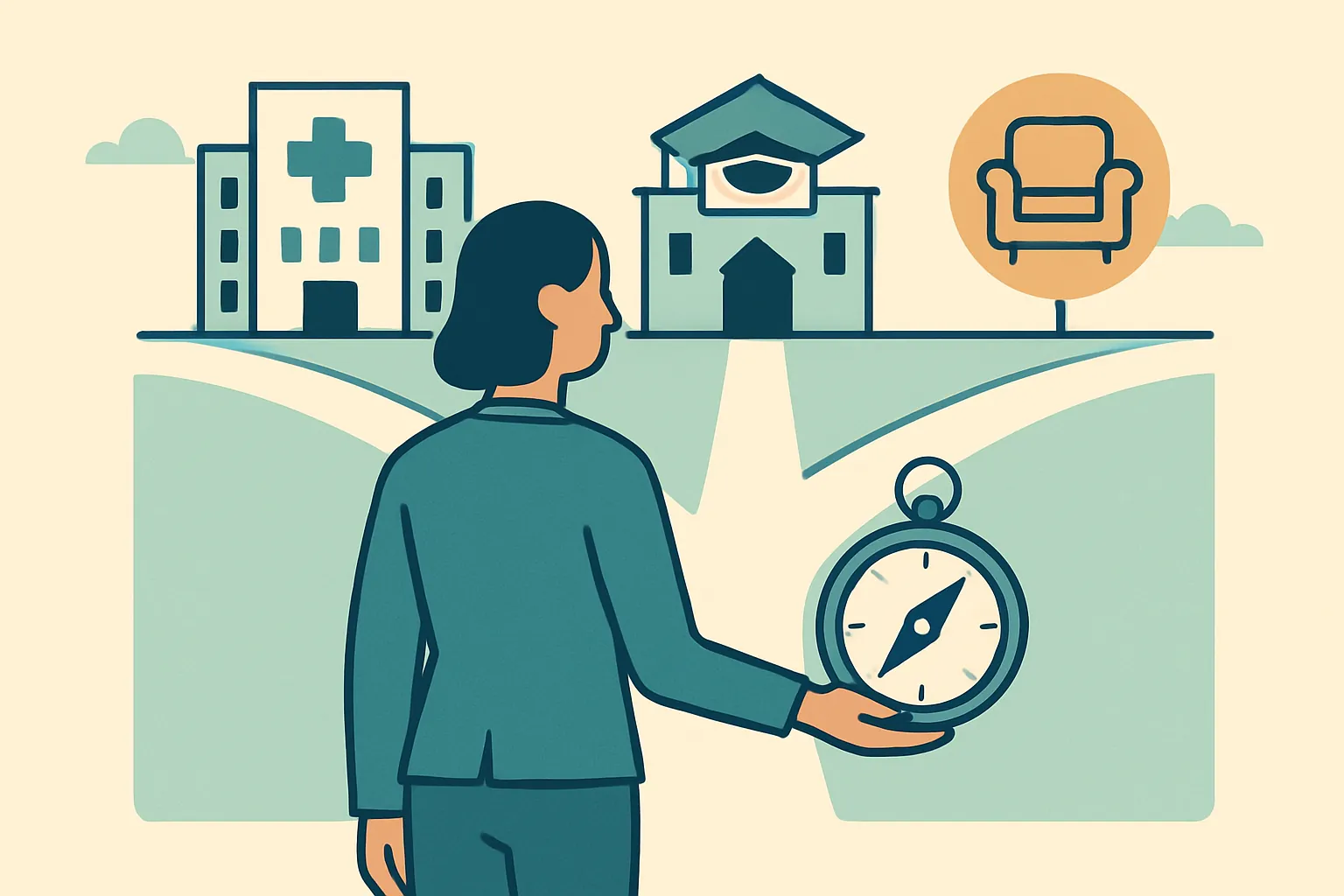
The New Counselor's Crossroads: Open a Practice, or Build Experience First? 🧭
You survived the supervised hours, the exam prep, and the long road to licensure—congratulations. For many clinicians, though, the relief is short-lived, replaced by a larger and more practical question: "Where do I go now?" The pull toward your own private space competes with a quiet worry that your clinical experience is still thin.
Here is what tends to hold true over a long career: the credential itself matters less than where you do your first real clinical work. The field you start in shapes your professional identity and, just as importantly, your capacity to respond when a session turns into a crisis. This guide compares three formative settings—hospitals, schools, and counseling clinics—and lays out what to take from each before you hang your own shingle.
Where Will You Build Your Clinical Stamina? (Hospital vs. School vs. Clinic)
Running a private practice means far more than being good in the room. You also carry marketing, administration, risk management, and ethical responsibility. That makes it essential to encounter a wide range of unfiltered, real-world cases—the kind supervised training rarely covers in full—before you're working without colleagues down the hall.
Each setting offers different soil for growth. Use the comparison below to weigh strengths and trade-offs against what you most need right now.
| Hospital (inpatient/clinical psych) | School counseling office/department | Private or community counseling clinic | |
|---|---|---|---|
| Typical clients | Clients with pronounced psychiatric symptoms, often alongside medication management | Children and adolescents presenting with academic, peer, and family concerns | Adults with relational issues, work stress, and personal-growth goals across a broad range |
| Core work | Psychological assessment (full battery), diagnosis, collaboration with medical teams | Brief counseling, crisis intervention, teacher/parent consultation, administration | Medium- to long-term therapy, group work, program design |
| Growth edge | Depth in psychopathology and diagnostic accuracy | Systems thinking (family/school) and rapid response to unexpected crises | Building the therapeutic relationship, session structure, and case conceptualization |
| Watch-outs | Assessment-report writing can crowd out actual therapy hours | Heavy administrative load and involuntary clients raise burnout risk | Pay and supervision structures vary widely with the organization's philosophy |
If private practice is the goal, aim to experience at least two of these settings. Sharpen your eye for diagnosis and assessment in a hospital, then develop your ability to form and sustain a working alliance in a clinic. Later, when you run your own practice, that combination lets you screen and refer clients with serious pathology appropriately—and carry the right clients into sustained, longer-term work.
Three Clinical "Tools" to Secure Before You Open
Logging hours in an agency doesn't automatically build skill. Adopt the mindset of a future practice owner and deliberately extract the competencies each setting is uniquely positioned to teach. Once you're solo, no colleague or supervisor is sitting beside you—so you need to build a seaworthy boat before you leave the harbor.
- A documented crisis-intervention protocol. When suicide or self-harm risk, suspected child abuse, or other legal and ethical issues arise, you need a protocol you can follow without freezing. Schools and public agencies surface these situations frequently, and that experience is strong insurance against the legal risk you'll one day carry alone. Know your jurisdiction's mandated-reporting laws cold—reporting thresholds, timelines, and the agencies you report to vary by state and country—and fold them directly into your protocol.
- A documentation system you trust. Many early-career counselors underestimate the administrative side. Progress notes, clinical summaries, and formal correspondence aren't tedious busywork—they're the evidence that documents client change and protects the clinician. Learn the structured templates your agency uses; they become the backbone of an efficient system when you run your own practice.
- A supervision and referral network. The greatest advantage of agency life is colleagues. Private practice can be isolating. While you're still embedded in a team, build relationships with trusted peers, supervisors, and psychiatric providers you can refer to. That network is essential infrastructure for delivering good care once you're on your own.
Raise the Quality of Care While Cutting the Paperwork
The most concrete wall you'll hit while building experience is time. After a full day of sessions, a mountain of session transcripts and reports is waiting. Many trainees and seasoned clinicians alike burn their energy re-listening to recordings and typing—rather than thinking about the client. If you're preparing for private practice, this is exactly where to build a better workflow and protect your capacity for clinical insight.
Clinical settings are increasingly adopting AI to address this. Tools that go beyond raw transcription—understanding the context of a session and surfacing what matters—help counselors stay in the role of therapist rather than documentation clerk.
- AI-assisted transcripts and progress notes. Right after a session, before memory fades, review an AI-generated draft for core affect, key client statements, and your own interventions. This dramatically shortens the time it takes to reconstruct a 50-minute session.
- Data-informed self-review. Use AI analysis to see, objectively, the words you reach for most, your question style (open vs. closed), and your talk-time ratio with clients. This is valuable material for supervision and a real boost to your metacognition.
- Security and ethics first. When choosing any AI tool, confirm rigorous client-privacy protection and data security. Modalia AI is built as a security-first partner for counselors—handling transcription, case conceptualization, and documentation—so that adopting technology strengthens, rather than compromises, your professional standards.
In Closing: Don't Rush—Build a Solid Foundation
Opening a practice isn't the finish line of a counseling career; it's the start of a different chapter. With a hospital's diagnostic sharpness, a school's crisis readiness, and a clinic's flexible relational skill, the practice you eventually open can become a space clients genuinely trust to heal in.
So don't let impatience set in if private practice isn't happening yet. Every client you meet across these settings is a teacher, and the demanding hours you spend with them become the roots that hold you steady later. Along the way, let modern AI lighten the repetitive load of administration and recordkeeping—so you can spend your attention where it belongs: on the client in front of you. Prepared counselors are the ones who shine, even in a crisis.
Frequently asked questions
Should I open a private practice right after getting licensed?
Most early-career counselors benefit from gaining clinical experience in an agency setting first. Private practice carries the full weight of risk management, documentation, and ethical responsibility with no colleagues nearby, so building a foundation across one or more settings makes for a safer, more sustainable launch.
Which clinical setting is best for a new counselor?
There is no single best setting—each builds different competencies. Hospitals deepen psychopathology knowledge and diagnostic skill, school counseling offices develop crisis intervention and systems thinking, and counseling clinics cultivate the therapeutic relationship and case conceptualization. Experiencing at least two is ideal before private practice.
What competencies should I secure before going into private practice?
Three matter most: a documented crisis-intervention protocol aligned with your local mandated-reporting laws, a documentation system you trust for progress notes and clinical summaries, and a network of trusted supervisors, peers, and psychiatric providers for referrals.
Are AI tools safe to use for counseling documentation?
They can be, provided you choose a tool with rigorous client-privacy protection and data security. Used well, AI-assisted transcription and progress notes reduce repetitive recordkeeping and free up time for clinical insight—but vetting the security posture of any tool is non-negotiable.
This article was written and reviewed using Modalia AI's clinical guidelines, with professional human review before publication.
Related articles
 Clinical Skills
How to Write Better Supervision Questions: Getting What You Actually Need from Your Supervisor
Stuck on what to ask in supervision? Use these structured question strategies to turn vague check-ins into focused clinical insight.
7 min read Clinical Skills
From "The Client Seems Depressed" to a Clinical Hypothesis: How Word Choice Elevates Your Case Reports
Turn vague observations into precise clinical hypotheses. A practical guide to terminology and sentence formulas that make your case reports read like expert work.
7 min read Clinical Skills
The Wounded Healer Trap: Why "I Want to Heal Myself" Sinks Your Counseling Grad School SOP
Why admissions faculty flinch at "I want to heal my own wounds"—and how to transform personal pain into a research-grade statement of purpose that gets you in.
6 min read