From "I Just Want to Be Happy" to "Walk Twice a Week": The Art of Concrete Goal Setting
Turn vague client wishes into observable, trackable behavioral goals — three clinical techniques that sharpen the working alliance and drive real outcomes.
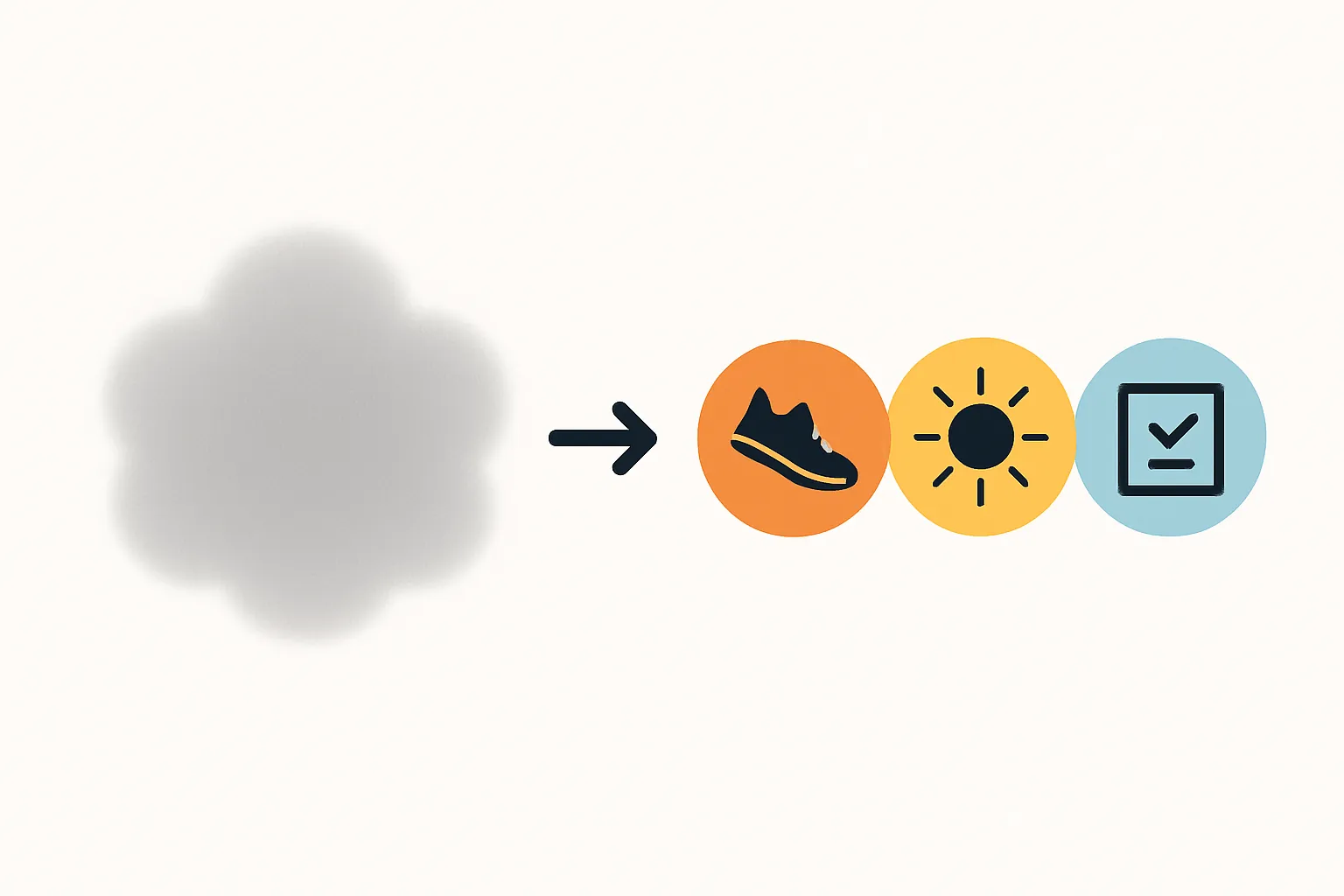
Key takeaway
Abstract requests like "I want to be happy" or "I wish I weren't anxious" describe outcome states that are hard to measure or control, so they can't function as workable counseling goals on their own. Per Bordin's working alliance theory, when counselor and client never agree on a concrete goal, therapy drifts no matter how strong the rapport. The fix is to operationally define the wish as observable behavior — using the video-camera question, a scaled-down "first sign" variation of the miracle question, and values-linked action goals — and then to track those agreed-upon behaviors relentlessly in later sessions, because that follow-up is what determines effectiveness.
What Do You Say to the Client Who Just Wants to Be "Happy"?
A client settles into the chair, and you ask the opening question: "What do you hope to get out of our work together?" Nine times out of ten, the answer is some version of "I just want to be happy," "I wish I weren't so anxious," or "I want to find myself again."
If a small knot tightens in your chest when you hear those phrases, you are not alone. You can feel the client's longing, but where exactly do you begin? And when therapy ends, what is the benchmark that lets either of you say it "worked"? That uncertainty is one of the most universal clinical dilemmas in our field — and it is also the hinge on which a course of treatment swings.
Edward Bordin, whose work shaped how we think about the therapeutic relationship, named three components of the working alliance: the bond, the tasks, and the goals. His point is easy to underestimate. If counselor and client never converge on a concrete goal, even excellent rapport leaves the work adrift. The ability to translate "I want to be happy" into something like "a 30-minute walk, twice a week" is not a clerical step — it is a core clinical competency. This article lays out how to convert vague presenting concerns into clinically meaningful behavioral goals, and how doing so strengthens both the alliance and the client's sense of momentum.
Why "Happiness" Can't Be a Goal: The Clinical Trap of Vagueness
When a client names "happiness," "peace," or "confidence," they are describing an outcome state rather than a goal. Set those states up as the target of treatment and you inherit two problems: they are not measurable and they are not directly controllable.
That second problem matters clinically. When people try to control what they cannot control, they tend to feel more helpless and more anxious, not less. There is a genuine paradox here: making "eliminate my anxiety" the goal can itself raise the client's anxiety, because every flicker of anxious feeling now registers as failure.
The way out is operational definition — the same move researchers make when they specify how an abstract variable will be observed and measured. In the consulting room, translating an abstract wish into observable behavior is itself therapeutic. The moment a formless distress becomes a concrete, doable task, the client begins to recover a sense of control over their own life.
Vague Goals vs. Behavioral Activation Goals
The table below shows how a client's initial presenting concern (a vague goal) can be reworked into a clinically meaningful behavioral goal. This kind of reframing sits at the heart of cognitive behavioral therapy (CBT) and solution-focused brief therapy (SFBT).
| Client's initial statement (abstract) | Clinical question (the exploration) | Reframed goal (behavioral / concrete) | Intended effect |
|---|---|---|---|
| "I want to feel self-assured around people." | "If you felt self-assured, what would you actually do in a meeting that you don't do now?" | "Offer at least one idea in every weekly team meeting." | Graded exposure; greater self-efficacy |
| "I want my depression to lift." | "If the heaviness dropped from a 10 to a 5, how would you be spending your Saturday morning?" | "Get up at 10 a.m. Saturday and walk in the neighborhood park for 20 minutes." | Behavioral activation; restored daily rhythm |
| "I want things to be better with my partner." | "Back when things were good, what kinds of conversations happened over dinner?" | "Twice a week, phones off at dinner, share 10 minutes about each other's day." | Reinforced positive interaction; revised relational pattern |
Table 1. Examples of converting abstract requests into concrete behavioral goals.
Three Practical Techniques for Sharpening Counseling Goals
So how do you actually steer the conversation in session? Simply pressing the client to "be more specific" can feel like pressure and shut things down. Here are three techniques that refine a goal gently but clearly.
-
Use the Video-Camera Question
Try asking: "If a video camera were following you through an ordinary day, what would the lens show me that tells us you've become 'happier'?" A camera can't film an internal feeling. It can only capture behavior, facial expression, and tone of voice. The question quietly redirects the client from inner states to observable action. If the answer is "I'd be smiling," follow the thread: "Who are you with, and what are you doing, when you're smiling?" — until you have a concrete context to work with.
-
Adapt the Miracle Question: Find the Smallest First Sign
The solution-focused miracle question is well known, but it can feel too grand for some clients. Scale it down: "After the miracle, what is the very first, almost trivial sign that something has started to change?" The aim is not a sweeping transformation but a micro-goal — getting up the first time the alarm sounds, drinking a glass of water before bed. Small wins have to accumulate before the brain's reward circuitry engages and real momentum builds.
-
Go Beyond SMART: Link the Goal to a Valued Action
A goal that stays purely mechanical ("take a walk") wears thin quickly. Connect the behavior to the client's core values. "Walking" isn't just exercise; it is a way of enacting something the client cares about — a healthy life, or a sense of freedom. As acceptance and commitment therapy (ACT) emphasizes, behavior that aligns with one's values carries the power to make discomfort worth tolerating.
The Counselor's Job: Record, Track, Give Feedback
Setting a great behavioral goal with the client is not the finish line. A challenge many counselors know well: the specific goal set last session gets forgotten, or quietly fizzles out. Presenting concerns shift from week to week, and across a full caseload it is easy to lose the thread of one client's particular task.
If you agreed on "walk twice a week" and then open the next session only with "How was your mood last week?", the client learns that the goal didn't really matter. Instead, ask for it directly: "We'd planned walks on Wednesday and Friday — when you tried it, what was that like for you?" This kind of persistent follow-up is what determines whether therapy is effective.
Realistically, though, perfectly recalling 50 minutes of conversation and checking every goal quantitatively, week after week, costs enormous energy. Progress notes alone can eat up an hour. To capture both a client's subtle nuance and the precise goals you agreed on, you can't rely on memory alone.
Conclusion: Raise the Quality of Care With Data-Informed Goals
Sharpening a counseling goal is not wordplay. It is the work of pulling a client out of an open sea of undefined suffering and handing them a map of action they can navigate under their own power. When the abstract noun "happiness" becomes the verb "walk," change can finally begin.
This is also where smart tools can support the work rather than replace it. To avoid losing the offhand clue ("actually, I do kind of like walking") or the task you set last week ("ten minutes of meditation a day"), consider letting technology carry some of the cognitive load:
- An AI-assisted documentation and session-transcript tool can surface the key themes and behavioral goals a client mentioned, and summarize them, so nothing slips through.
- With less pressure to scribble notes, you can stay with the client's eyes and the here-and-now of the interaction.
- And when accumulated data lets you show a client their progress toward a goal visually, motivation tends to multiply.
Modalia AI is built for exactly this — a security-first AI partner for counselors that handles transcription, case conceptualization support, and documentation, so the agreed-upon goal doesn't depend on memory alone. Pair your capacity for warm, accurate empathy with reliable tracking, and the "happiness" a client longed for stops being a distant dream and becomes something they can practice today. Start now: translate one of your client's vague sentences into the language of action.
References
- 1.
Frequently asked questions
Why can't "I want to be happy" work as a counseling goal?
Happiness, calm, and confidence are outcome states rather than goals — they are hard to measure and not directly controllable. Trying to control an uncontrollable state often increases helplessness and anxiety, so the wish has to be operationally defined as observable behavior before it can guide treatment.
What is the video-camera technique?
You ask the client what a camera following them through an ordinary day would actually show that signals they've improved. Because a camera can only capture behavior, expression, and tone — not inner feeling — the question redirects the client from abstract internal states toward concrete, observable actions you can build a goal around.
How does Bordin's working alliance relate to goal setting?
Bordin described the working alliance as having three components: the bond, the tasks, and the goals. Strong rapport alone isn't enough — if counselor and client never agree on a concrete goal, therapy drifts. Mutual agreement on a specific, behavioral goal is what gives the alliance direction.
How should I follow up on behavioral goals in later sessions?
Ask about the specific agreed-upon behavior, not just general mood. Instead of "How was your week?", ask "We planned walks on Wednesday and Friday — when you tried it, what was that like?" This persistent, specific follow-up signals that the goal matters and is a key driver of therapeutic effectiveness.
This article was written and reviewed using Modalia AI's clinical guidelines, with professional human review before publication.
Related articles
 Case Conceptualization
Breaking the "Yes, But" Game: A Transactional Analysis Guide for Therapists
Every suggestion you offer gets met with "Yes, but..." Here's the TA structure behind that stall—and four clinical moves to break it.
7 min read Case Conceptualization
Yalom's The Gift of Therapy: Passages Every New Counselor Should Copy by Hand
Irvin Yalom's prescription for therapists who fear silence: meet your client as a "fellow traveler" and let the here-and-now become the heart of the work.
6 min read Case Conceptualization
Working With Silence in Therapy: What Client Silence Means and How to Hold It
Silence in session isn't empty space. Learn to read its clinical meaning, tell productive from defensive silence, and use it as a therapeutic tool.
6 min read