Conduct Disorder vs. Oppositional Defiant Disorder: A Family-Systems Guide to Adolescent Antisocial Behavior
Is it ordinary teen rebellion or a clinical disorder? A clinician's guide to the family dynamics behind ODD and conduct disorder—and what actually shifts them.
Key takeaway
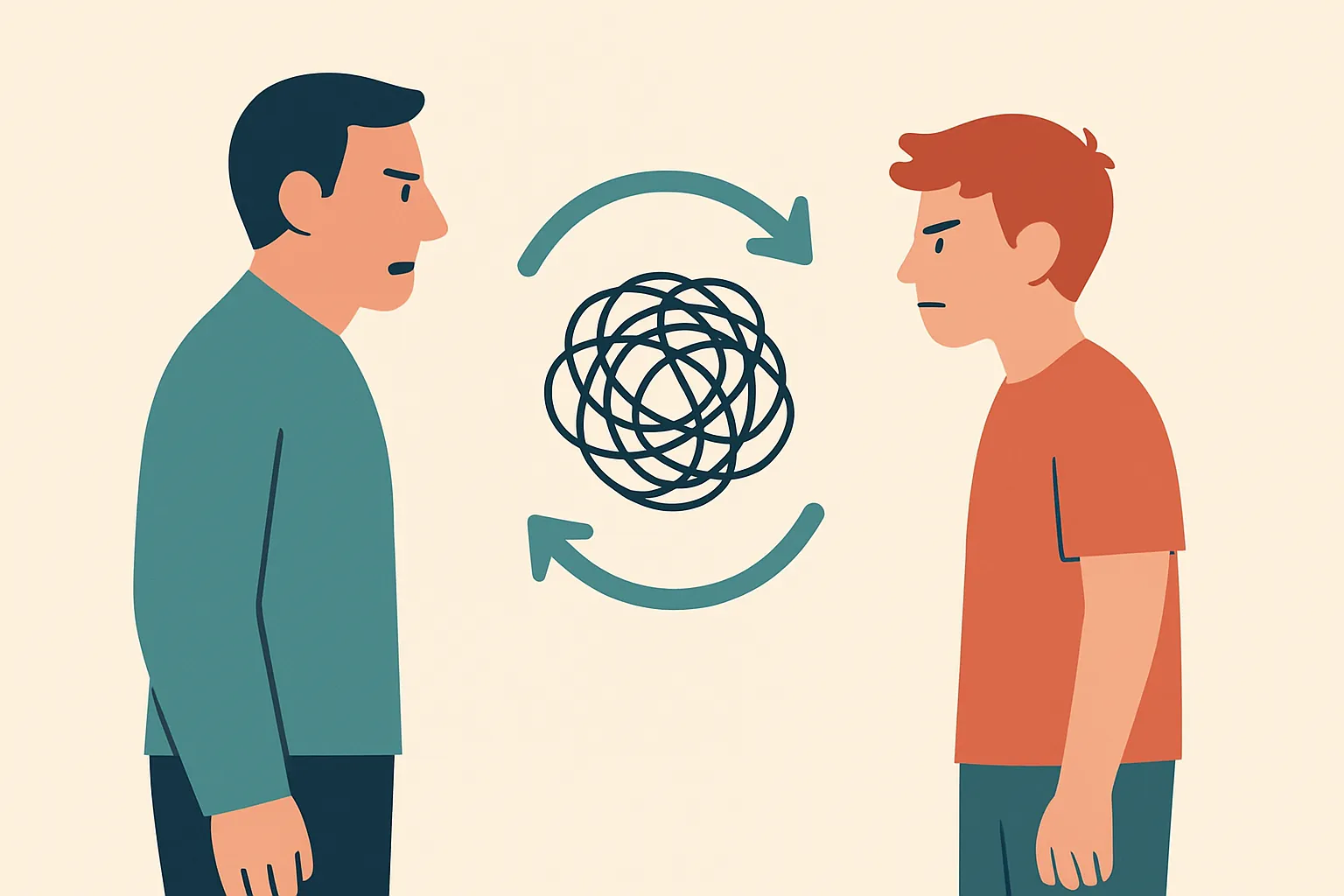
Oppositional defiant disorder (ODD) and conduct disorder (CD) both fall under disruptive behavior problems, but the family dynamics that sustain them differ. ODD centers on power struggles and resistance to authority, while CD is more often marked by lapses in parental monitoring and early attachment disruption. Patterson's coercive family process explains how negative reinforcement locks oppositional behavior into a self-perpetuating loop that migrates from home to peer relationships. The most effective interventions are parent management training, multigenerational work using a genogram, and functional family therapy that reframes the symptom within the family system.
Ordinary Teen Rebellion or a Clinical Problem? Reading the Family Behind the Behavior
If you work with adolescents, you have almost certainly sat across from a parent who says, in effect, "I have completely lost control of my child." The room fills with helplessness. And as clinicians, we face a genuinely difficult discrimination: when a teenager moves past garden-variety adolescent pushback into violating others' rights or persistently defying authority, is this the normal turbulence of development—or is it a clinical picture that meets criteria for oppositional defiant disorder (ODD) or conduct disorder (CD)?
The distinction matters, and not only for diagnosis. Our job is not to correct a behavior in isolation but to understand the family dynamics that produce and maintain it. Parenting style, marital conflict, and the family's communication patterns are inseparable from a young person's acting-out. The hardest question in this work is rarely "What is the child doing?" It is "How do we interrupt the loop the whole family is caught in?" This article looks at ODD and CD through a family-systems lens and offers concrete intervention strategies you can take into the room.
ODD and CD Share a Category—But Not a Family System
Both disorders sit within the DSM-5-TR grouping of disruptive, impulse-control, and conduct disorders. But the dynamics that present in the family differ in subtle, clinically important ways. ODD is driven mainly by reactivity to authority and difficulty regulating affect; CD is defined by violation of social norms and aggression toward others. Telling them apart is essential to setting the right goals for family work. Research consistently identifies inconsistent discipline and coercive interaction as the key mediators along the pathway from ODD to CD.
ODD: The Family as a Battlefield of Power
In families of a child with ODD, you see a relentless power struggle. The parent tries to assert control; the child resists and pushes for autonomy. When the parent is simultaneously controlling and low in warmth, the child learns to win attention—or simply to "win"—through negative, oppositional behavior. The conflict is loud, frequent, and organized around everyday rules: homework, curfew, screens.
CD: Absent Supervision and Damaged Attachment
In families where a teenager has progressed to CD, the more striking feature is often an absence of parental monitoring. Parents may not know—or may not track—where the child is or who they spend time with. Frequently there is serious early attachment disruption underneath, and the emotional climate of the home does little to cultivate empathy for others' distress. Discipline, when it appears, tends to swing between neglect and harsh, even physical, punishment.
Table 1. ODD vs. CD: family dynamics and clinical features
| Oppositional Defiant Disorder (ODD) | Conduct Disorder (CD) | |
|---|---|---|
| Core symptoms | Angry/irritable mood, argumentative and defiant behavior, vindictiveness | Aggression toward people/animals, destruction of property, deceit/theft, serious rule violations |
| Primary family conflict | Resistance to authority; verbal battles over daily rules (homework, curfew) | Parental neglect or excessive physical punishment, often surfacing around social/legal trouble |
| Parenting style | Inconsistent discipline, highly reactive affect, over-involvement | Rejecting stance, lack of supervision, alternating harsh punishment and neglect |
| Clinical focus | Repairing the parent–child relationship; coaching emotion regulation | Behavior change, strengthening parental monitoring, multisystemic therapy (MST) |
Patterson's Coercive Family Process: The Loop That Trains Defiance
One of the most powerful explanations of adolescent antisocial behavior is Gerald Patterson's coercive family process—and it is also the pattern you will observe most often when you watch a family interact in session. At its heart is the trap of negative reinforcement.
The Micro-Social Coercive Cycle
A parent issues a command: "Clean your room." The child ignores it or responds with irritation (an aversive stimulus). The parent raises their voice. The child escalates—shouting back, throwing something (a more intense aversive stimulus). Exhausted, the parent withdraws the demand: "Fine, do whatever you want." In that moment the child learns a rule: escalate hard enough and the demand disappears. The behavior is reinforced. And the parent, too, is reinforced—the conflict stops, they get a moment of relief—so the faulty interaction calcifies on both sides.
The Macro Outcome: Antisocial Behavior Gets Socialized
These coercive exchanges don't stay home. The aggressive coping style the child rehearses with parents gets carried into school and peer settings, where it produces peer rejection and academic failure. Increasingly excluded, the young person drifts toward a deviant peer group of similarly struggling youth—and it is there that full-blown conduct disorder often consolidates.
Intervention Strategies: Breaking the Loop and Rebuilding the Relationship
So how do we intervene in a dynamic this entrenched? Talking the child down or lecturing the parents is not enough. The work has to be structured and strategic.
1. Parent Management Training (PMT): Re-engineering the Interaction
The most robust evidence-based treatment here is parent management training. Coach parents in the specifics: give clear, concrete instructions; reinforce small positive behaviors immediately; favor loss of privileges (time-out, removing access) over punishment. The crucial shift is helping the parent deliver consistent consequences without an emotional reaction. That teaches the child a new contingency: escalation no longer works.
2. A Multigenerational Lens: The Parent's Unfinished Business
Often a parent's own difficulties—depression, alcohol dependence, antisocial traits—or unresolved marital conflict gets in the way of effective parenting. Use a genogram to explore whether antisocial patterns are being transmitted across generations. Helping a parent gain insight into the parenting they received in their family of origin, and into the hostility they may be projecting onto their child, is frequently a precondition for any behavioral change to stick.
3. Functional Family Therapy (FFT): From Blame to Function
FFT moves the family away from blaming one another and toward asking what function the problem behavior serves within the system. If a child's acting-out reliably interrupts the parents' fighting, for example, then the symptom will persist until the marital conflict itself is addressed. Peeling off the "problem child" label and reframing the behavior as a symptom of the family system is one of the most useful moves available to us.
Conclusion: The Clinician as Choreographer
Conduct disorder and oppositional defiant disorder are never the story of one child alone; they are a complex drama the whole family is entangled in. Our role is closer to that of a choreographer—helping parent and child learn a new dance. Catching the micro-level coercive exchanges, and restoring the parent's sense of competence, is the core of the work.
In that effort, the precision of your clinical record and the depth of your analysis matter enormously. In family work—especially the emotionally charged sessions typical of adolescent treatment—it is easy to miss a fleeting nonverbal cue or a momentary shift in the interaction. This is one place where a security-first AI partner like Modalia AI can quietly strengthen the work: accurate transcription, support for case conceptualization, and documentation that frees your attention for the room. Reviewing an objective record of who spoke when, where conflict language clustered, and how affect shifted can surface the subtle change in a parent's tone or the child's avoidance that you didn't have the bandwidth to log—so you walk into the next session with a sharper hypothesis and a more precise plan.
References
- 1.
- 2.
- 3.
- 4.
Frequently asked questions
What is the key difference between ODD and conduct disorder in family terms?
ODD typically presents as an ongoing power struggle—reactive parenting, inconsistent discipline, and loud conflict over daily rules. Conduct disorder is more often marked by absent parental monitoring and underlying attachment disruption, with discipline swinging between neglect and harsh punishment. The progression from ODD to CD is mediated chiefly by inconsistent discipline and coercive interaction.
What is Patterson's coercive family process?
It describes how negative reinforcement traps a family in escalating conflict. A child escalates against a parental demand until the parent gives up; the child learns that escalation removes demands, and the parent is relieved when conflict stops. Both sides are reinforced, the pattern hardens, and the child's aggressive coping style then transfers to school and peer relationships.
Which interventions are most effective for adolescent conduct problems?
Parent management training (PMT) is the strongest evidence-based approach, teaching consistent, non-reactive consequences. Multigenerational work with a genogram addresses parental factors and transmitted patterns, and functional family therapy reframes the behavior as a symptom of the wider family system rather than the fault of one 'problem child.' Multisystemic therapy (MST) is also indicated for more severe CD.
This article was written and reviewed using Modalia AI's clinical guidelines, with professional human review before publication.
Related articles
 Case Conceptualization
Breaking the "Yes, But" Game: A Transactional Analysis Guide for Therapists
Every suggestion you offer gets met with "Yes, but..." Here's the TA structure behind that stall—and four clinical moves to break it.
7 min read Case Conceptualization
Yalom's The Gift of Therapy: Passages Every New Counselor Should Copy by Hand
Irvin Yalom's prescription for therapists who fear silence: meet your client as a "fellow traveler" and let the here-and-now become the heart of the work.
6 min read Case Conceptualization
Working With Silence in Therapy: What Client Silence Means and How to Hold It
Silence in session isn't empty space. Learn to read its clinical meaning, tell productive from defensive silence, and use it as a therapeutic tool.
6 min read