5 Core Techniques for Managing Anxiety: A CBT, ACT, and Relaxation Toolkit for Early-Career Clinicians
Five evidence-based, ready-to-use techniques—drawn from CBT, ACT, and somatic relaxation—so you never freeze when a client presents with anxiety.
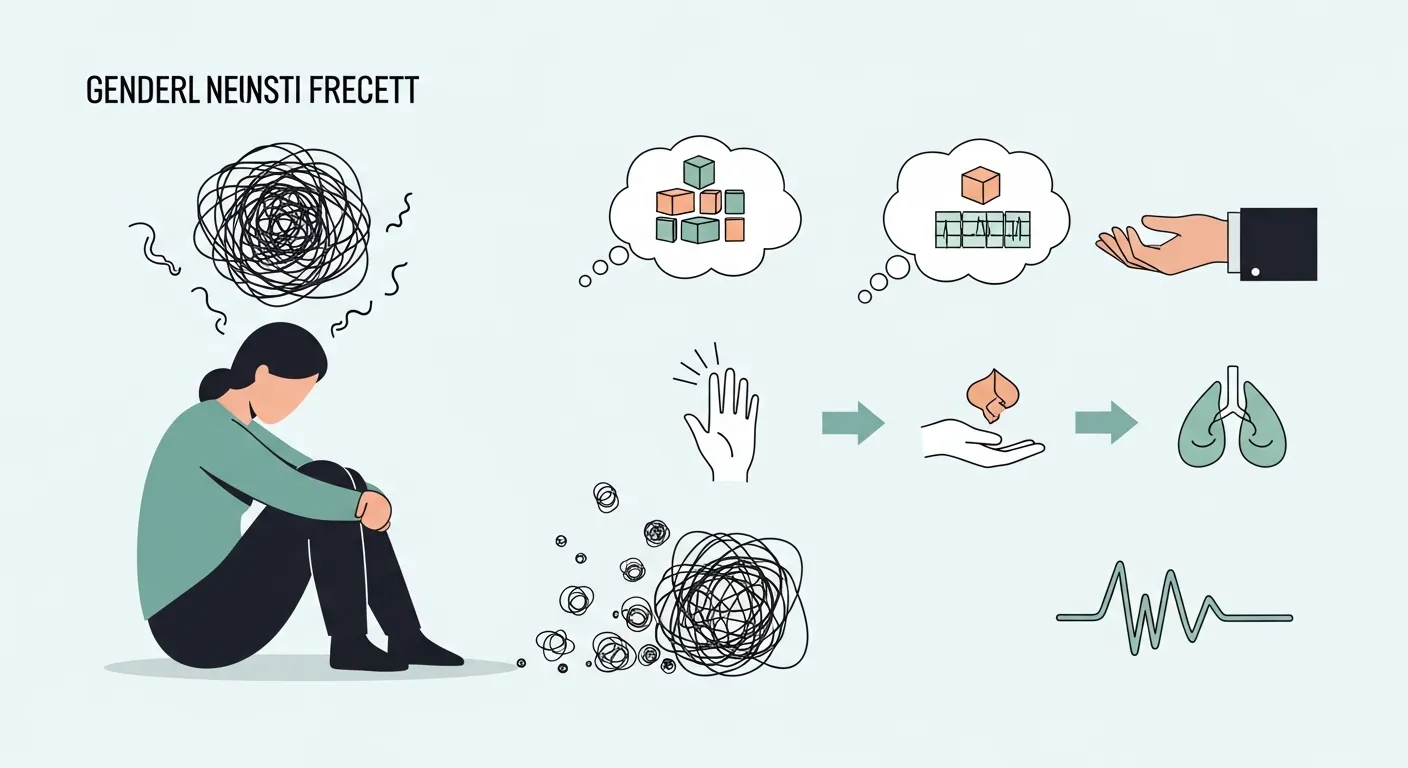
Key takeaway
Anxiety is the single most common presenting concern in clinical practice, and giving clients a quick, felt sense that anxiety is manageable is where the working alliance begins. CBT tools like Socratic questioning and decatastrophizing test irrational beliefs and shrink vague dread into solvable problems, while ACT's cognitive defusion builds psychological flexibility by creating distance from anxious thoughts rather than fighting them. Somatic methods—progressive muscle relaxation and box breathing—deliver immediate downregulation even when the amygdala is hijacked. The clinical art lies in matching the right technique to the right client.
When a Client Says "I'm So Anxious I Can't Function"—How to Stay Grounded
Of everyone who walks through your office door, clients whose chief complaint is anxiety make up the largest share. If you're early in your career, you may remember the helplessness of sitting across from someone who is hyperventilating, visibly panicked, demanding that you "just make this feeling stop—now." In those moments the clinician often catches the anxiety too: your own heart speeds up, and every framework you studied seems to vanish from your mind.
Anxiety is a survival emotion, but pathological anxiety can paralyze a life. A consistent theme across the clinical literature is that effective anxiety treatment depends heavily on how quickly and convincingly the clinician can instill a sense of self-efficacy—the felt belief that anxiety is something the client can influence and regulate. Sophisticated case conceptualization matters, but in the first sessions, what cements the therapeutic alliance is putting an immediate tool in the client's hands so they aren't overwhelmed by a panic attack or anticipatory anxiety the moment they leave your office.
This article lays out five core, evidence-based techniques for working with anxiety that even a new clinician can deploy right away. They're organized into three approaches—cognitive, acceptance-based, and somatic—with guidance on which tool to reach for depending on the client's level of distress and temperament.
Cognitive Approach: Testing the Substance of Anxiety with CBT (Techniques 1 & 2)
Traditional cognitive behavioral therapy (CBT) excels at catching and revising the irrational beliefs that fuel anxiety. When a client is swept up in a diffuse fear, your job is to help them make the thought concrete and strengthen their reality-testing. The two techniques below can be used from the very first session.
1. Socratic Questioning: Evidence Checking
Highly anxious clients mistake possibility for fact. Your role is to help them discover the contradiction themselves through questions—not to reassure. Simply saying "It'll be fine" rarely lands. Try instead:
- "On a scale from 0 to 100%, how likely is it that this actually happens?"
- "In the past, when you've worried like this, how often did the thing you feared actually occur?"
- "What's the evidence that this anxious thought is true—and what's the evidence that it isn't?"
2. Decatastrophizing: The "And Then What?" Technique
Use this when a client is frozen in front of an imagined worst-case scenario. Instead of letting them avoid the feared outcome, you walk them all the way through it so they discover it's less catastrophic than it felt.
- Clinician: "If you did fail the exam, what would happen?"
- Client: "I wouldn't be able to get a job."
- Clinician: "And if you didn't land a job right away, what happens next? In the absolute worst case, what becomes of your life?"
Following the chain to its end pulls vague dread down into the territory of concrete, solvable problems—and the intensity of the anxiety drops with it.
Acceptance Approach: Creating Distance Instead of Fighting (Technique 3)
Not every anxious thought can be argued away with logic. Sometimes the harder a client tries to suppress anxiety, the more it amplifies through a rebound effect. This is where acceptance and commitment therapy (ACT) becomes useful. The pivot is from control to acceptance.
3. Cognitive Defusion
Clients fuse with their anxious thoughts—they become the thought ("I'm a failure"). Defusion opens up space between the person and the thought.
- "I'm having the thought that…" phrasing: Instead of "I'm going to fail," the client says, "I'm having the thought that I'm going to fail."
- Visualizing the thought: Invite the client to picture an anxious thought as a passing cloud, or a leaf floating down a stream, and simply watch it. This shifts them out of the seat of the sufferer and into the seat of the observer.
In practice, you'll need to judge quickly whether CBT or ACT fits a given client better. The table below maps the difference.
| Dimension | CBT Approach | ACT Approach |
|---|---|---|
| Goal | Revise the content of anxiety-provoking thoughts; reduce symptoms | Change the relationship to anxious thoughts; build psychological flexibility |
| Core strategy | Dispute irrational beliefs, reality-test, cognitive restructuring | Acceptance, cognitive defusion, commitment to values |
| Best-fit client | Can reason logically and wants concrete problem-solving | Has a strong need for control and is exhausted from fighting anxiety; chronic anxiety |
| Sample clinician line | "What's the evidence that thought is true?" | "Can you make room for that anxious feeling, just as it is?" |
Table 1. Clinical comparison of CBT and ACT approaches to anxiety.
Somatic Approach: Sending the Body a Safety Signal (Techniques 4 & 5)
When anxiety spikes and the amygdala is hyperactivated, even the most elegant cognitive intervention can't reach the verbal, prefrontal brain. Here you need bottom-up processing—using bodily sensation to send the brain a "you are safe" signal.
4. Progressive Muscle Relaxation (PMR)
PMR teaches clients to feel the contrast between tension and release. Clenching a fist, shrugging the shoulders—tense the muscle for about five seconds, then let it drop loose for ten, with a cue like "focus on the sensation of the tension draining away." Practice it together in session for about five minutes, then send the client home with a recorded track or written script as homework.
5. Box Breathing and Grounding
This is your go-to for a client who is hyperventilating in the room. Breathe in for four counts, hold for four, exhale for four, hold for four—repeat. The pattern activates the parasympathetic nervous system and brings the heart rate down quickly. Pairing it with a grounding exercise—"name five things you can see, four things you can hear"—is especially effective for bringing a dissociating client back to the here and now.
Conclusion: Precise, Data-Informed Intervention—and Where AI Helps
These five tools—drawn from CBT, ACT, and somatic relaxation—belong in every clinician's kit. But knowing the techniques matters less than knowing which technique worked for this client, and when. One client finds insight through Socratic questioning; another feels interrogated by it and digs in. Effectiveness comes from closely reviewing the client's response, session by session.
The problem is that progress notes and transcription often eat the very time you'd otherwise spend on clinical analysis. This is where a security-first AI partner built for counselors—Modalia AI—can give that time back. With accurate session transcripts handled for you, you can:
- Analyze responsiveness: Review exactly how a client responded—verbally, or in the length of their silences—right after you tried a specific technique like decatastrophizing.
- Surface patterns: Let the system pull out recurring "anxiety keywords" a client returns to, so you can identify core irrational beliefs faster and adjust the treatment plan.
- Strengthen supervision: An accurate transcript gives your supervisor a sharper basis for feedback—which feeds directly back into your own growth as a clinician.
A counselor should never become a mechanical applier of techniques. But with the right support, you can become a true scientist-practitioner—someone who uses technology to make their own interventions more objective. In your next session, resist being swept up in the client's anxiety. Choose one of these five techniques, apply it with clarity, then document and study the result.
FAQ
Frequently asked questions
How do I decide between a CBT and an ACT approach for an anxious client?
Reach for CBT when a client can reason logically and wants concrete problem-solving—Socratic questioning and decatastrophizing test the content of their fears. Reach for ACT when a client has a strong need for control, is exhausted from fighting anxiety, or presents with chronic worry; cognitive defusion changes their relationship to the thought rather than its content.
What can I do when a client is too activated for cognitive techniques to land?
When anxiety spikes and the amygdala is hyperactivated, verbal, prefrontal interventions can't get through. Switch to bottom-up, somatic tools: box breathing (in for four, hold four, out for four, hold four) to activate the parasympathetic system, paired with grounding such as naming five things you can see and four you can hear.
Why is instilling self-efficacy so important early in anxiety treatment?
Giving a client a quick, felt sense that anxiety is something they can influence builds the working alliance and reduces the risk that they'll be overwhelmed by panic or anticipatory anxiety between sessions. An immediate, usable tool often does more for early engagement than a fully developed case conceptualization.
What's the simplest decatastrophizing question to start with?
Ask "And then what?" repeatedly. Follow the feared outcome all the way to its end point—"In the absolute worst case, what becomes of your life?"—so the client discovers the scenario is more concrete and survivable than the vague dread suggested.
This article was written and reviewed using Modalia AI's clinical guidelines, with professional human review before publication.
Related articles
 Case Conceptualization
Breaking the "Yes, But" Game: A Transactional Analysis Guide for Therapists
Every suggestion you offer gets met with "Yes, but..." Here's the TA structure behind that stall—and four clinical moves to break it.
7 min read Case Conceptualization
Yalom's The Gift of Therapy: Passages Every New Counselor Should Copy by Hand
Irvin Yalom's prescription for therapists who fear silence: meet your client as a "fellow traveler" and let the here-and-now become the heart of the work.
6 min read Case Conceptualization
Working With Silence in Therapy: What Client Silence Means and How to Hold It
Silence in session isn't empty space. Learn to read its clinical meaning, tell productive from defensive silence, and use it as a therapeutic tool.
6 min read