When the Client Won't Come Out: Counseling Parents of Socially Withdrawn (Hikikomori) Adults
How to open a door that stays shut: family-systems strategy, home-visit (outreach) protocols, and clinical boundaries for treating severe social withdrawal.
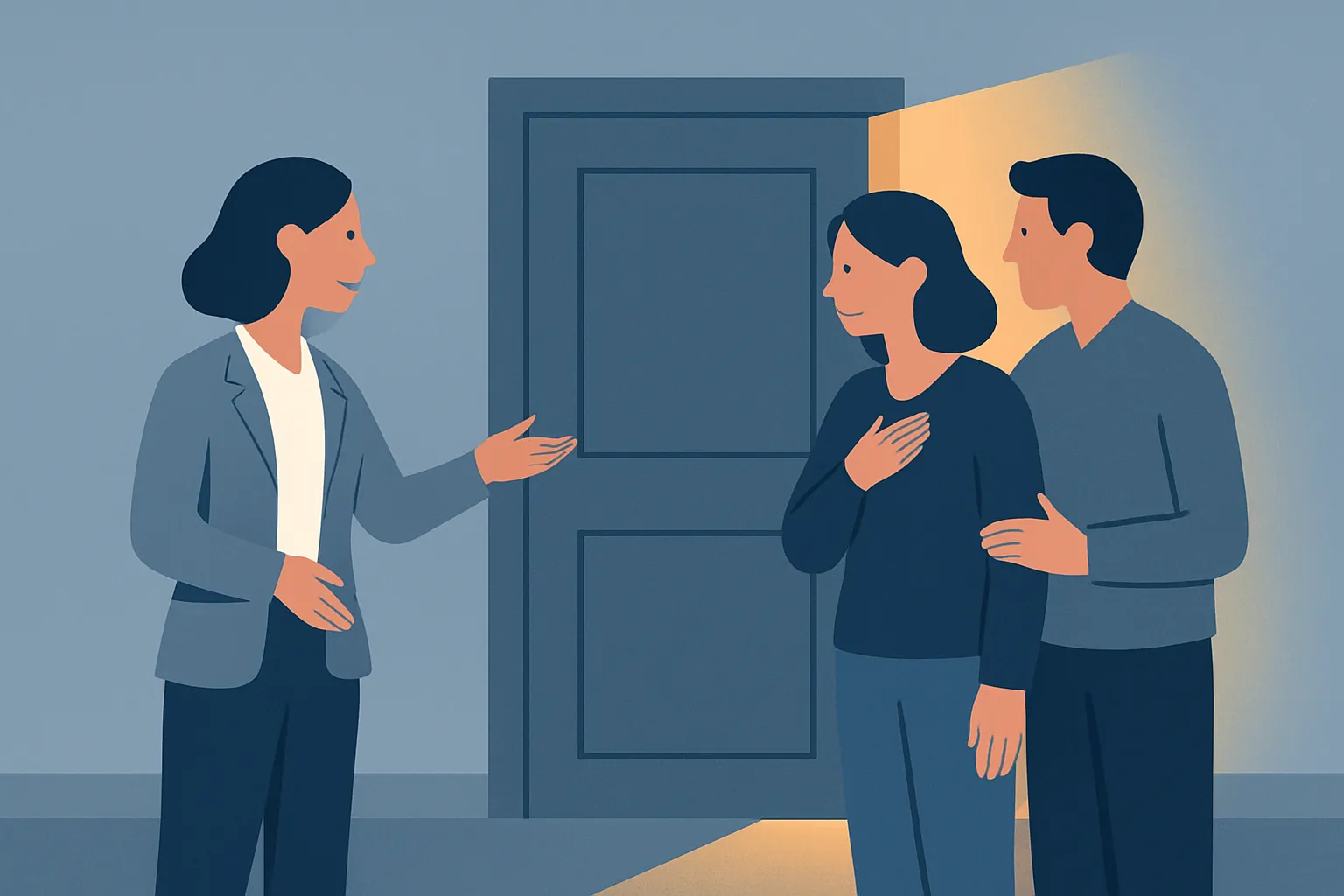
Key takeaway
When you counsel a family with a severely withdrawn (hikikomori) adult child, treat the withdrawal not as isolated individual pathology but as a symptom of the whole family system. Codependency, double-bind communication, and internalized shame all reinforce the retreat. The clinical work is to recast parents as co-therapists, train non-coercive connection strategies (regular knocks, notes under the door), and—during any home visit—hold firm clinical boundaries that validate the young person's distress while setting clear limits on harmful behavior.
The Parents at the Closed Door: Home-Visit and Clinical Strategy for Families Affected by Severe Social Withdrawal
You are used to greeting the client who walks through your office door. But what do you do when the person who most needs help will never walk out of theirs?
Severe, prolonged social withdrawal—the pattern widely known by its Japanese name, hikikomori, and now formally recognized in ICD-11 as a condition of pathological social isolation—has surged in the years since the pandemic. The longer an adult child stays sealed in their room, the deeper the parents' despair runs, and the more the entire family system tends to calcify around the symptom.
Clinicians face a real dilemma here. Can parent-only sessions accomplish anything if the identified client refuses to attend? If I conduct a home visit (outreach), how do I manage safety risk and therapeutic boundaries on someone else's territory? These are not just questions of technique—they sit squarely on the clinician's ethical responsibility. Understanding the family dynamics hidden behind the silence, building parents into co-therapists, and—when indicated—bringing the work to the closed door itself are increasingly part of competent practice rather than optional add-ons. This article walks through the core of working with parents of a withdrawn adult child, and the practical mechanics of home-based outreach.
1. How the Fortress Gets Built: A Family-Systems View
Severe withdrawal is rarely a problem the individual constructs alone. From a systems perspective, the withdrawn young person often functions as the family's identified patient—the member who carries, and expresses, distress that belongs to the system as a whole.
Codependency and secondary gain
In a striking number of cases, parents genuinely want the withdrawal to end while unconsciously deriving their own sense of worth from the caretaking role. If the child never becomes independent, the parent's care remains permanently necessary—a paradoxical codependent equilibrium. Meanwhile the young person is often collecting a secondary gain of their own: the room becomes a way to avoid the dreaded possibility of social failure.
Double-bind communication
A pattern you'll see repeatedly in session is the parent's contradictory message. "I wish you'd come out of your room," delivered in the same breath as the projected anxiety, "but what if you get hurt out there again?" These double-bind signals leave the young person more paralyzed, not less, and reinforce the retreat into the room.
Internalized shame and social contagion
Parents frequently attribute the child's condition to their own failure as parents, and the shame runs deep. That shame drives the parents to sever their own social ties, so that the whole family slides into a shared state of social withdrawal—a self-reinforcing loop. For this reason, the first task of treatment is almost always to relieve and externalize the parents' guilt, not to strategize about the child.
2. Office-Based vs. Home-Based Work: Structural Differences
Clinic-based sessions and home visits differ completely in structure and therapeutic meaning. You need a clear grasp of the trade-offs so you can choose flexibly, based on the acuity of the case and the family's readiness. The table below compares the two.
| Dimension | Clinic Setting | Home Visit / Outreach |
|---|---|---|
| Treatment environment | A neutral, safe space you control | The client's living space (their territory); unpredictable variables |
| Power dynamics | You hold the therapeutic structure | The young person owns the space and may hold the psychological upper hand |
| Information gathered | Relies on the family's verbal report | Direct observation of living conditions, hygiene, and real-time interaction |
| Primary goals | Parent coaching, system change, drawing the child toward the office | Rapport, crisis intervention, direct contact with the withdrawn person |
| Clinician burnout | Relatively low (structured time and space) | High (travel, unexpected events, intense emotional transference) |
Table 1. Clinical structure of office-based versus home-based work.
3. A Practical Action Plan for Clinicians
The following staged strategy is designed to grow parents into clinical partners and, ultimately, to help open the closed door.
Reframe parents as "co-therapists"
When the child refuses treatment, parents feel powerless. This is the moment to recast them as agents of change: "When you change, your child responds. You are the most powerful treatment environment in your child's life." An acceptance and commitment therapy (ACT) framework is especially useful here—coach parents to accept their own anxiety and respond functionally to their child rather than reactively.
Non-coercive persistence and the art of the knock
During a home visit, forcing the door is never appropriate. What's needed instead is the skill of keeping the thread of connection unbroken:
- Notes under the door: short, low-pressure messages ("Nice weather today," "I picked up the snack you like").
- The regular knock: not an intrusion but a signal of presence. Visit at a set time, say a brief "Just stopping by—I'll be on my way," and leave. Over time this imprints the existence of a safe other.
Clinical boundaries and safety
On a home visit, your personal safety comes first. Go in pairs whenever possible, and confirm an emergency contact plan in advance. If the young person becomes violent, withdraw immediately and guide the parents through crisis-intervention steps—contacting emergency services or arranging inpatient evaluation. Demonstrating a firm clinical boundary also sends the young person a powerful social message: violence is not permitted.
Functional communication: validation plus limit-setting
Teach parents to balance validation with limit-setting. They should fully empathize with their child's painful feelings ("I can see how much you're struggling right now") while holding a firm "no" to violence or exploitative demands (for example, escalating demands for money). In most of these families that balance has collapsed in one direction or the other, so concrete role-play in session is essential rehearsal.
4. The Long Game—and Where Documentation Helps
Work with these families is a marathon. A parent's small shift may take months, sometimes years, to register as movement on the other side of the door. Your job across that long, grinding process is to catch the family's micro-changes and reflect them back. And in the field—on a home visit, or in a heated parent session—the sheer volume of emotion and information can make it nearly impossible to record the core dynamics in real time.
This is where a security-first AI documentation partner earns its place in clinical practice. By capturing the conversation—or a parent's long, anguished account—into accurate text, Modalia AI lets you redirect the energy you'd spend taking notes into the here and now of interaction and observation. Reviewing the transcript afterward, you can trace the family's recurring patterns and double-bind language more objectively—material that also makes excellent supervision data. (Modalia AI is built security-first for counselors, handling transcription, case conceptualization support, and documentation.)
Right now, somewhere, a parent is weeping at a closed door, and behind it a young person sits in silence. May your skilled, compassionate intervention be the first light that opens it.
Action items for clinicians
- Self-check: When you counsel parents of a child who won't attend, are you treating them as mere caregivers—or as genuine co-therapists?
- Network: Connect with community resources (a Community Mental Health Center, IAPT/NHS Talking Therapies in the UK, or a dedicated youth-withdrawal service) to share outreach protocols or form a peer study group.
- Tooling: To avoid losing complex family dynamics in the moment, evaluate an AI tool that automatically captures and analyzes session content, freeing clinical attention for the work itself.
References
- 1.
Frequently asked questions
Can therapy help if the withdrawn young person refuses to attend sessions?
Yes. Parent-only work is often the most effective entry point. By recasting parents as co-therapists and changing how they communicate—replacing double-bind messages with validation plus clear limits—you alter the family system the young person lives inside, which frequently shifts the withdrawal over time.
When is a home visit (outreach) appropriate, and how do I stay safe?
Consider outreach when office-based work has stalled and you need direct contact or crisis assessment. Prioritize safety: visit in pairs, confirm an emergency contact plan in advance, never force the door, and withdraw immediately if the person becomes violent—then guide the family to emergency services or inpatient evaluation.
Why is the family system, not just the individual, the focus of treatment?
Severe withdrawal is typically maintained by family dynamics—codependency, secondary gain, internalized shame, and contradictory communication. Treating only the individual ignores the loop that sustains the behavior, so effective work usually begins with the parents and the system's patterns.
What does 'validation plus limit-setting' mean in practice?
Parents fully empathize with their child's distress ('I can see how hard this is') while firmly declining harmful or exploitative behavior, such as escalating demands or violence. Most affected families have lost this balance in one direction, so rehearsing it through in-session role-play is essential.
This article was written and reviewed using Modalia AI's clinical guidelines, with professional human review before publication.
Related articles
 Case Conceptualization
Breaking the "Yes, But" Game: A Transactional Analysis Guide for Therapists
Every suggestion you offer gets met with "Yes, but..." Here's the TA structure behind that stall—and four clinical moves to break it.
7 min read Case Conceptualization
Yalom's The Gift of Therapy: Passages Every New Counselor Should Copy by Hand
Irvin Yalom's prescription for therapists who fear silence: meet your client as a "fellow traveler" and let the here-and-now become the heart of the work.
6 min read Case Conceptualization
Working With Silence in Therapy: What Client Silence Means and How to Hold It
Silence in session isn't empty space. Learn to read its clinical meaning, tell productive from defensive silence, and use it as a therapeutic tool.
6 min read