Why Won't Anyone Sign Up? Psychology-Backed Copywriting That Fills Your Counseling Workshops
Struggling to fill your group therapy workshops? Learn psychology-based copywriting that translates clinical language into words clients actually respond to.
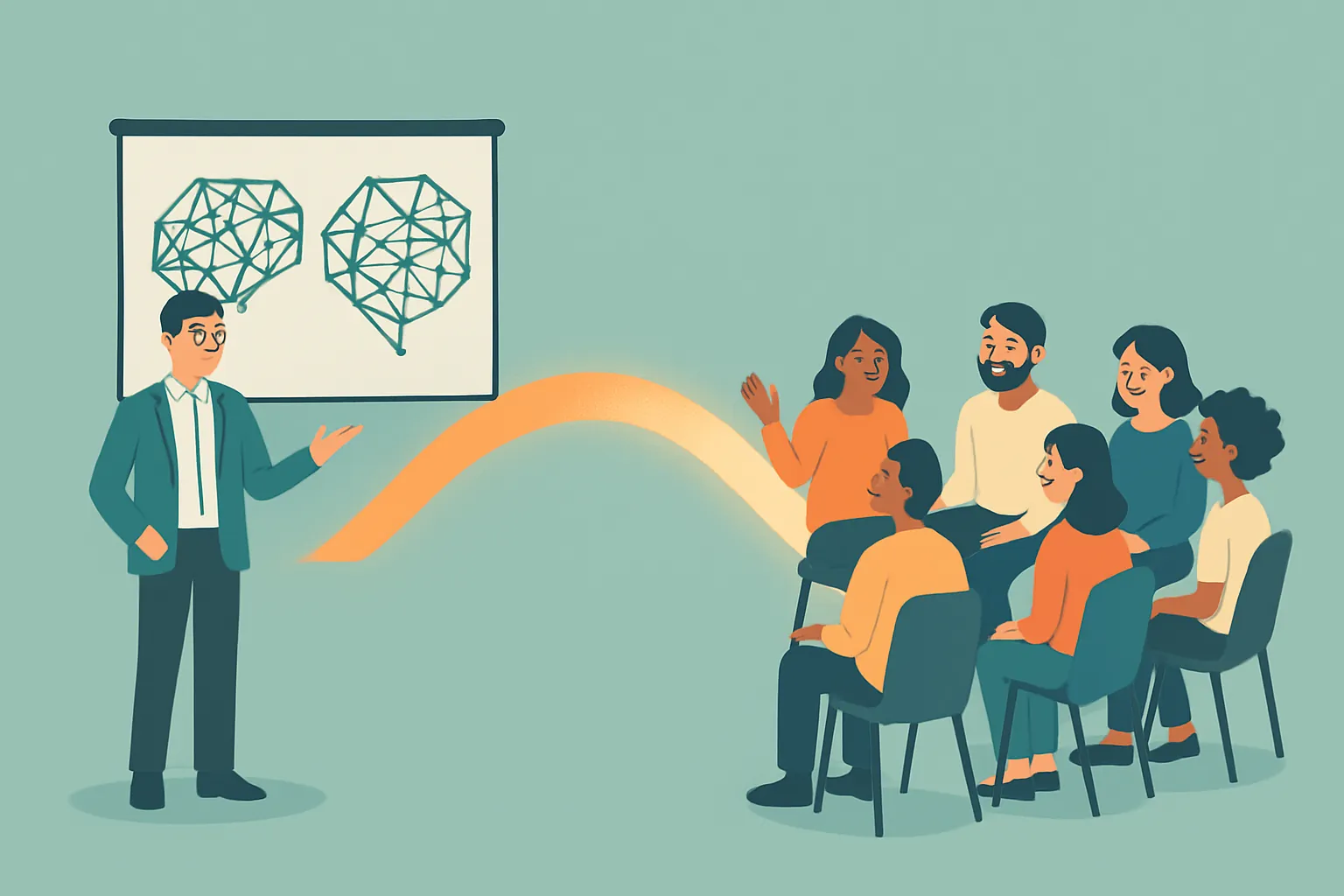
Key takeaway
Most counseling promotions fail because of the gap between clinician language and client language. Clients respond far more to descriptions of their everyday struggles than to clinical terminology, so the first step is translating symptoms into their words. To move people from interest to enrollment, the Problem-Agitation-Solution (PAS) structure makes the motivation for change concrete. Visual choices—clear subheadings, ethically anonymized testimonials, and an FAQ section—lower the barrier to entry and meaningfully raise sign-up rates.
You Built a Great Program. So Why Is the Room Empty?
Fellow counselors, does this sound familiar? You spend months building a curriculum, you bring it to supervision to validate its clinical soundness, and you design what feels like the perfect group therapy program. Then you post the announcement—and the registrations trickle in at a handful, or no one inquires at all. We are experts at healing what is on a client's mind, yet we shrink when it comes to the "marketing" that actually moves someone to open the door and walk into the room.
"Writing promotional copy feels too commercial—it makes me uncomfortable." Many clinicians say exactly this. But promoting a counseling program isn't selling a product. It is better understood as a form of early intervention: helping a client who genuinely needs support recognize their problem and find the right professional—you. When a client never enrolls in a program that could have helped them, simply because they couldn't decode our professional vocabulary, that is both a clinical loss and an ethical one. This article takes a careful look at how to write promotional copy that lowers client resistance and raises the motivation to participate, using established psychological principles.
1. Drop the "Expert Voice" and Speak to the Client's Pain Point
The most common mistake counselors make in promotional writing is using provider-centered language. We're so fluent in the terms we use in conferences and journals that we copy them straight onto our flyers. But a client doesn't respond to "a CBT-based emotion regulation group." They respond to "When you want to stop snapping at the people you love and finally feel in control."
Closing the Language Gap: Clinical Terms vs. the Presenting Problem
We have to describe the client's lived difficulty vividly, from their point of view. Marketers call this "building a persona," but clinically we might call it putting empathic understanding into words. The table below shows how to convert the phrases we reach for by default into language a client actually recognizes as their own.
| Clinical phrasing (expert voice) | Client-facing phrasing (promotional copy) | Why it works |
|---|---|---|
| Improving interpersonal efficacy and social skills training | "Why do I shrink the moment I'm around other people? Conversation practice for the person who can't say no and quietly resents it." | Concrete situations invite self-recognition |
| Relaxation and mindfulness for anxiety reduction | "When the worries pile on one after another at bedtime—and you just want to switch them off and sleep." | Names the symptom's daily impact to surface the need |
| Repairing attachment injuries and building self-esteem | "The version of me that gets anxious in every relationship: how to break the cycle of the same old wound." | Highlights a relationship pattern to offer insight |
Table 1. Translating clinical terminology into client language.
Translating the chief complaint into the client's everyday words is the first step. It triggers the reaction we're after—"Wait, that's literally me"—and that moment of being seen is where rapport, and trust in you as a clinician, begins.
2. A Psychological Structure That Prompts Action: Using PAS
Listing what the program covers is not enough. You have to give the client a reason to enroll right now. This is where PAS (Problem – Agitation – Solution), a structure widely used in marketing psychology, adapts beautifully to counseling promotion. It helps the client face their current state (Problem), makes the cost of leaving it unaddressed concrete enough to motivate change (Agitation), and then offers counseling as a safe way forward (Solution).
-
Problem (name it)
Pose the client's current difficulty as a specific question. Example: "Do you keep starting over with food, falling into a binge, and then turning it all on yourself?"
-
Agitation (raise the stakes—gently)
Empathically name the psychological cost or drop in quality of life if the problem continues unaddressed. Crucially, avoid heavy fear appeals; ethically, the goal is only to help the person feel the need for change. Example: "Each time, your self-worth slips a little lower, and even looking in the mirror starts to feel hard. On your own, this may not be a willpower problem at all—it may be a hunger that lives in your mind, not your stomach."
-
Solution (offer the way forward)
Lay out a clear roadmap for how your program addresses the problem. What matters most here is signaling a safe environment. Example: "Together with a clinician, you'll learn what it really means to feed that hunger. In a safe space where no one judges you, you'll begin to make peace between your body and your mind."
3. Visual Structure That Improves Readability and Builds Trust
No matter how good the content is, a wall of text loses an emotionally depleted reader—they give up before they start. People reading on the web or a phone tend to scan in an F-shaped pattern. So you need a clear information hierarchy and a layout that feels easy on the eyes.
Detail-Page Elements That Build Trust
- Use subheadings. Break content up with clear subheadings instead of long blocks of prose (e.g., "This program is for you if…", "Four weeks from now, here's what's different").
- Use social proof ethically. Past participants' testimonials are powerful motivators. But honor confidentiality: use thoroughly anonymized and lightly fictionalized accounts, or a general description of "the kind of change participants experience" that you have explicit consent to share.
- Lower the barrier with an FAQ. Address the fears a client is likely to have before they ask. A friendly section answering questions like "Can I just listen if I don't want to talk?" or "Is anything recorded?" can raise sign-up rates dramatically.
| Element | Weak version (discourages sign-up) | Strong version (encourages sign-up) |
|---|---|---|
| Structure | A bare academic curriculum (Session 1: Orientation, Session 2: Self-disclosure…) | Benefits from the participant's view (Week 1: Building your inner safe base) |
| Credibility | Dense dissertation titles and license numbers only | The counselor's philosophy on the issue, plus a warm, human line |
| Call to action | "Inquire to register" / a phone number with no context (vague) | "Six spots, first come—a small, intentional group so we can start safely" (specific) |
Table 2. Strong vs. weak choices in counseling-program promotion.
Closing: Promotion Is Just Another Way of Reaching Out
Effective promotional copy ultimately starts where everything in our work does: deep understanding of the client. More than polished rhetoric, the core is validation—showing them you see their pain—and the reassurance that you, as a professional, are ready to help. Try applying the three tools from today—translating into client language, the PAS structure, and clean, readable formatting—to your next workshop announcement.
Using AI to Learn Client Language and Reclaim Your Time
Finally: the best place to learn your clients' language is inside the counseling room itself. But it's nearly impossible to capture every phrase a client uses while you're fully present with them. This is where the AI-based session transcription and progress-note tools that more practices are adopting can help.
These tools don't just cut documentation time; they turn sessions into searchable text you can accumulate as data. That lets you analyze the keywords and sentence patterns clients tend to use when describing their own symptoms. When your promotional copy is built from words drawn straight from real clients' voices, its resonance multiplies. Spend the energy you reclaim from paperwork on designing better programs—and on writing the warm invitation that actually reaches the people who need it. Modalia AI is a security-first AI partner built for exactly this kind of work: transcription, case conceptualization support, and documentation.
Frequently asked questions
Isn't marketing my counseling workshop unethical or too commercial?
Promotion isn't selling—it's a form of early intervention. Helping a client recognize their difficulty and find the right professional is part of ethical practice. The line to hold is honesty: name real problems, avoid heavy fear appeals, and protect confidentiality in any testimonials.
What is the PAS structure and how do I apply it to a counseling program?
PAS stands for Problem, Agitation, Solution. You name the client's difficulty as a concrete question, gently make the cost of leaving it unaddressed feel real (without fear-mongering), and then present your program as a safe, clear way forward. It turns passive interest into a motivated decision to enroll.
How can I use participant testimonials without breaching confidentiality?
Use thoroughly anonymized and lightly fictionalized accounts, or share only a general description of the kind of change participants experience—and only with explicit consent. Never include identifying details. The goal is credible social proof that fully honors client privacy.
How does AI documentation help me write better promotional copy?
AI transcription and progress-note tools turn sessions into searchable text, letting you spot the exact keywords and phrases clients use to describe their struggles. Building copy from those real words makes it resonate far more—and it frees up time you'd otherwise spend on paperwork.
This article was written and reviewed using Modalia AI's clinical guidelines, with professional human review before publication.
Related articles
 Clinical Skills
How to Write Better Supervision Questions: Getting What You Actually Need from Your Supervisor
Stuck on what to ask in supervision? Use these structured question strategies to turn vague check-ins into focused clinical insight.
7 min read Clinical Skills
From "The Client Seems Depressed" to a Clinical Hypothesis: How Word Choice Elevates Your Case Reports
Turn vague observations into precise clinical hypotheses. A practical guide to terminology and sentence formulas that make your case reports read like expert work.
7 min read Clinical Skills
The Wounded Healer Trap: Why "I Want to Heal Myself" Sinks Your Counseling Grad School SOP
Why admissions faculty flinch at "I want to heal my own wounds"—and how to transform personal pain into a research-grade statement of purpose that gets you in.
6 min read