Compassion Fatigue Self-Check: How Much Empathic Energy Do You Have Left?
A clinician's guide to spotting compassion fatigue vs. burnout, plus three structured strategies to protect your empathic energy and stay well.
Key takeaway
Compassion fatigue is a well-documented occupational hazard for therapists, with studies of mental-health professionals reporting that a substantial share experience clinically significant levels over the course of a career. It is not a personal weakness but a predictable cost of high-intensity emotional labor, and it differs from job burnout in cause, onset, and recovery. Practical safeguards include a ritualized end-of-day transition out of the therapist role, supportive supervision that addresses countertransference and depletion, and reducing administrative load so cognitive energy is preserved for clients.
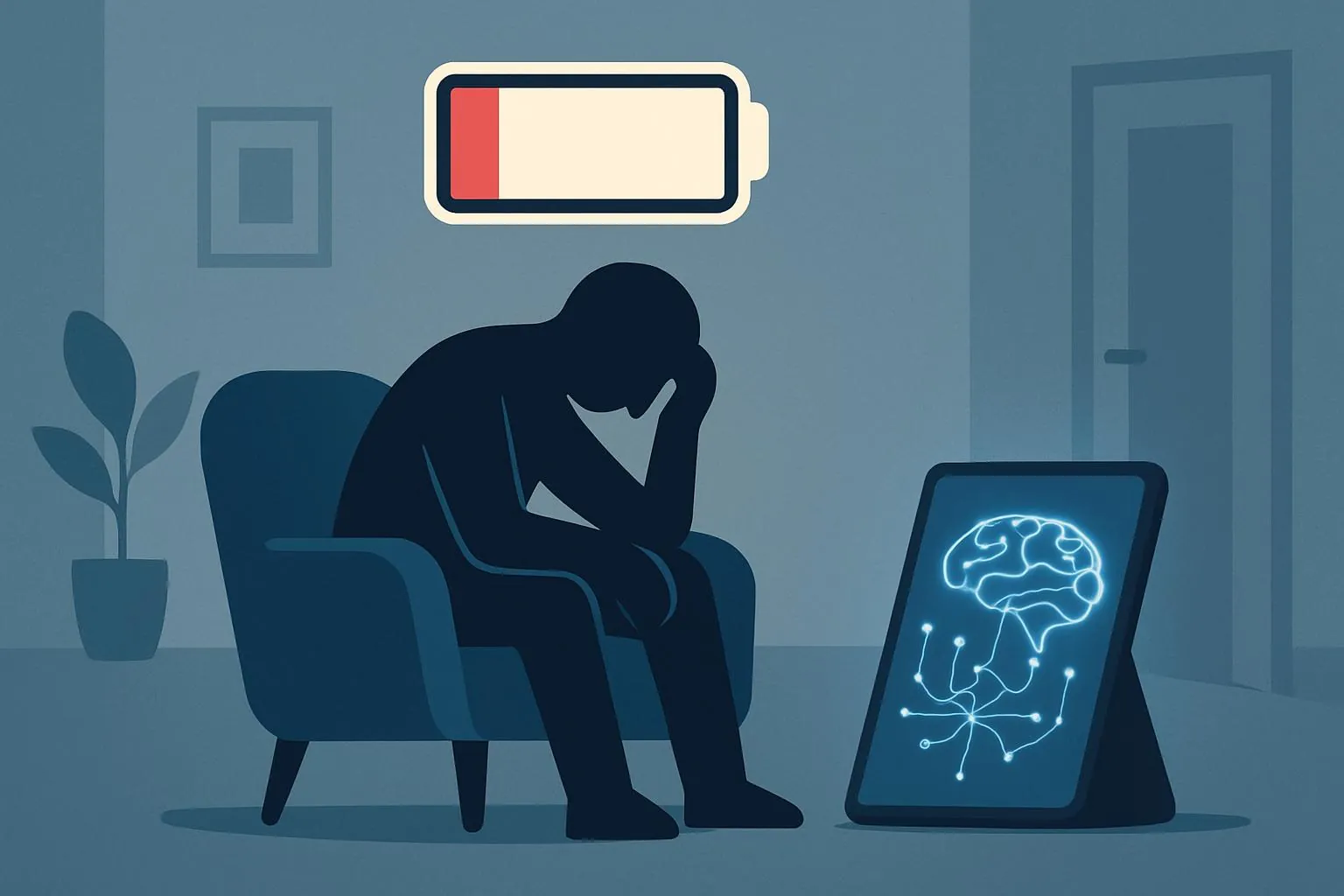
"This one was heavy today." Is your empathic tank running on empty?
You close the door after a session, sink into your chair, and let out a long breath. Sound familiar? Day after day, we sit with other people's pain and walk into the deep places they're afraid to go alone. The image of the "wounded healer" endures for a reason: clinicians are human too, and carrying the emotional weight of our clients is rarely effortless.
Research on mental-health professionals consistently finds that a large proportion experience clinically significant compassion fatigue at some point in their careers — figures around 45% appear in the literature, though prevalence estimates vary widely by setting, instrument, and population. Whatever the exact number, the pattern is clear: this is far more than ordinary job stress. Left unaddressed, depletion can erode the quality of the therapeutic alliance and quietly cloud the ethical judgment our clients depend on.
And yet many counselors read their own warning signs as a verdict on their competence — "I'm not good enough," or "I'm mishandling my countertransference." That framing gets it backward. Compassion fatigue is not a character flaw. It is a predictable occupational risk of doing high-intensity emotional labor well. In this piece we'll look, through a clinical lens, at how to read your current "empathic fuel gauge" — and at concrete, evidence-informed ways to refill it. Tending to your own mind first isn't indulgent. It's the most ethical opening move you can make on a client's behalf.
Burnout vs. Compassion Fatigue: Naming What You're Actually Feeling
When we say we're "wiped out," it pays to be more precise. Are you depleted simply because the caseload and paperwork are crushing — or are you carrying a secondary traumatic response from immersing yourself in a client's trauma? Telling these apart matters, because the remedies differ.
Job burnout tends to grow out of environmental and organizational factors — workload, low reward, administrative strain — and was first operationalized in the burnout research of Maslach and Jackson. Compassion fatigue, sometimes called the "cost of caring," arises from the therapeutic relationship itself and from repeated exposure to clients' suffering (Figley, 2002).
| Dimension | Job Burnout | Compassion Fatigue |
|---|---|---|
| Primary driver | Excessive workload, low reward, administrative burden | Exposure to client trauma, over-immersion in empathy |
| Core affect | Exhaustion, cynicism, reduced accomplishment | Fear, helplessness, intrusive thoughts about clients |
| Onset | Accumulates gradually over months or years | Can appear suddenly, even acutely |
| What helps recovery | Rest and changes to the work environment | Professional support and deeper trauma processing |
Table 1. Clinical distinctions between job burnout and compassion fatigue.
A few red flags are worth taking seriously. If you sit down to write a progress note and struggle to recall what the client actually said — or if a cynical "here we go again" surfaces in response to their distress — pay attention. If you notice a depersonalization-like sense of watching yourself from outside the room, or you leave work and a client's words keep replaying almost intrusively, that calls for prompt action. These are signals that your empathic reserves are spent, and practicing from that state risks an iatrogenic effect — harm done in the very encounter meant to heal.
Three Strategies to Conserve and Restore Your Empathic Energy
Preventing compassion fatigue takes more than a vague intention to "rest." It takes structure. Here are three practices that hold up in real clinical settings.
-
Build a psychological firewall: a ritualized transition
The moment you leave the consulting room, it helps to deliberately set down the therapist self. Give an ordinary act — a specific playlist on the commute, changing out of your work clothes — the meaning of a switch that logs you off "therapist mode." Transition rituals like these help downshift sympathetic-nervous-system arousal and cue genuine recovery.
-
Use peer support and supervision deliberately
Isolation is compassion fatigue's closest ally. Beyond supervision aimed at case conceptualization, ask explicitly for supportive supervision that makes room for your own countertransference and depletion. Professional bodies such as the NASW and BACP frame ongoing supervision and consultation as core to ethical, sustainable practice — not a sign of struggling. And in a peer consultation group, simply confirming the universality of "it's not just me" measurably strengthens resilience.
-
Streamline documentation: stop the cognitive leak
Ask clinicians where the strain lives, and writing up sessions and keeping notes current is near the top of the list. Spending one to two hours on documentation after a 50-minute session drains energy fast. The cognitive resources you owe your clients shouldn't be siphoned off by repetitive paperwork. Adopting AI-assisted clinical documentation can free you to put that attention back where it belongs — on therapeutic work.
Your Wellbeing Is the Quality of the Work
Because our identity is bound up in "the one who helps," we habitually push our own distress to the back of the line. But a depleted clinician cannot offer empathy, and therapy without empathy loses its capacity to heal. If today's honest check puts your empathic energy in the red, the responsible move is to stop and refuel — not in spite of your clients, but for the sake of every client still to come.
Start small and start now. Practice a clean disconnection after work. Tell a trusted colleague that it's been hard. And, above all, find ways to lighten the load that has nothing to do with the actual therapy.
Increasingly, AI-assisted documentation and analysis tools are functioning as a dependable co-therapist behind the scenes — accurately turning a complex conversation into a session transcript and surfacing a client's core concerns, so you're released from the pressure of note-taking and free to stay with the client's eyes and emotions. Modalia AI is built for exactly this: a security-first partner for counselors that handles transcription, case conceptualization support, and documentation, so the time you reclaim can go toward replenishing your own empathic reserves. When your mind is well, you're far better placed to help heal others.
References
- 1.
- 2.
- 3.
- 4.
Frequently asked questions
What's the difference between burnout and compassion fatigue?
Job burnout grows mainly from environmental factors — heavy caseloads, low reward, administrative strain — and accumulates gradually. Compassion fatigue stems from the therapeutic relationship and exposure to clients' trauma; it can appear suddenly and often needs professional support or deeper trauma processing to resolve, rather than rest alone.
Is compassion fatigue a sign that I'm not cut out for this work?
No. It is a predictable occupational hazard of high-intensity emotional labor, not a personal weakness or a failure to manage countertransference. Treating it as a structural risk — and responding with structured supports — is the professional, ethical stance.
What are early warning signs to watch for?
Struggling to recall what a client said while writing notes, cynical reactions to client distress, a depersonalization-like sense of detachment in session, or a client's words replaying intrusively after work. These suggest your empathic reserves are low and warrant prompt attention.
How does reducing documentation help with compassion fatigue?
Spending one to two hours on notes after a 50-minute session drains cognitive energy you owe to clients. Streamlining documentation — including with AI-assisted tools — preserves that energy for therapeutic work and reduces a common, avoidable source of depletion.
This article was written and reviewed using Modalia AI's clinical guidelines, with professional human review before publication.
Related articles
 Case Conceptualization
Breaking the "Yes, But" Game: A Transactional Analysis Guide for Therapists
Every suggestion you offer gets met with "Yes, but..." Here's the TA structure behind that stall—and four clinical moves to break it.
7 min read Case Conceptualization
Yalom's The Gift of Therapy: Passages Every New Counselor Should Copy by Hand
Irvin Yalom's prescription for therapists who fear silence: meet your client as a "fellow traveler" and let the here-and-now become the heart of the work.
6 min read Case Conceptualization
Working With Silence in Therapy: What Client Silence Means and How to Hold It
Silence in session isn't empty space. Learn to read its clinical meaning, tell productive from defensive silence, and use it as a therapeutic tool.
6 min read