Desk-Bound and Aching: A Spine-Health Guide for Counselors
Active listening quietly wrecks your spine. Learn why clinician posture drives neck and low-back pain—and the between-session stretches that protect your body and your work.
Key takeaway
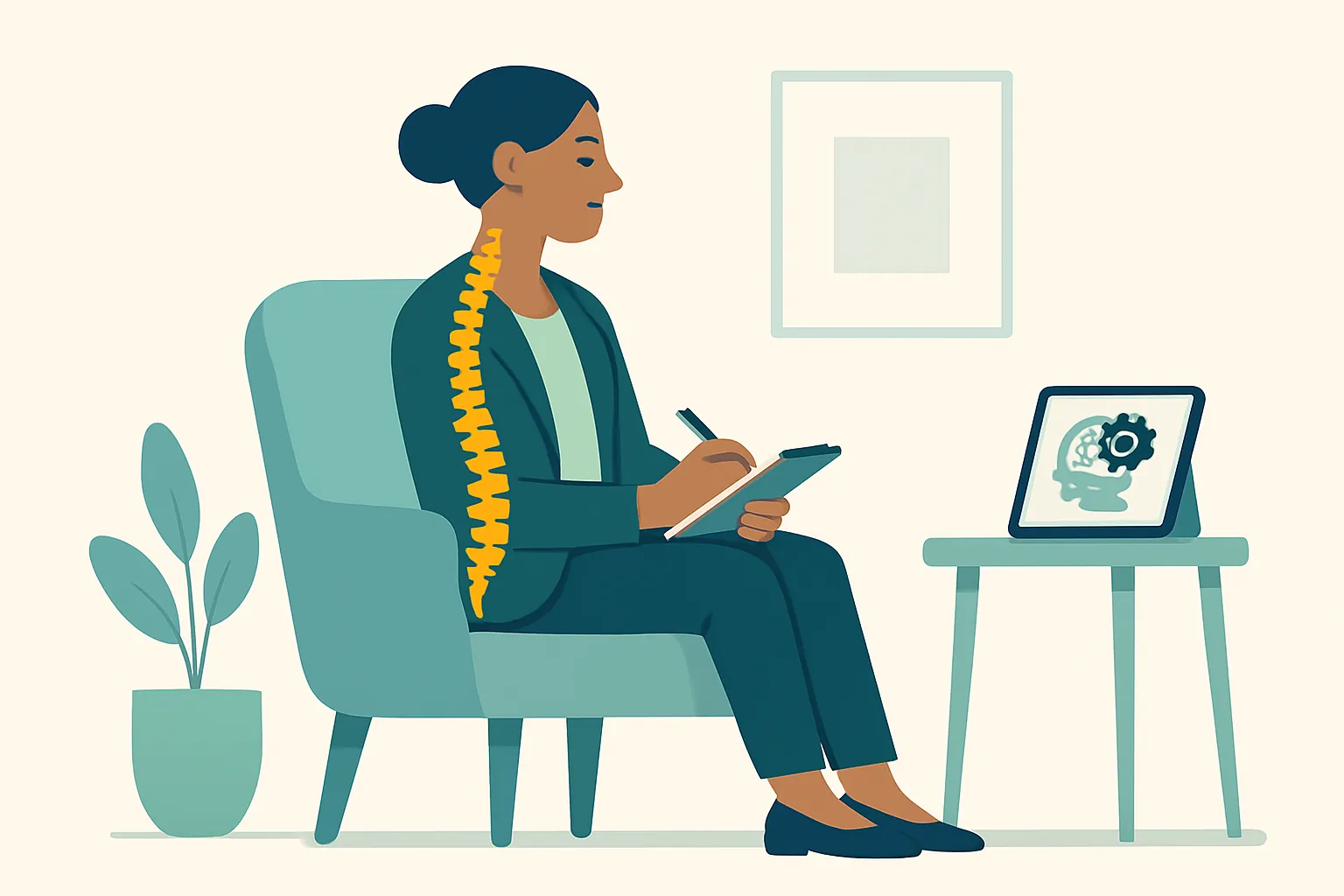
The forward-leaning "active listening" posture clinicians adopt can multiply the load on the cervical spine three to fourfold and place sustained pressure on the L4–L5 segment. Chronic musculoskeletal pain narrows attention and dulls empathy, directly degrading session quality and accelerating compassion fatigue. Short between-session breaks are enough to reset the thoracic spine, correct forward head posture, and release the piriformis—and shifting documentation onto an AI-assisted tool further reduces the physical strain of note-writing.
When Empathy Hurts Your Back: Protecting Your Spine as a Clinician
You finish another fifty-minute session of intense emotional labor, and as you stand you're already reaching for a stiff shoulder or a tight lower back. The forward-leaning posture of active listening—body angled toward the client, fully attuned—is a wonderful instrument for building rapport. Paradoxically, it is also one of the more reliable threats to a counselor's spinal health.
In clinical practice we tend to frame burnout in emotional terms: depletion, exhaustion, the slow erosion of capacity to feel. But chronic musculoskeletal pain is more than physical wear. It is a direct contributor to lower-quality care. Pain pulls attention away from the client and toward the body, so subtle nonverbal cues slip past unnoticed. In more severe cases, physical discomfort can leak into the room as irritable countertransference. This article looks at why the counseling setting in particular produces these physical problems, and offers practical correctives you can apply in the few minutes between clients.
The Occupational Cost of the "Listening Posture"
Counselors sit, on average, six to eight hours a day. That alone is hard on the body—but we compound it. To stay fully present, we unconsciously crane the head forward and tip the upper body toward the client. This forward head posture can increase the load on the cervical spine to roughly three or four times its normal range, while placing continuous pressure on the L4 and L5 vertebrae of the lower back.
Add the time spent looking down to type notes or glance at a notepad, and the tension in the neck and shoulders crosses a threshold. There's an irony worth naming here: the clinician who serves as a container for the client's emotion is quietly cracking their own physical container. This kind of bodily strain isn't just discomfort—it can act as an accelerant for compassion fatigue.
How Pain Shows Up in the Room
A counselor's physical condition is also an ethical matter. A clinician who isn't caring for themselves is less able to act in the client's best interest. The table below sketches the difference that physical pain makes in actual clinical performance.
| Domain | Good physical condition | Chronic pain / fatigue |
|---|---|---|
| Attention | Catches subtle shifts in facial expression and other nonverbal cues | Attention diverted to the painful area; greater chance of missing the client's core concern |
| Empathy | Steady emotional holding and accurate reflection | Physical irritability blunts empathy or surfaces as irritable countertransference |
| Documentation | Captures key content and dynamics accurately right after the session | Note-writing feels like physical labor, so notes get thinned out or postponed |
| Therapeutic alliance | Settled posture and relaxed expression build trust | Frequent shifting in the seat or a wince can unsettle the client |
Table 1. Clinical performance by counselor pain level.
A Ten-Minute "Survival Stretch" Routine
If carving out separate workout time feels impossible, use the ten-minute inter-session break strategically. The following corrective routine can be done in professional clothing without any fuss.
- Open Book (thoracic recovery) 🧘 — Opens the chest after a session spent hunched forward. Seated, lace your hands behind your head, spread the elbows wide, and lift the chest toward the ceiling. Exhale fully and hold for ten seconds. This counters rounded shoulders and deepens the breath, which has a settling, emotionally clearing effect.
- Chin Tuck (forward head correction) 🐢 — Returns the neck from its pulled-forward position toward monitor or client. Press your chin gently with two fingers and draw the head straight back, as if touching the back of your skull to a wall. Feel the back of the neck lengthen; hold five seconds, repeat five times. It's the simplest and most effective way to realign the cervical spine.
- Piriformis Stretch (pelvic balance) 🪑 — Seated, place one ankle on the opposite knee (a figure-four shape). Keep the spine tall and slowly hinge the torso forward. Feel the deep glute muscle release, easing the pressure that prolonged sitting puts on the sciatic nerve.
Redesigning the Workspace and Working Smarter
As valuable as stretching is, removing the root cause matters more. One of the biggest culprits is the physical strain of documentation. Sitting down after a session to reconstruct it from memory through a long stretch of typing is, in effect, a finishing blow to an already tired neck and back. This is the point at which it's worth seriously considering technical tools that preserve clinical rigor while easing the physical load.
A security-first AI partner such as Modalia AI can be a strong alternative here. By automatically converting session audio into a transcript and surfacing key themes and the client's emotional arc, tools of this kind dramatically cut the time spent hunched over a keyboard. The benefit isn't only administrative efficiency—it gives the counselor room to physically rest and to reopen the psychological space needed for the next client. Your health is inseparable from your clients' healing. So when today's session ends, before you reach reflexively for the keyboard, try tucking the chin and opening the chest first. Then hand the repetitive documentation to AI, and give yourself the genuine time to tend to you.
Frequently asked questions
Why do counselors develop neck and back pain so often?
The forward-leaning active-listening posture, combined with six to eight hours of daily sitting and time spent looking down to write notes, can multiply the load on the cervical spine three to fourfold and place sustained pressure on the lower lumbar vertebrae (L4–L5).
Can physical pain actually affect the quality of my counseling?
Yes. Chronic pain diverts attention to the affected area, making it easier to miss subtle nonverbal cues. It can also blunt empathy or surface as irritable countertransference, and it tends to make documentation feel like a chore, so notes get thinned out or delayed.
What stretches can I realistically do between sessions?
Three seated moves fit a ten-minute break in professional clothing: the Open Book to release the thoracic spine and open the chest, the Chin Tuck to correct forward head posture, and the Piriformis (figure-four) stretch to ease pressure on the sciatic nerve.
How can AI documentation tools reduce physical strain?
By transcribing sessions automatically and surfacing key themes and the client's emotional arc, AI-assisted documentation cuts the long stretches of hunched-over typing that aggravate neck and back pain—freeing you to rest physically and reset between clients.
This article was written and reviewed using Modalia AI's clinical guidelines, with professional human review before publication.
Related articles
 Case Conceptualization
Breaking the "Yes, But" Game: A Transactional Analysis Guide for Therapists
Every suggestion you offer gets met with "Yes, but..." Here's the TA structure behind that stall—and four clinical moves to break it.
7 min read Case Conceptualization
Yalom's The Gift of Therapy: Passages Every New Counselor Should Copy by Hand
Irvin Yalom's prescription for therapists who fear silence: meet your client as a "fellow traveler" and let the here-and-now become the heart of the work.
6 min read Case Conceptualization
Working With Silence in Therapy: What Client Silence Means and How to Hold It
Silence in session isn't empty space. Learn to read its clinical meaning, tell productive from defensive silence, and use it as a therapeutic tool.
6 min read