Why Counselor Development Never Stops: The Case for Supervision and Continuing Education
Licensure is the starting line, not the finish. Here's how supervision, continuing education, and smarter documentation keep your clinical skills growing.
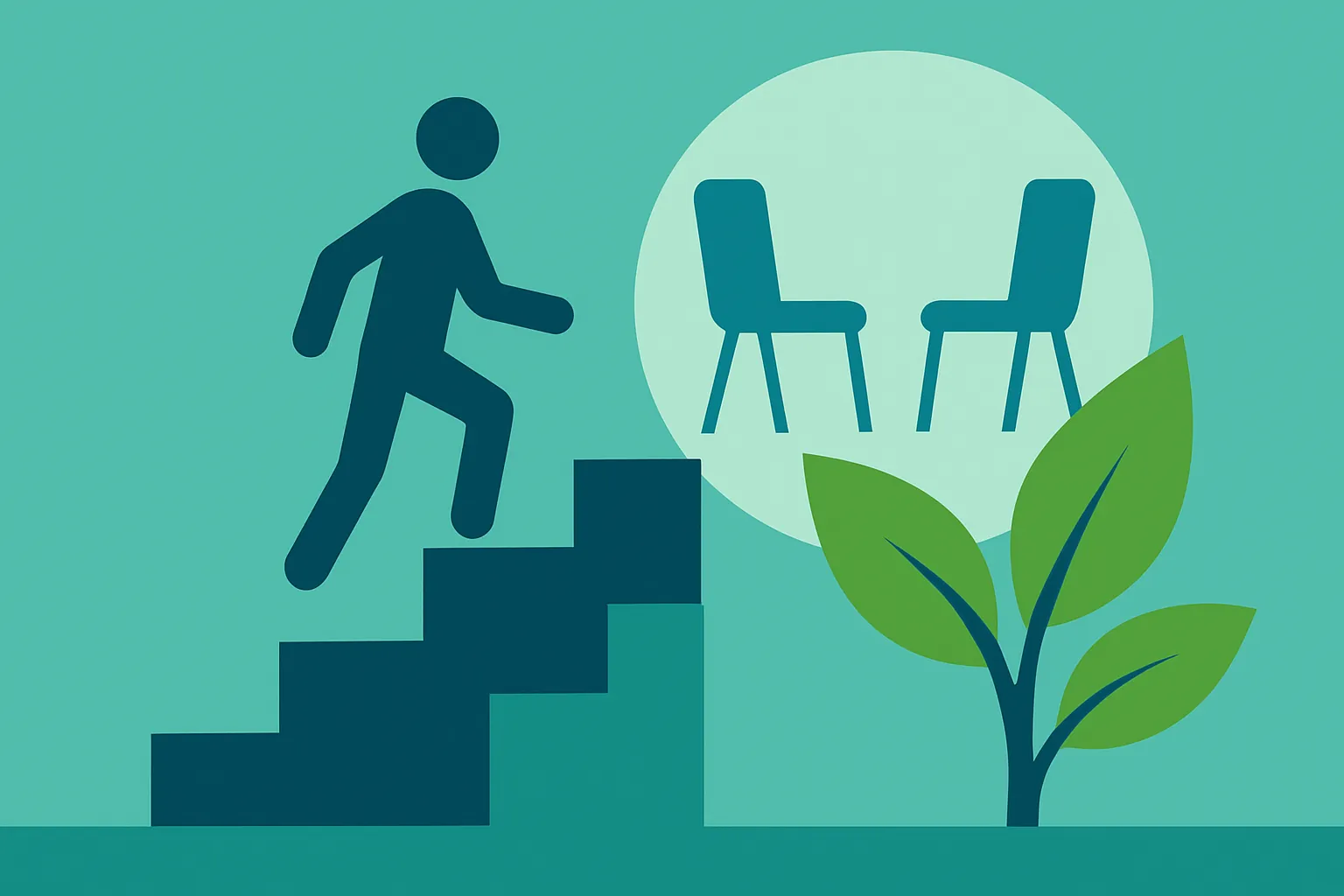
Key takeaway
Professional development doesn't end with licensure—it has to keep pace with a changing clinical landscape. Supervision surfaces countertransference and blind spots while protecting against vicarious trauma and burnout, and its formative, restorative, and normative functions each serve a distinct purpose: skill-building, emotional steadiness, and ethical safety. Continuing education lets clinicians adopt evidence-based approaches like Polyvagal-informed work and EMDR, sharpen cultural competence, and build a specialty. Peer supervision, deliberate practice, and AI-assisted documentation make ongoing growth realistic even under real-world constraints of time and cost.
When the Therapy Room Goes Quiet: Why Growth Is Never Optional
If you spend your days holding the weight of other people's lives, here's a question that rarely gets asked: where is your growth right now? We are in the business of helping others develop, yet we seldom give ourselves room to ask the same of our own practice. Sooner or later—usually after a session that didn't land the way you hoped—the questions arrive: Am I actually good at this? Is my work with this client genuinely helping?
Those doubts are not a sign of inadequacy. They are the natural cost of being a thoughtful clinician who takes the work seriously.
The clinical landscape keeps shifting. Neuroscience-informed trauma treatment, the ethics of telehealth, and a steady rise in clients presenting with complex, co-occurring conditions all raise the bar for what competent care requires. In that context, supervision and continuing education are not box-checking exercises for license renewal. They are a buffer against burnout and an ethical obligation to act in the client's best interest. This article makes the case for why a good counselor remains, in the best sense, a lifelong student—and how that stance translates into sharper clinical insight.
Breaking Clinical Isolation: What Supervision Actually Does
Surfacing blind spots and parallel process
The therapy room is a closed system. Without a third party's perspective, it is genuinely difficult to see your own countertransference or the habits you've quietly fallen into. Supervision is the mirror that lights up those clinical blind spots.
It is especially powerful for examining parallel process—the way the dynamic between client and counselor gets unconsciously re-enacted in the relationship between supervisor and supervisee. Tracking that re-enactment gives the clinician a window into the client's unconscious patterns and, often, the first real clue for breaking through an impasse.
Preventing vicarious trauma and managing burnout
Empathy is our primary instrument, which makes the emotional labor of this work intense. Without adequate restorative supervision, clinicians drift toward compassion fatigue—and from there, toward either numbness or overinvolvement with clients. Regular supervision provides a place to process the emotional residue of the work and to keep the professional self intact and healthy. It is a safety mechanism, not a luxury.
Sharpening ethical sensitivity
A code of ethics on paper cannot resolve every subtle dilemma that arises in practice: dual relationships, the limits of confidentiality, crisis intervention, mandated reporting. Talking these situations through with an experienced supervisor minimizes legal and ethical risk and produces decisions that genuinely protect the client. Ambiguity is where good supervision earns its keep.
Table 1 — Three functions of supervision and their clinical payoff
| Type | Primary focus | Effect on the supervisee | Example in practice |
|---|---|---|---|
| Formative (educational) | Skills, theory, knowledge | Refines technique; strengthens assessment and case conceptualization | Coaching specific questioning when CBT structure breaks down; correcting MMPI-2 interpretation |
| Restorative (supportive) | The clinician's emotions and burnout | Restores emotional steadiness; rebuilds confidence; eases stress | Working through anxiety after a session with a suicidal client; accepting countertransference feelings |
| Normative (administrative) | Policy, ethics, accountability | Ensures professional responsibility and ethical/legal safety | Reviewing mandated-reporting duties for suspected abuse; auditing record security and data handling |
Staying Current: Continuing Education and Emerging Practice
Keeping up with evidence-based practice
What worked a decade ago is not guaranteed to be the best available approach today. The field keeps producing new evidence. Body-based and neuroscience-informed methods—Polyvagal-informed work and EMDR among them—have moved toward the center of trauma treatment. Continuing education is how you adopt these developments and bring the most effective, scientifically grounded care to your clients.
Expanding cultural competence
Clients arrive from an ever-widening range of backgrounds—cultural, racial, gender and sexual identity, and family structure. Training from years ago may not equip you to work across that diversity. Ongoing education is where clinicians examine their own cultural assumptions and develop the multicultural competence to understand and respect clients on their own terms.
Building a specialty
No one is excellent at everything. Continuing education is an opportunity to develop a depth area—addiction, adolescent risk behavior, geriatric depression, trauma, and so on. Beyond the professional identity it builds, a specialty is what lets you offer real depth to the clients who need it most.
Practical Strategies—and Where Technology Helps
So how do you actually grow on a full caseload? Three approaches that hold up under real-world constraints:
Activate a peer supervision group
When cost and scheduling make a formal supervisor hard to access every time, build a regular case conference with trusted colleagues. Horizontal feedback—peers rather than a hierarchy—lowers the psychological stakes while still surfacing a range of perspectives. Two conditions are non-negotiable: a strict confidentiality agreement and a structured format for running the meetings.
Make deliberate practice a habit
Clocking hours in the chair does not, by itself, make you better. Improvement comes from reviewing recordings of your own sessions and analyzing them at a micro level: Was that empathic reflection well-timed? Was the confrontation appropriate? What nonverbal cue did I miss? Identify your weakest skill and train it deliberately and repeatedly. That is what moves the needle.
Use AI to streamline documentation and review
One of the biggest barriers to getting supervision is the burden of producing a verbatim session transcript. Recording and typing up a 50-minute session can take several times as long as the session itself. Modern AI-assisted documentation tools cut that repetitive labor dramatically—converting speech to text, separating speakers, and surfacing key themes—so your energy goes to analysis and reflection rather than transcription.
This is where a security-first partner matters. Modalia AI is built for clinicians: it handles transcription, supports case conceptualization, and streamlines documentation while keeping client data protected. Accurate records are the foundation of accurate supervision—and accurate supervision is what ultimately reaches the client as better care.
Closing: A Competent Counselor Is a Work in Progress
Professional development doesn't end at licensure. It continues until the day you close the office for the last time. Supervision and continuing education are not about exposing your shortcomings—they are the most powerful investment you can make in your own professional confidence and in the depth of every client encounter.
So: book the supervision session you've been putting off, or sign up for the workshop that's been on your mind. And seriously consider adopting AI documentation tools that give you back the hours you'd otherwise lose to transcription. Your growth, in the end, becomes someone else's hope.
References
- 1.
- 2.
- 3.
- 4.
Frequently asked questions
What are the three functions of clinical supervision?
Supervision serves formative, restorative, and normative functions. The formative function builds skills and theory; the restorative function supports the clinician's emotional well-being and guards against burnout; the normative function maintains ethical and legal accountability, including policy, documentation, and mandated-reporting obligations.
What is parallel process in supervision?
Parallel process is when the dynamic between client and counselor is unconsciously re-enacted in the relationship between supervisee and supervisor. Examining it gives the clinician insight into the client's unconscious patterns and often reveals a way to move past a therapeutic impasse.
Is peer supervision a legitimate alternative to formal supervision?
Yes, when cost or scheduling limits access to a formal supervisor. A peer case conference offers horizontal, lower-pressure feedback and diverse perspectives. To be effective and ethical, it requires a strict confidentiality agreement and a structured meeting format. It complements rather than fully replaces individual supervision for complex or high-risk cases.
How can AI documentation tools support supervision?
AI-assisted documentation reduces the time-consuming work of producing session transcripts by converting speech to text, separating speakers, and surfacing key themes. This frees the clinician to focus on analysis and reflection. A security-first tool that protects client data is essential for ethical use.
This article was written and reviewed using Modalia AI's clinical guidelines, with professional human review before publication.
Related articles
 Clinical Skills
How to Write Better Supervision Questions: Getting What You Actually Need from Your Supervisor
Stuck on what to ask in supervision? Use these structured question strategies to turn vague check-ins into focused clinical insight.
7 min read Clinical Skills
From "The Client Seems Depressed" to a Clinical Hypothesis: How Word Choice Elevates Your Case Reports
Turn vague observations into precise clinical hypotheses. A practical guide to terminology and sentence formulas that make your case reports read like expert work.
7 min read Clinical Skills
The Wounded Healer Trap: Why "I Want to Heal Myself" Sinks Your Counseling Grad School SOP
Why admissions faculty flinch at "I want to heal my own wounds"—and how to transform personal pain into a research-grade statement of purpose that gets you in.
6 min read