The Counselor's Curse: When You Can't Stop Therapizing People Off the Clock
Still in clinician mode at the dinner table? A practical guide to switching off, recovering authenticity in your personal life, and protecting yourself from burnout.
Key takeaway
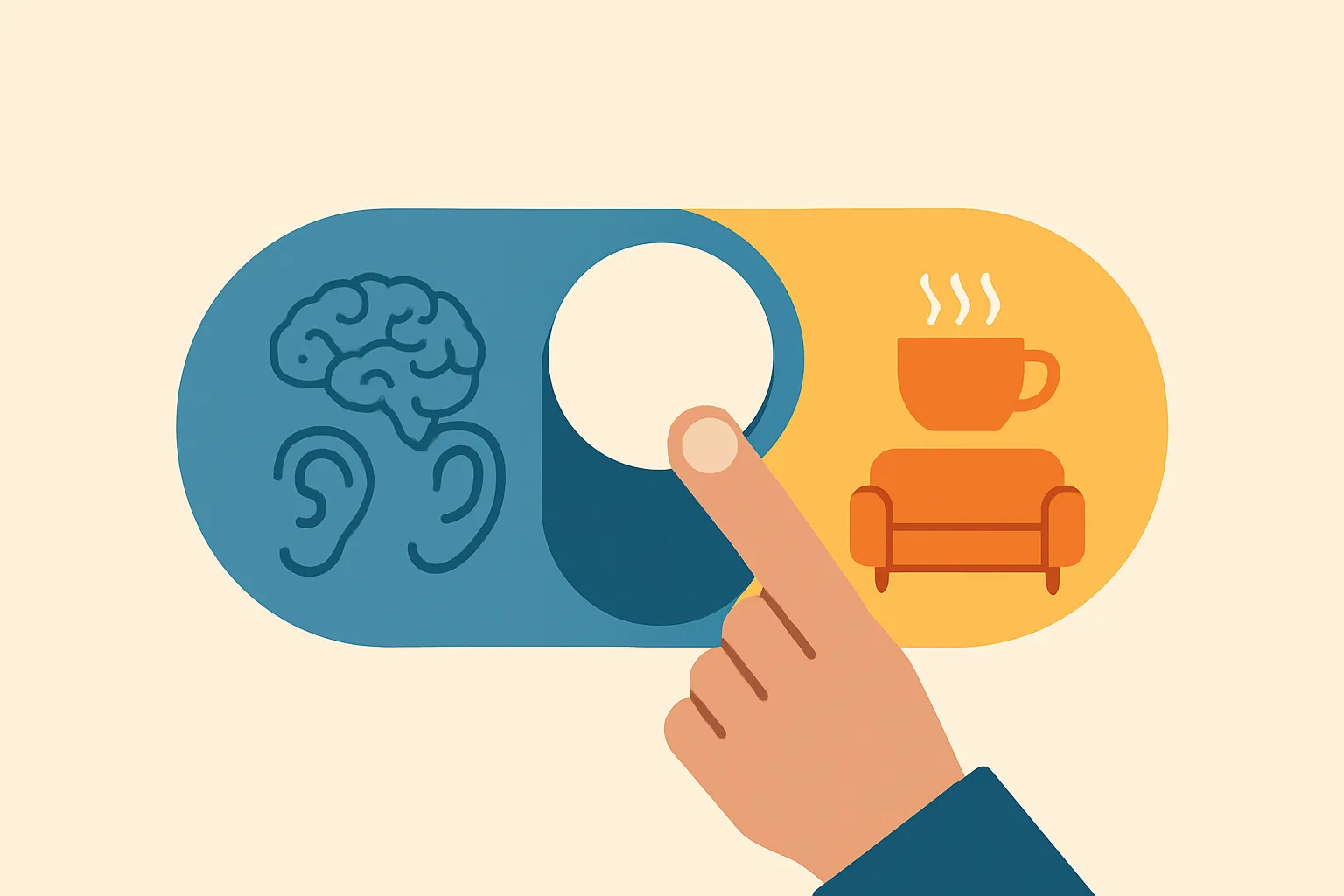
The reflexive, analytic listening that many counselors joke about as an occupational hazard is, clinically, an early warning sign of role residue and compassion fatigue. The cognitive schemas you automate during training stay switched on outside the therapy room, where analysis becomes a defense mechanism in ambiguous moments and locks personal relationships into a lopsided helper-and-helped dynamic. This article contrasts the structural differences between therapeutic and personal relationships and offers concrete tools—an end-of-day transition ritual, using I-statements for yourself rather than others, and streamlining documentation to free up cognitive bandwidth—to restore the boundary between your professional and personal self.
"And where do you think that feeling is coming from?" — The clinician switch that won't turn off
You're out to dinner with a friend, and they mention something hard. Almost without deciding to, you reflect it back: "That sounds like it was really painful for you." Or your partner grumbles about a small annoyance and you find yourself quietly scanning for the unmet need underneath it. Or you watch your child act out and a developmental hypothesis assembles itself in your head before you can stop it.
We tend to laugh this off as an occupational hazard. But from a clinical standpoint, it can be an early marker of role residue—the carryover of a professional role into off-duty life—and a precursor to compassion fatigue. Counselors are trained, more than almost anyone, to look deeply into another person's inner world. Ironically, many of us struggle to set a clear boundary between the professional self and the personal self. This is more than feeling tired. Left unchecked, it erodes authenticity in the relationships we care about most and, over the long run, feeds directly into burnout.
The complaint so many clinicians share—"I can't stop counseling people in ordinary conversation"—is really the moment when the expertise we built so devotedly for our clients turns around and colonizes our own lives. This piece looks at the psychological mechanisms behind that pattern, and then offers concrete strategies for clocking out as a complete non-expert and getting your life back into balance.
Why the switch stays on: the professional self bleeds through
1. Automated schemas and chronic hypervigilance
Clinical training asks us to detect and interpret a client's verbal and nonverbal cues, over and over, until it becomes second nature. That repetition rewires our cognitive schemas and dials our sensitivity to others' emotional signals up to the maximum. The problem is that the system stays always-on after we leave the office. Like a radar that never powers down, we automatically hunt for the "point of intervention" inside a friend's venting or a family member's complaint.
2. The pull toward control—and an ambiguous professional identity
In session, the counselor manages a structured environment and steers the conversation toward therapeutic goals. Out in the unstructured, uncertain conflicts of daily life, reaching for clinical technique can function as a defense mechanism. By turning the other person into an "object of analysis," we can—often without realizing it—sidestep the emotional waves rising in ourselves, or try to regain a sense of control over a situation that feels out of our hands.
3. Cementing an asymmetric relationship
The therapeutic relationship is, by design, asymmetric: one person gives help, the other receives it. Carrying a clinical stance into personal relationships can be a projection of the wish to remain the one who helps, one rung above the other person. In the family and romantic relationships that depend on equal, mutual exchange, that posture can create a quiet but serious disconnection.
Therapeutic vs. personal relationships: a side-by-side
Many counselors blur the line between a good conversation and a therapeutic conversation, and recognizing the difference is where change begins. The very skills we were trained in can become a liability in everyday life. Here's the contrast at a glance.
| Dimension | Therapeutic relationship (in session) | Personal relationship (off the clock) |
|---|---|---|
| Purpose | Client insight, behavior change, healing | Mutual emotional connection, enjoyment, shared information |
| Mode of listening | Active listening, reflection, clarification (analytic) | Natural reactions, interrupting, telling your own story (intuitive) |
| Direction of affect | Counselor holds the client's emotion (one-way) | Both people give and receive emotion (two-way) |
| Your stance | Neutral, accepting, non-judgmental | Subjective, evaluative, free to express likes and dislikes |
| Failure mode | Countertransference calls for supervision | Staying "professional" leaves the other person feeling shut out |
Table 1. Structural differences between therapeutic and personal relationships.
A field guide to clocking out of the clinician role
So how do you take off the heavy coat of "mental health expert" at the end of the day and return to being an ordinary, unguarded version of yourself? Here are practical strategies clinicians find genuinely useful.
1. Use an end-of-day ritual to switch your brain's mode
The moment you leave the office, your brain needs a clear "work is over" signal. Build a deliberate transition ritual to send it. Closing the door and silently telling yourself, "I'm leaving today's clients here," or changing out of work clothes into something comfortable at a fixed point on your way home, helps draw a psychological boundary line. This isn't a superstition—it acts as a cognitive switch that calms the chronic hypervigilance and lets your nervous system stand down.
2. Use the "I-statement" for yourself, not on others
We teach clients to use I-statements, yet in our own relationships we often read everyone else's feelings while suppressing our own needs. With family and friends, resist the urge to analyze and instead let your own vulnerability show. Rather than "You're right, I really empathize with that," practice saying what's actually true for you: "I'm wiped out today and I just want to zone out for a while," or "Honestly, that makes me angry too." Carve out time to exist as a human being with feelings, not as a counselor.
3. Reclaim cognitive bandwidth by streamlining documentation
One big reason the clinical mode won't shut off after hours is that your head is still holding the day's sessions and the transcripts and progress notes you owe. The more energy your records and case conceptualization demand, the more your brain refuses to clock out. Handling session analysis and documentation efficiently—so that you close out your clinical thinking before you leave—matters enormously. When no residue of the work follows you home, the switch back into ordinary life happens far faster.
Conclusion: allowing yourself to be imperfect makes you a better counselor
Counselors are people too. Sometimes we snap at our families, find a friend's problems tiresome, or spill out feelings that aren't remotely logical. Trying to be the perfect empathizer even in your private life ultimately drains you—and drains the very energy you need inside the therapy room. Setting down the "need to counsel" isn't a dereliction of duty. It's an essential act of self-care for anyone who wants to practice well, and for a long time.
Above all, returning fully to yourself after hours means minimizing the energy you spend outside of session time. The administrative load that so many clinicians dread—drafting transcripts, parsing client utterances—is exactly the kind of work where modern tools can lighten the burden. AI-assisted session documentation tools can automate accurate recording and surface key themes, which can loosen the compulsive grip that notes and transcripts hold on your attention. Modalia AI is built for this with a security-first approach to transcription, case conceptualization, and documentation for counselors.
So after work, take off the analyst's glasses. Hand the mechanical recording and analysis to the tools, and spend your evening sharing judgment-free laughter with the people you love. A counselor who rests well is, in the end, the one who can offer clients the best healing of all.
Frequently asked questions
Is it normal to keep "counseling" friends and family after work?
It's extremely common among clinicians, but it's worth paying attention to. The reflexive analytic listening is your trained schemas staying switched on outside the office. In small doses it's harmless; when it becomes constant and leaves loved ones feeling shut out or analyzed, it can signal role residue and the early stages of compassion fatigue.
What's the difference between a therapeutic conversation and a personal one?
A therapeutic conversation is structured, one-directional, and non-judgmental—built around the client's insight and change, with the counselor holding the client's emotion. A personal conversation is mutual, two-directional, and subjective, with both people freely sharing feelings, opinions, and their own stories. Applying therapeutic technique in personal settings often creates an asymmetry that erodes intimacy.
How can I actually switch off the clinician role at the end of the day?
Build a deliberate transition ritual—closing the office door while telling yourself you're leaving the day's clients there, or changing out of work clothes at a fixed point. Practice using I-statements to express your own needs rather than reading everyone else's. And close out documentation and case conceptualization before you leave so the work doesn't follow you home.
Does setting these boundaries make me a less dedicated counselor?
No. Trying to be the perfect empathizer in your private life depletes the energy you need in session and accelerates burnout. Stepping out of the helper role off the clock is a core form of self-care. A well-rested clinician is more present, more sustainable, and ultimately more effective for clients.
This article was written and reviewed using Modalia AI's clinical guidelines, with professional human review before publication.
Related articles
 Case Conceptualization
Breaking the "Yes, But" Game: A Transactional Analysis Guide for Therapists
Every suggestion you offer gets met with "Yes, but..." Here's the TA structure behind that stall—and four clinical moves to break it.
7 min read Case Conceptualization
Yalom's The Gift of Therapy: Passages Every New Counselor Should Copy by Hand
Irvin Yalom's prescription for therapists who fear silence: meet your client as a "fellow traveler" and let the here-and-now become the heart of the work.
6 min read Case Conceptualization
Working With Silence in Therapy: What Client Silence Means and How to Hold It
Silence in session isn't empty space. Learn to read its clinical meaning, tell productive from defensive silence, and use it as a therapeutic tool.
6 min read