Why Counselors Need Time Alone: The Clinical Case for Strategic Solitude
Strategic solitude isn't selfish—it's how clinicians protect against compassion fatigue. Discover four sensory hobbies that restore depleted therapists.
Key takeaway
For counselors who spend their days resonating deeply with clients' emotions, time spent away from people isn't merely rest—it's an essential way of recalibrating the self as a therapeutic instrument amid the risks of compassion fatigue and vicarious trauma. Rather than refilling depleted social energy with yet more social interaction, 'active solitude' through hands-on, sensory hobbies like ceramics, woodworking, solo camping, swimming, and gardening builds clinical resilience by minimizing verbal processing. Securing time alone is not self-indulgence but a cornerstone of professional self-care: you can only hold another person's story when you are healthily emptied first.
"Did You Give All Your Energy to People Again Today?" The Skill of Solitude for Preserving Clinical Capacity
After a full day of resonating with other people's pain and emotion, many of us walk out the door craving complete silence—the wish not to speak a single additional word. If you're a counselor, you've almost certainly had the thought: I just want to be somewhere with no one around. And when that wish surfaces, do you also feel a flicker of guilt? Am I just burned out? What kind of helping professional wants to avoid people?
From a clinical perspective, however, time spent away from people isn't simply rest. It's an essential process of recalibrating the self that serves as your therapeutic instrument. In the presence of ongoing risks like compassion fatigue and vicarious trauma, how do we protect ourselves and sustain a long career in this work? Solitary hobbies—activities that focus entirely on your own sensory experience rather than someone else's narrative—may not be a luxury but an ethical responsibility. This article makes the case for strategic solitude and offers concrete ways to practice it, written for clinicians worn thin by a profession built on relationship after relationship.
Relational Overload: Why Counselors Need to Disconnect
Counseling is labor that draws on high-level cognitive and emotional energy at the same time. Across a 50-minute session, we continuously read nonverbal cues, track transference and countertransference, and listen beneath the surface of what is spoken. Neurologically, the clinician's brain runs its mirror neuron system at full capacity to simulate another person's affect. This inevitably produces what we might call relational overload.
The reason so many counselors find even a dinner with friends or a conversation with family depleting after work is simple: the day's allotment of social energy and empathic capacity is already spent. What's needed in that moment isn't another form of social exchange. It's activity that shuts out external stimulation and either activates the brain's resting state—the default mode network (DMN)—or supplies an entirely different kind of sensory input. A hobby that doesn't involve other people is, in particular, the fastest route to shedding the professional persona and returning from "somebody's counselor" to simply yourself.
What Makes a Hobby Clinically Restorative: Active Solitude vs. Passive Isolation
Not all time alone offers the same restorative effect. Simply lying on the couch scrolling your phone—passive isolation—can actually deepen low mood and reinforce a sense of helplessness. Active solitude, by contrast, means deliberately carving out time for yourself and experiencing positive affect through absorption and flow.
The hobbies best suited to counselors minimize verbal processing and maximize sensory experience. The table below compares the qualities that let the brain genuinely rest.
| Dimension | Social hobbies (clubs, groups) | Digital-drain hobbies (social media, streaming) | Resilience-building hobbies (recommended) |
|---|---|---|---|
| Primary activity | Conversation, relationship-building, reading the room | Passive viewing, dopamine-seeking | Physical sensation, flow, creation |
| Energy effect | Spends additional relational energy | Accumulates cognitive fatigue | Emotional release and sensory recharge |
| Effect on counselors | Risk of "occupational reflex" (analyzing, active listening) | Helplessness, guilt over wasted time | Restored self-efficacy, grounding |
| Examples | Book clubs, team sports | Endless short-form video | Woodworking, ceramics, solo camping, playing an instrument |
Table 1. Comparison of hobby types for counselor energy recovery.
Four "People-Free" Hobbies for Counselors
1. Analog creation that wakes up your sense of touch (ceramics, woodworking, knitting)
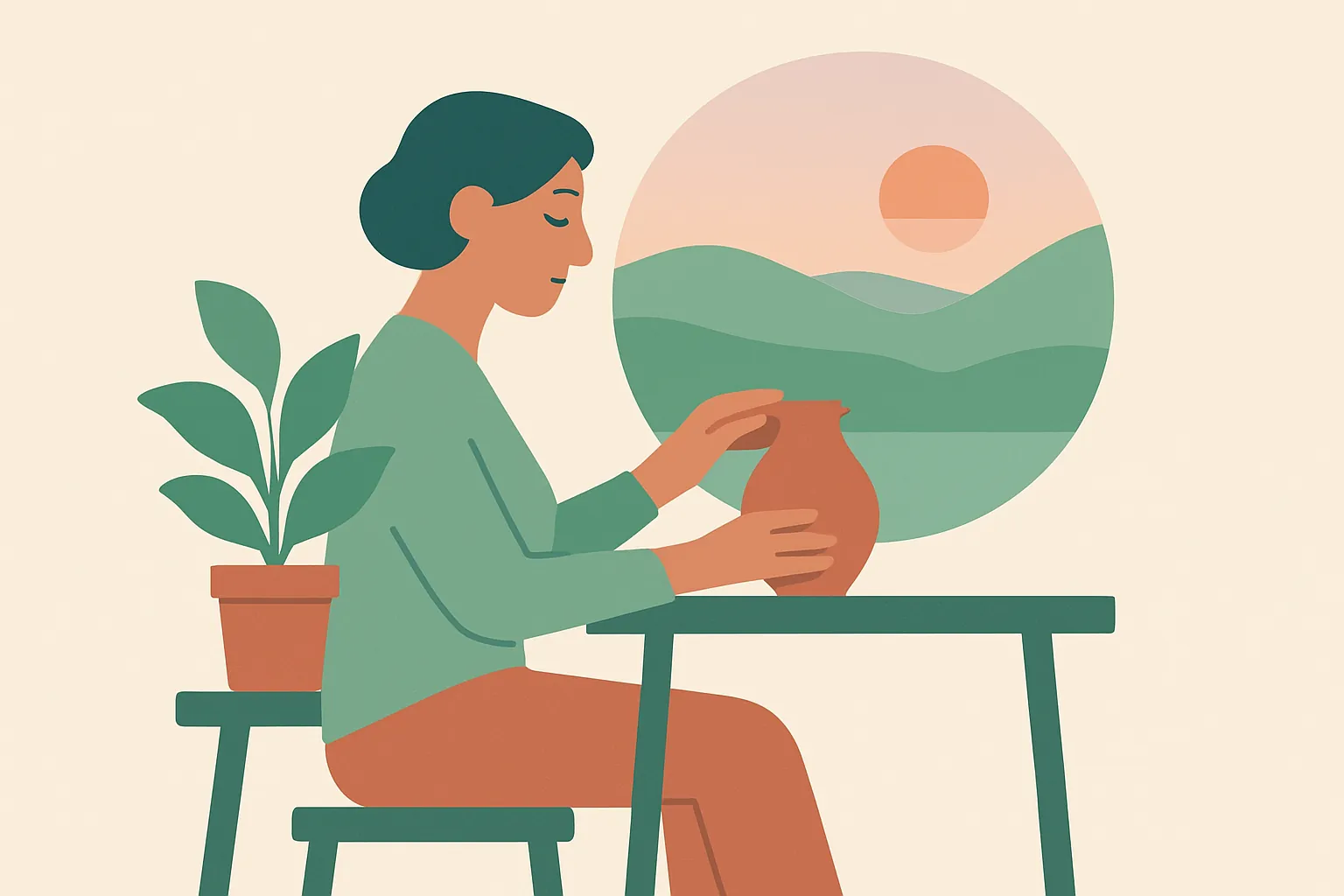
Counseling is the work of handling formless things—mind and language. The ambiguity of work whose results you can't see takes a real toll. Activities like ceramics or woodworking, where you focus on the sensation at your fingertips and produce something tangible, offer immediate feedback and a sense of control. Feeling the texture of clay or wood becomes an excellent grounding technique, settling a mind that has been floating through the consulting room back into the present and the physical.
2. An escape into nature: solo camping and fire-gazing
Nature doesn't judge. There are no irrational beliefs to gently challenge, no empathy required. Pitching a tent alone in the woods and watching the crackle of a campfire reduces beta-wave activity and generates alpha waves, inducing deep relaxation. The simple act of staring into a fire—losing yourself in the flames—is a surprisingly powerful way to halt the rumination that complex clinical cases tend to provoke, by anchoring visual attention on something hypnotic and undemanding.
3. Wordless immersion: swimming or hiking
While you're submerged in water or climbing a steep trail, there's no room for complicated verbal thought to intrude. Your attention narrows to the bodily sensations themselves—breath quickening, muscles working. This aligns with the principles of somatic therapy. It's a way of releasing the physical tension accumulated during sessions (tight shoulders, shallow breathing) and reclaiming your body's sensations as your own.
4. Building a world of your own: gardening and terrariums
People can be unpredictable and, at times, leave us feeling betrayed; plants respond honestly to care. Watering a plant and watching new growth emerge offers a kind of vicarious experience of secure attachment. And tending a small garden with your hands in the soil, alone in a quiet room, grants the counselor the calm standing of an observer of life rather than a provider of care.
Conclusion: Solitude Is a Counselor's Most Powerful Tool
Securing time alone is not a selfish act. It is, rather, central to the professional self-care that lets you offer clients the best therapeutic work you're capable of. Only when you are healthily emptied is there room to hold another person's story. This weekend, what if you turned off your phone and woke up your senses in genuine, people-free solitude?
In practice, though, excessive administrative work—session transcripts, case reports, progress notes—may be the very thing stealing your time to rest alone. It's a quiet irony: you need rest to do this work well, yet the documentation makes rest impossible. This is exactly where modern AI-based tools for clinical documentation and transcription can be a genuinely practical, sensible solution. While technology handles the repetitive recording work, you can walk in the woods or put your hands in the soil and recharge—and the time you reclaim returns, in full, as clinical insight and quality of life.
Frequently asked questions
Is wanting to avoid people after work a sign that I'm burned out?
Not necessarily. The wish for silence and solitude after a day of empathic labor is a normal regulatory response, not a character flaw. Counseling depletes social and empathic energy, so craving quiet is often the mind signaling a legitimate need to recover—though persistent dread, exhaustion, and detachment may point toward compassion fatigue worth addressing.
What's the difference between active solitude and just isolating myself?
Passive isolation—lying around scrolling a phone—can deepen low mood and helplessness. Active solitude is deliberately chosen time for yourself spent in absorbing, sensory, or creative activity that produces flow and positive affect. The distinction is intention and engagement, not simply being alone.
Why are hands-on, sensory hobbies better for counselors than social ones?
Counselors spend the workday in verbal processing and emotional attunement. Hobbies that minimize language and maximize physical sensation—ceramics, woodworking, swimming, gardening—let the depleted systems rest while offering grounding, control, and immediate feedback that talk-based or relational activities can't provide.
Isn't prioritizing my own downtime selfish when clients need me?
Self-care is a professional and ethical foundation of competent practice, not self-indulgence. You can only hold a client's story if you are healthily emptied first. Solitude that restores your capacity directly protects the quality and sustainability of the care you provide.
This article was written and reviewed using Modalia AI's clinical guidelines, with professional human review before publication.
Related articles
 Case Conceptualization
Breaking the "Yes, But" Game: A Transactional Analysis Guide for Therapists
Every suggestion you offer gets met with "Yes, but..." Here's the TA structure behind that stall—and four clinical moves to break it.
7 min read Case Conceptualization
Yalom's The Gift of Therapy: Passages Every New Counselor Should Copy by Hand
Irvin Yalom's prescription for therapists who fear silence: meet your client as a "fellow traveler" and let the here-and-now become the heart of the work.
6 min read Case Conceptualization
Working With Silence in Therapy: What Client Silence Means and How to Hold It
Silence in session isn't empty space. Learn to read its clinical meaning, tell productive from defensive silence, and use it as a therapeutic tool.
6 min read