Trapped in the Therapy Chair: A 5-Minute Stretch Routine to Prevent Tech Neck and Back Pain
A 5-minute between-session stretch routine that protects clinicians from chronic neck and back pain—and a sustainable way to reclaim recovery time.
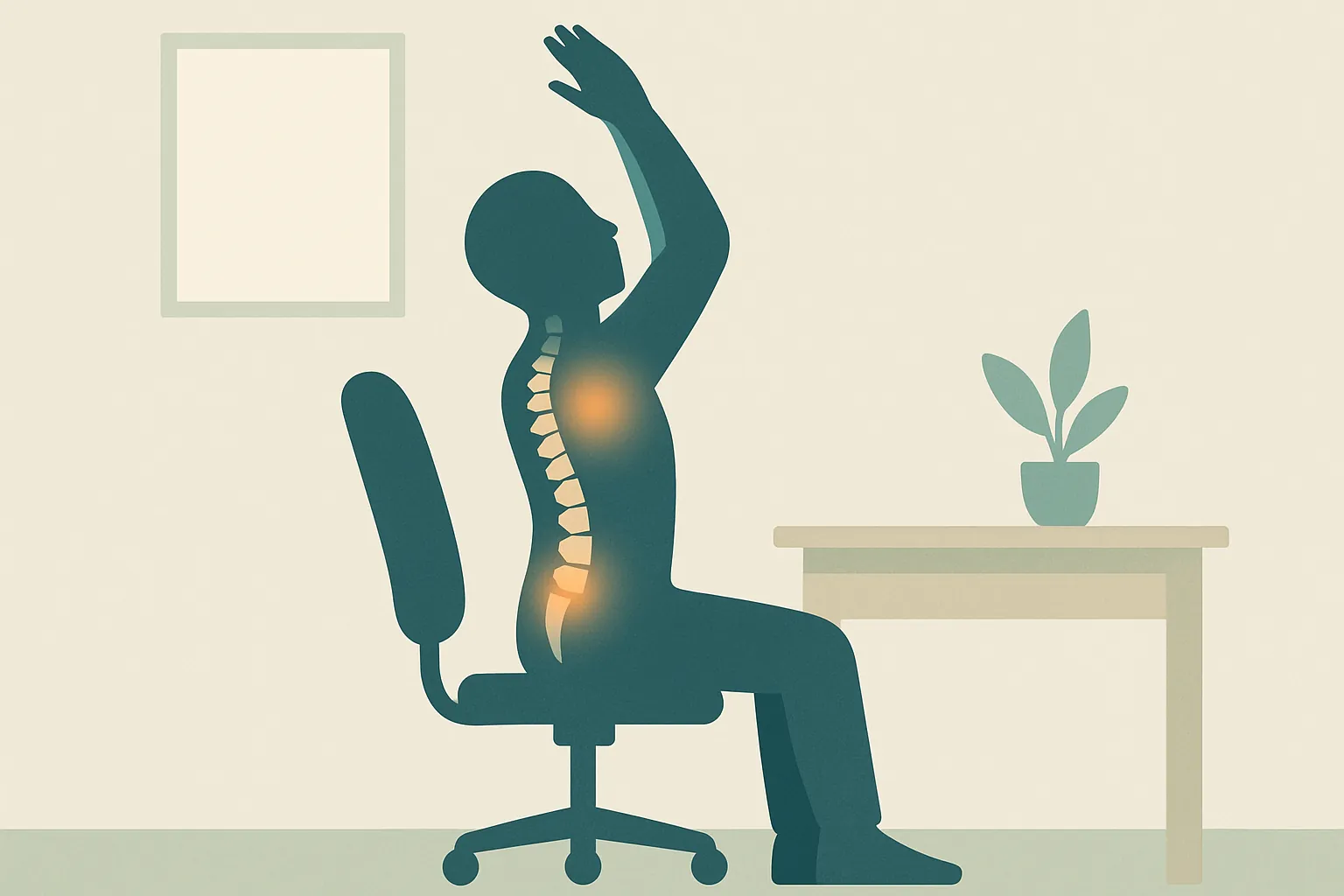
Key takeaway
Therapists spend their days leaning forward, nodding, and holding tension to stay attuned to clients—a posture that quietly loads the cervical spine and hip flexors and drives chronic neck and back pain. Because that pain drains cognitive resources and clouds clinical judgment, physical self-care is an ethical issue, not just a comfort one. A short 5-minute routine between sessions (sternocleidomastoid release, thoracic mobility, hip-flexor stretch) eases the strain, and automating documentation can free up the recovery time clinicians rarely get.
When the Weight of Empathy Lands on Your Spine
How many clients did you sit across from today? And during all those hours, how did your neck and back hold up?
In session, we lean forward slightly so we don't miss a fleeting change in expression. We nod almost continuously to signal that we're with the client. We unconsciously brace our shoulders to hold the weight of someone else's distress. This active listening posture is essential to building the working alliance—yet, ironically, it can leave a clinician's body with a very real occupational injury.
Many therapists describe feeling "physically battered just from listening." That is not ordinary tiredness. As a form of somatic countertransference, the muscular tension a client carries can register in the clinician's own body, producing genuine stiffness and guarding. Add the administrative load of writing progress notes, and most of the day is spent frozen between a client and a screen.
This matters beyond comfort. Physical discomfort narrows attention and can cloud clinical judgment—which ties it directly to competence, professional responsibility, and the ethics of the work. A clinician's body is not a side concern; it is part of the instrument.
Your Body: Instrument of Empathy, or Storehouse of Pain?
The body is the most important tool we bring to the room. So what happens when that tool rusts and seizes up? From a clinical-psychology standpoint, chronic pain is a key accelerant of burnout. Pain continuously consumes cognitive resources, and that drain undercuts the presence required to be fully with a client.
The anatomy of the listening posture
Clinicians carry a stress pattern unlike that of typical desk work. The rounded shoulders of attentive listening and the slight neck extension we use to hold eye contact place a heavy load on the cervical spine. Research on cervical loading suggests that tilting the head forward just 15 degrees increases the load on the neck to roughly 27 pounds (about 12 kg)—the equivalent of hanging a bowling ball from your neck for the full 50-minute hour. Repeated session after session, this disrupts autonomic balance, feeds chronic fatigue and headaches, and quietly erodes the quality of care.
How pain shows up in the room
Comparing how a clinician functions in a pain-free versus a chronically tense state makes clear why stretching is a necessity, not a luxury.
| Domain | Pain-free / relaxed | Chronic pain / tension |
|---|---|---|
| Attention | Full immersion in the client's verbal and nonverbal cues | Brain resources diverted to processing pain (roughly 20–30% drop in focus) |
| Countertransference | Clear separation between your feelings and the client's | Physical irritation risks being misread as negative feeling toward the client |
| Empathy / holding | Spacious capacity to hold the client's affect | Accelerated compassion fatigue; emotional defenses come online |
| After the session | Quick recovery, ready for the next client | Residual tension accumulates; depletion lingers long after the workday |
Table 1. Clinical functioning by physical state.
Five Minutes Between Sessions: A Survival Routine
The ten minutes between a finished session and the next client usually evaporate—a quick trip to the restroom, a scramble to jot down notes. But just five minutes can determine the quality of your entire afternoon. No sweat, no mat, no changing clothes: here is a practical routine you can run right from your chair.
1. Sternocleidomastoid (SCM) release — undoing all that nodding
The muscle you use most in session is the SCM at the front of the neck—the one that fires every time you nod. When it shortens, it drives forward-head posture and headaches.
- Stack both hands just below your collarbones and apply gentle, steady pressure.
- Slowly tilt your head back, lifting your chin toward the ceiling.
- Turn your head slightly left and right, holding the stretch along the front of the neck for about 15 seconds.
2. Thoracic mobility — reopening a chest closed by empathy
Leaning toward the client contracts the chest and rounds the upper back. That shallows the breath and can heighten your own physiological arousal.
- Sit tall with your hips pushed all the way back, not resting against the chair.
- Interlace your hands behind your head and, as you inhale, open your elbows wide.
- Look up toward the ceiling and lift through the chest to extend the upper spine. (Keep the movement in the upper back—don't crank the lower back.)
3. Hip-flexor stretch — releasing the cost of sitting
Long hours of sitting shorten the iliopsoas at the front of the hip, a primary driver of low-back pain.
- Stand and place one foot up on the chair.
- Engage the glute of the standing leg and gently press your pelvis forward.
- Feel the lengthening down the front of the thigh and deep in the hip, and hold for about 20 seconds.
Redesigning the Environment for a Sustainable Practice
As important as the stretches themselves is protecting the time to do them. The main reason clinicians don't actually rest on their breaks is documentation. When transcribing a session or distilling its key points eats the gap, there's no margin left to even stand up. This is where it's worth rethinking the clinical environment with a little technological help.
AI-assisted documentation and session-transcript tools—platforms like Nabla, Heidi, or general-purpose transcription such as Otter—are increasingly common in clinical settings. Their value goes beyond trimming paperwork: they give the clinician time to physically recover. While the session is auto-transcribed and key themes surface on their own, you can step away from the screen, roll your shoulders back, and look out the window. With AI supporting the accuracy of the record, you can reserve your own body and mind for the deep empathy and insight that only a human can offer.
Used this way, technology doesn't replace the clinician—it helps the clinician show up as a more whole human being for the client, which may be the most ethical use of it there is. Choose a tool that is secure and confidentiality-first, such as Modalia AI, so that reclaiming your recovery time never comes at the cost of client privacy.
When your spine is upright, you are better able to help clients stand upright in their own lives. After your last session today, hand the notes to a tool for a moment, get out of the chair, and stretch—tall and wide. A healthy body is your best therapeutic instrument.
Frequently asked questions
Why do counselors develop neck and back pain so often?
The attentive listening posture—leaning forward, holding eye contact, and nodding repeatedly—loads the cervical spine and shortens the chest and hip flexors. Combined with long hours of seated documentation, this pattern drives forward-head posture, chronic neck pain, and low-back strain over time.
What is somatic countertransference, and how does it cause physical tension?
Somatic countertransference refers to bodily reactions a clinician has in response to a client. The muscular tension and guarding a client carries can register in the therapist's own body, producing genuine stiffness rather than ordinary fatigue.
Can physical pain really affect clinical judgment?
Yes. Pain continuously consumes cognitive resources, narrowing attention and reducing presence. It can also be misread internally—physical irritation may be mistaken for negative feeling toward a client—which is why physical self-care is tied to competence and professional ethics.
How can a 5-minute routine fit into a packed clinical day?
The routine is built for the gap between sessions and needs no equipment: a sternocleidomastoid release, a seated thoracic extension, and a standing hip-flexor stretch. Automating documentation can also free up the recovery minutes clinicians usually lose to note-writing.
This article was written and reviewed using Modalia AI's clinical guidelines, with professional human review before publication.
Related articles
 Case Conceptualization
Breaking the "Yes, But" Game: A Transactional Analysis Guide for Therapists
Every suggestion you offer gets met with "Yes, but..." Here's the TA structure behind that stall—and four clinical moves to break it.
7 min read Case Conceptualization
Yalom's The Gift of Therapy: Passages Every New Counselor Should Copy by Hand
Irvin Yalom's prescription for therapists who fear silence: meet your client as a "fellow traveler" and let the here-and-now become the heart of the work.
6 min read Case Conceptualization
Working With Silence in Therapy: What Client Silence Means and How to Hold It
Silence in session isn't empty space. Learn to read its clinical meaning, tell productive from defensive silence, and use it as a therapeutic tool.
6 min read