Move to Stay Present: Desk Stretches and Energy Habits for Counselors Who Sit All Day
Chronic neck and back strain quietly erodes therapeutic presence. Here are 10-minute between-session stretches and ergonomic fixes to protect your body and your clinical attunement.
Key takeaway
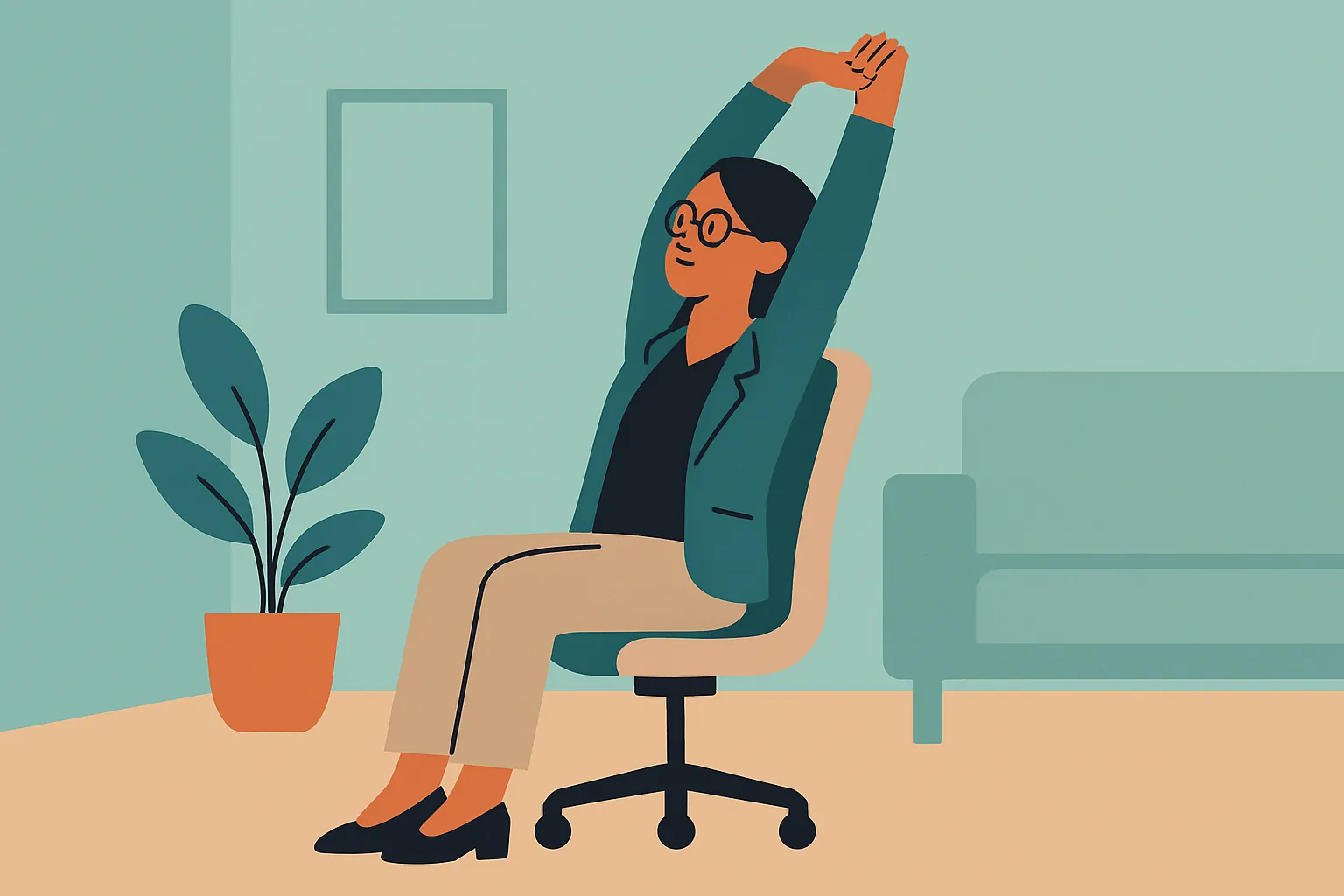
Counselors spend six to eight hours a day seated and attending closely to clients, and the physical strain this produces has measurable clinical costs. Drawing on embodied cognition theory, chronic pain and poor posture can stiffen nonverbal warmth, muddy somatic countertransference, and slow post-session documentation. This guide offers a 10-minute chair-based routine—sternocleidomastoid release, seated cat-cow, and a piriformis stretch—plus ergonomic changes that preserve the physical energy clinical work demands.
Empathy Runs on Stamina: A Between-Session Stretch Routine for the Seated Clinician
When the office door closes and you settle in across from a client, you step fully into their world. But after six to eight hours a day in a chair, leaning in to track every nuance of a story, it's easy to ignore the signals your own body is sending. Do you notice your lower back aching by the last session, or your neck seizing up the moment you sit down to write a note?
Most clinicians are attuned to compassion fatigue. Far fewer name its physical counterpart: the slow depletion of the body that sits underneath it. Research in embodied cognition suggests that a clinician's physical discomfort doesn't stay private—it leaks into posture, facial expression, and breath, shaping rapport and emotional attunement in ways neither party consciously registers. A stiff neck and a sore back are not just muscle problems. They can become obstacles to therapeutic presence. What follows is a practical routine you can run in the short break between 50-minute sessions to protect both your spine and your clinical sensitivity.
How Physical Discomfort Shows Up in the Room
The chronic musculoskeletal pain counselors carry is rarely "just" a personal health issue. Pain narrows attention and shortens patience. When you push through it to stay with a client, several clinical side effects can follow.
Confused somatic countertransference
Clinicians often read a client's affect through their own bodily sensations. But when your baseline already includes chronic pain, it becomes harder to tell whether a tightening in your chest or shoulders is a response evoked by the client or simply your own discomfort. That ambiguity can cloud clinical judgment at exactly the moments it matters most.
Stiffened nonverbal communication
Severe back pain rigidifies posture and flattens facial expression. A client can unconsciously misread that stiffness as rejection or boredom, which weakens your capacity to function as a secure base in the relationship.
Slower, costlier documentation
The focused work of writing up session notes and case conceptualizations after a client leaves demands sustained concentration. Tension headaches and fatigue from forward-head posture ("text neck") stretch routine administrative work out longer than it should take—eroding your quality of life one note at a time.
A Quick Self-Check: Symptoms and Their Clinical Cost
The table below maps the most common complaints among clinicians who sit for long stretches to their likely postural cause and their effect on the actual work of therapy. Use it to take stock of where you are right now.
| Symptom | Postural cause | Effect on clinical work |
|---|---|---|
| Forward head posture | Staring at a monitor while writing notes; craning toward a client out of over-engagement | Chronic headaches that degrade listening capacity; a furrowed brow that reads as disapproval |
| Rounded shoulders | Hunching forward with arms on the desk or knees while listening | Compressed chest and shallow breathing, rising internal anxiety, and a posture clients may read as defensive |
| Lower back pain | Sitting cross-legged or in a couch with poor lumbar support | More frequent shifting (distracting), and depleted empathic patience |
Table 1. Common musculoskeletal complaints in counselors and their clinical impact.
A 10-Minute "Chair Work" Stretch Routine
Carving out separate exercise time inside a packed caseload is rarely realistic. The following routine can be done without leaving your chair, or in a 10-minute break between sessions. It also calms the sympathetic nervous system and engages the parasympathetic—offering a small grounding ritual before the next client arrives.
1. Sternocleidomastoid release (the "listening" muscles)
These front-of-neck muscles do quiet, constant work every time you nod or tilt your head toward a client. Press gently down on your collarbone with both hands, then tip your head diagonally back and hold for 15 seconds on each side. This helps prevent tension headaches and softens facial muscles, making a warmer expression easier to hold.
2. Seated cat-cow (spinal mobility)
Sitting tall, inhale as you open your chest and gently arch your lower back (cow). Exhale as you round your spine and draw your gaze toward your navel (cat). The movement realigns the spine and opens a chest that's been compressed all day, making breathing during session noticeably easier.
3. Seated piriformis stretch (undoing the crossed-leg habit)
Sitting upright, rest one ankle on the opposite knee to make a "figure 4," keep your back straight, and lean your torso slowly forward. This releases the deep hip muscles, helps prevent sciatic pain, reduces lower-body swelling from prolonged sitting, and supports circulation.
Redesigning Your Space for Sustainable Practice
A counselor's physical health is one of the most basic ethical responsibilities you hold toward your clients. Beyond stretching, it's worth redesigning the work environment itself to be ergonomic and efficient. Start by raising your monitor to eye level, using lumbar support, and reducing the volume of repetitive typing.
Writing up session notes and tidying up your case log is one of the heaviest physical loads in the job—a frequent source of carpal tunnel strain and forward-head posture. Increasingly, tools exist to lighten that repetitive administrative burden.
Using an AI-assisted documentation tool is more than a convenience; it can be a deliberate strategy for conserving physical energy. When session content is transcribed automatically and key themes are surfaced for you, you can dramatically cut the time spent hunched over a keyboard. Modalia AI is built for exactly this—a security-first partner for counselors that handles transcription, case conceptualization support, and documentation so the stamina and focus you save can be reinvested where it belongs: in empathy and insight for your next client.
Action items you can start today
- Adjust your chair so your knees sit slightly below your hips, easing pressure on the pelvis.
- Reserve five minutes after each session for stretching and slow breathing, clearing the emotional residue of the previous client.
- Seriously evaluate voice-recognition or AI documentation tools to cut down on repetitive typing.
- Start a "healthy office" challenge with colleagues and give each other posture feedback.
References
- 1.
Frequently asked questions
How does physical discomfort actually affect my work with clients?
Embodied cognition research suggests pain and poor posture leak into your nonverbal behavior—stiffening facial expression, flattening warmth, and shortening patience. A rigid posture can be misread by clients as rejection or boredom, and chronic pain can make it harder to distinguish your own bodily sensations from somatic countertransference, clouding clinical judgment.
Can I really do meaningful stretching in a 10-minute break?
Yes. A short, targeted chair routine—sternocleidomastoid release, seated cat-cow, and a piriformis stretch—addresses the specific muscle groups strained by seated clinical work. It also calms the sympathetic nervous system and supports a grounding reset before your next client arrives.
What ergonomic changes give counselors the biggest return?
Raise your monitor to eye level, use lumbar support, and set your chair so your knees sit slightly below your hips. Beyond hardware, reducing repetitive typing—through voice recognition or AI-assisted documentation—is one of the most effective ways to cut the strain that drives carpal tunnel and forward-head posture.
This article was written and reviewed using Modalia AI's clinical guidelines, with professional human review before publication.
Related articles
 Case Conceptualization
Breaking the "Yes, But" Game: A Transactional Analysis Guide for Therapists
Every suggestion you offer gets met with "Yes, but..." Here's the TA structure behind that stall—and four clinical moves to break it.
7 min read Case Conceptualization
Yalom's The Gift of Therapy: Passages Every New Counselor Should Copy by Hand
Irvin Yalom's prescription for therapists who fear silence: meet your client as a "fellow traveler" and let the here-and-now become the heart of the work.
6 min read Case Conceptualization
Working With Silence in Therapy: What Client Silence Means and How to Hold It
Silence in session isn't empty space. Learn to read its clinical meaning, tell productive from defensive silence, and use it as a therapeutic tool.
6 min read