When Your Clients Show Up in Your Dreams: Meditation for the Counselor's Overworked Brain
Clients echoing in your head after hours? Learn the brain science behind session residue—and three grounded meditation techniques to log off and protect against burnout.
Key takeaway
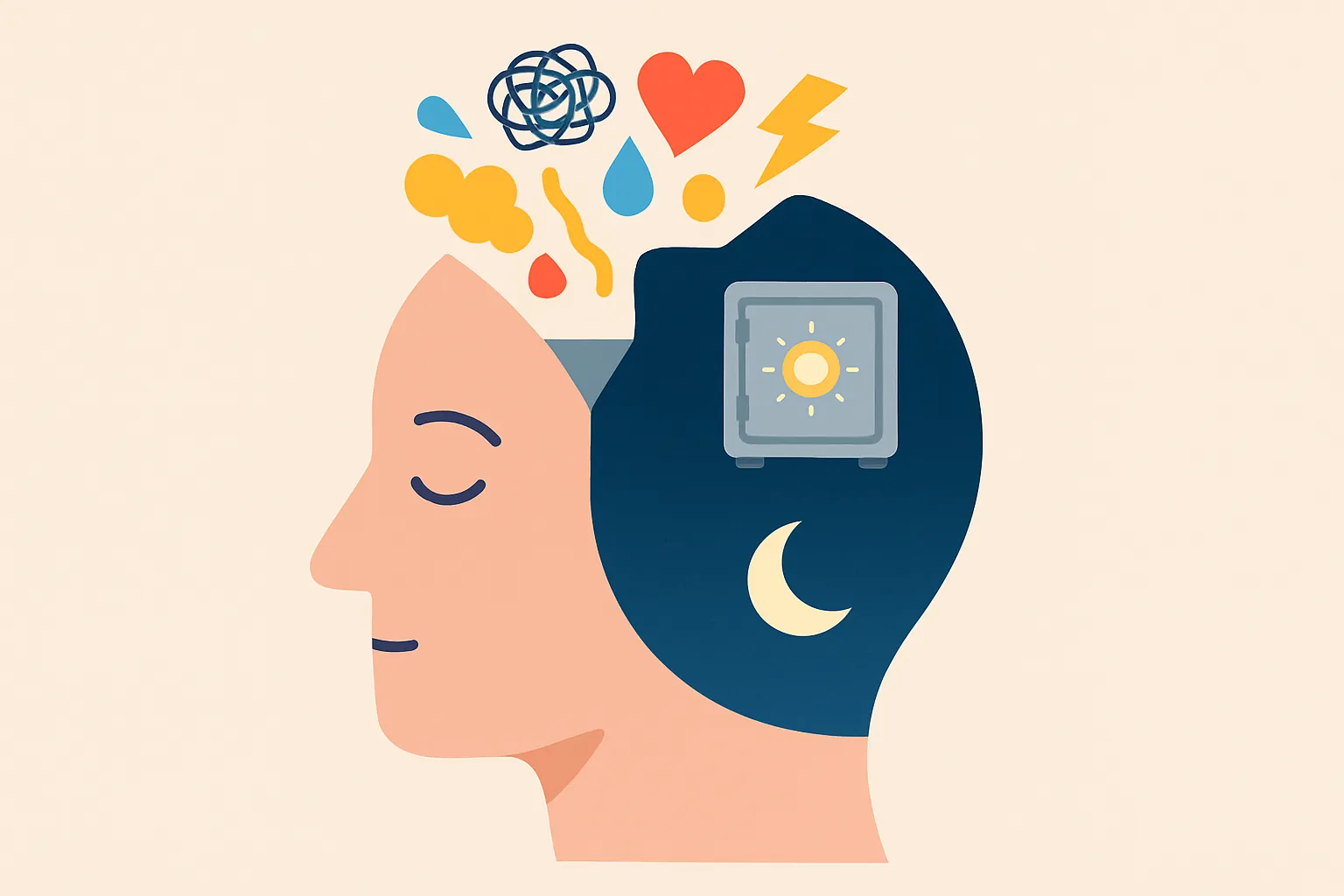
If a client's voice lingers after you've left the office, or session scenes replay in your dreams, your brain hasn't finished "logging off." This residue is explained by the Zeigarnik effect (unfinished tasks stay active in memory), lingering mirror-neuron activation from deep empathic attunement, and cortisol elevated by ethical hypervigilance. To clear it, use a Container visualization to safely "store" heavy material until next session, 5-4-3-2-1 grounding to return to the present, and a physical leave-work ritual that acts as an off-switch. Because documentation pressure intensifies the Zeigarnik effect, reducing cognitive load is directly tied to restoring sleep quality.
When the Session Won't End: Why Clients Follow You Home
Have you ever left the office only to keep hearing a client's voice, or watched a session replay itself in your dreams? If you wake up more depleted than rested—as though you'd spent the whole night doing therapy—that's not just a dream. It's a signal.
In the room, we act as a container: we take in, hold, and metabolize our clients' pain and affect. But a container that never gets emptied eventually overflows into burnout or vicarious trauma. When the residue of a session starts bleeding into your evenings and your sleep, it means your clinical brain hasn't yet logged off. That matters not only for your own health, but for your capacity to bring an optimal therapeutic self to the next person who walks in.
This piece looks at the psychological and neuroscientific reasons session residue lingers, then offers concrete meditation practices and rituals to clear it—so your nights can belong to you again.
The Psychology: Why a Client Ends Up in Your Dreams
When the brain can't power down after a session has ended, a few core mechanisms are usually at work. Understanding them is the first step toward relief.
1. The Zeigarnik Effect and Unfinished Business
The human brain holds onto unfinished tasks far longer than completed ones—a phenomenon first described by Bluma Zeigarnik. If a client's disclosure trailed off ambiguously, or you left the office without finishing your progress notes, the brain files that as an open loop. Even during sleep, it keeps working the puzzle, and the unfinished material surfaces as dreams.
2. Mirror Neurons and Empathy Fatigue
Deep empathic attunement recruits the mirror-neuron system to simulate what a client is feeling. The problem arises when that emotional synchrony runs so hot that the switch doesn't flip off once the session ends. This is one face of countertransference: the client's affect lingers in your own nervous system, and the boundary between their experience and yours blurs.
3. Ethical Hypervigilance and Over-Responsibility
"Did I miss something? Was that intervention appropriate?" This kind of self-scrutiny and ethical conscientiousness keeps cortisol elevated and the nervous system in a state of arousal. Chronically raised cortisol degrades sleep quality and interferes with the memory-processing work the brain does during REM.
A Quick Self-Check: Ordinary Fatigue, Burnout, or Vicarious Trauma?
Not all session residue is pathological. But it helps to know whether what you're experiencing is transient—or whether it calls for active intervention. Use the table below to take stock.
Clinical distinctions: Healthy Empathy vs. Residue/Burnout vs. Vicarious Trauma
| Healthy Empathy | Session Residue & Burnout | Vicarious Trauma | |
|---|---|---|---|
| Core signs | Brief post-session fatigue; recovers easily | Chronic exhaustion, cynicism toward clients, frequent appearance in dreams | Re-experiencing a client's trauma, negative shifts in worldview, avoidance |
| Sleep | Restorative sleep | Trouble falling asleep, light sleep, work-related dreams | Nightmares, insomnia, night terrors |
| Emotional response | Sense of meaning and accomplishment | Helplessness, irritability, urge to escape | Fear, hyperarousal, excessive anxiety about safety |
| What's needed | Ordinary rest | Active meditation, time off, peer supervision | Professional treatment and extended recovery |
Three Meditation Techniques to Rinse the Clinical Brain
To clear the residue and return to your off-duty self, the brain needs a deliberate transition ritual. The following practices are practical and well established in clinical settings.
1. The "Container" Visualization
Drawn from trauma treatment, this technique is just as useful turned toward yourself.
- How: Close your eyes and picture a sturdy, secure vault or box—your container.
- Before leaving for the day, take the heavy emotions from today's sessions, the client problems that remain unresolved, and your own anxiety, and give each a visual form. Place them inside the box.
- Tell yourself, "This stays safely stored here until our next session," and imagine locking it.
- The ritual signals to your brain that it's safe to pause processing this material and shift into rest mode.
2. The 5-4-3-2-1 Grounding Practice
Therapy is a highly abstract, verbal activity. To rest an overloaded language center, anchor yourself in sensation and return to the here and now.
- See (5): Silently name five things you can see (the clock, a plant, your desk…).
- Touch (4): Notice four things you can feel (the chair against your back, the floor under your feet, the fabric of your clothes…).
- Hear (3): Identify three sounds around you.
- Smell (2): Notice two scents.
- Taste (1): Notice one taste in your mouth.
3. A Leave-Work Ritual and Physical Boundaries
Alongside meditation, physical boundary-setting is essential. Let a specific moment—crossing the threshold of your office, or taking off a cardigan you wear only for sessions—become your switch-off trigger.
- Washing your hands: As the water runs over them, imagine the day's emotional residue rinsing away with it.
- Leaving it at the door: Before you step inside your home, picture brushing off the energy you carried from outside.
Closing: Protect Your Mental Margin with Smarter Tools
Clients can only be well if their counselors are well. A client appearing in your dreams is evidence of how seriously you hold their care—but it's also your brain asking for rest. Try the practices above starting on tonight's commute home.
Guarding against burnout also means lowering the cognitive load of administrative work. The compulsion to remember every detail perfectly, and the burden of documentation, amplify the Zeigarnik effect and become a leading cause of disrupted sleep.
This is where AI session-documentation tools can genuinely help. When a tool securely converts your sessions into text and summarizes the key points, your brain gets to relax: "The record is safely kept—I'm allowed to let go now." That kind of cognitive offloading frees up mental energy that can go entirely toward your own recovery and the insight you'll bring to your next session.
An action plan for today:
- Take three minutes before you leave to lock today's residue away with the Container technique.
- Consider adopting an AI documentation tool to ease the pressure to remember everything.
- Tonight, let yourself dream only for you.
References
- 1.
Frequently asked questions
Why do I keep dreaming about my clients?
Unfinished sessions and incomplete notes register in the brain as open loops (the Zeigarnik effect), so it keeps processing them during sleep. Intense empathic attunement can also leave mirror-neuron activity running after hours, and ethical hypervigilance keeps cortisol elevated—together disrupting REM sleep and surfacing as work-related dreams.
How do I know if it's normal fatigue or vicarious trauma?
Healthy empathy produces brief fatigue that resolves with ordinary rest. Burnout brings chronic exhaustion, cynicism, and frequent work dreams—and calls for active recovery and peer supervision. Vicarious trauma involves re-experiencing a client's trauma, nightmares, hyperarousal, and worldview shifts, and warrants professional treatment.
What's the fastest way to 'switch off' after a hard session?
Pair a brief Container visualization—mentally locking the day's heavy material in a secure box until next session—with a 5-4-3-2-1 grounding exercise to return to the present, then a physical ritual like washing your hands or changing clothes to mark the boundary between work and home.
Can reducing documentation load actually improve my sleep?
Yes. The pressure to remember every detail and complete records perfectly intensifies the Zeigarnik effect, keeping the brain in an unfinished-task state. Offloading documentation to a secure tool lets the brain release the material, which is directly tied to better sleep quality and recovery.
This article was written and reviewed using Modalia AI's clinical guidelines, with professional human review before publication.
Related articles
 Case Conceptualization
Breaking the "Yes, But" Game: A Transactional Analysis Guide for Therapists
Every suggestion you offer gets met with "Yes, but..." Here's the TA structure behind that stall—and four clinical moves to break it.
7 min read Case Conceptualization
Yalom's The Gift of Therapy: Passages Every New Counselor Should Copy by Hand
Irvin Yalom's prescription for therapists who fear silence: meet your client as a "fellow traveler" and let the here-and-now become the heart of the work.
6 min read Case Conceptualization
Working With Silence in Therapy: What Client Silence Means and How to Hold It
Silence in session isn't empty space. Learn to read its clinical meaning, tell productive from defensive silence, and use it as a therapeutic tool.
6 min read