De-escalating Couples in Conflict: A Therapist's Guide to Intervening When Blame Takes Over
When a couples session erupts into mutual blame, here are four field-tested steps to reclaim therapeutic control and turn the fight into a breakthrough.
Key takeaway
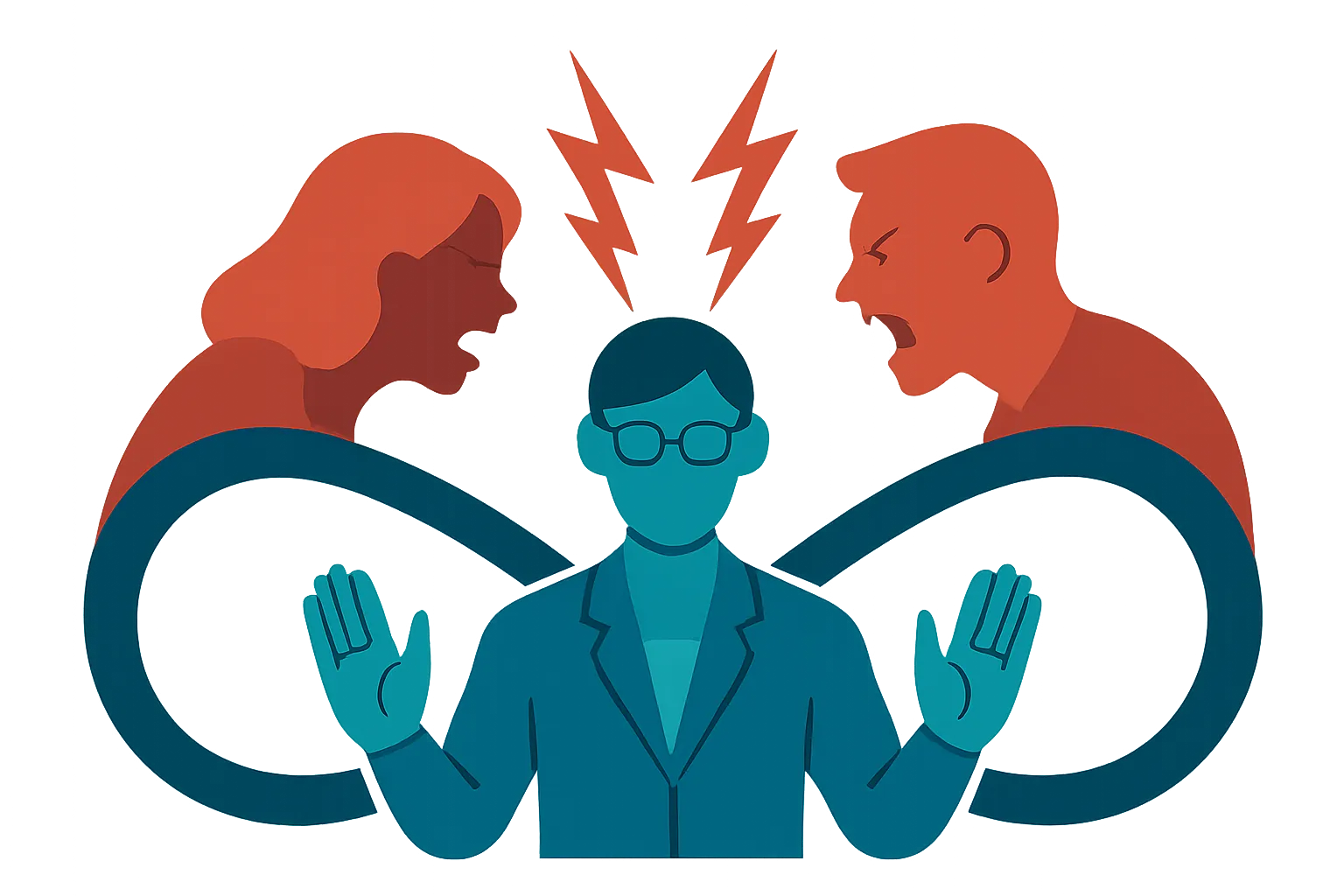
When a couples session erupts into mutual blame, the conflict is both a clinical dilemma and a decisive opportunity—the destructive pattern they live at home is now replaying in the here-and-now. Drawing on Gottman's concept of emotional flooding (a heart rate above 100 bpm shuts down the prefrontal cortex, making genuine listening biologically impossible), the therapist's first job is to restore a sense of safety rather than assign fault. Effective therapeutic intervention follows four steps: decisively stop the interaction, externalize the conflict onto the negative cycle rather than either partner's character, reflect the primary attachment emotions hidden beneath the blame, and coach a new way of speaking through enactment.
"Let me finish!" — When the Therapy Room Becomes a Battlefield
Most clinicians who do couples work know the feeling. A session that opened calmly tips, in the span of one accusation, into raised voices and crossfire.
"You always do this." — "When? You started it!"
High-conflict moments like these are stressful for the therapist, too. Newer clinicians often freeze or shrink back; even seasoned therapists face a recurring ethical and clinical dilemma—how to contain this intensity without taking a side. Holding the room while two people come apart is genuinely hard work.
And yet, paradoxically, a couple fighting in your office is a decisive therapeutic opportunity. The destructive pattern they rehearse at home is now unfolding in the here-and-now, in front of you. If you can't intervene to interrupt that cycle, the couple leaves with a familiar verdict: "Therapy doesn't help." If you can, you have something to work with that no amount of calm retrospective reporting could give you.
So how do we step therapeutically between two people who are blaming each other and flooded with emotion? Below is a closer look at the intervention skills and clinical strategy for handling blame and conflict—one of the hardest moments in couples work.
1. Why They Can't Stop: Understanding Emotional Flooding
Before we talk technique, we need to understand the mechanism: why can't a couple stop attacking each other, even in the room with you? John Gottman named this state emotional flooding.
When heart rate climbs past roughly 100 beats per minute and cortisol floods the system, the brain loses access to the prefrontal cortex's reasoning capacity and hands the controls to the amygdala, which governs the fight-or-flight response. In that state, a partner's words register not as information but as attack. In other words, no matter how skillfully you invite a rational exchange, listening has become biologically impossible.
That reframes the therapist's first objective. It is not to determine who is at fault. It is to bring down the physiological arousal and restore a felt sense of safety. Everything else depends on it.
2. Structuring vs. Intervening: What Therapeutic Containment Actually Looks Like
Many therapists, in the act of breaking up a fight, inadvertently trigger a client's defenses or appear to take a side. Simply stopping the argument is not the same as a therapeutic intervention. The table below is a useful way to check where your own moves tend to land.
| Dimension | Ineffective intervention (to avoid) | Therapeutic intervention (to aim for) |
|---|---|---|
| Focus | Content — "Who said it first? Did you really say that?" | Process — "Let's notice the way the two of you are talking right now." |
| Stance | Judge or bystander — adjudicating fault, or letting the fight run its course | Active director — firmly halting the exchange and providing a safe structure |
| Goal | Temporarily papering over the conflict — "Okay, let's calm down and talk about something else." | Helping the couple see the negative cycle — "This same pattern repeats at home and keeps hurting you both." |
Table 1. Ineffective intervention vs. therapeutic intervention in couples work.
3. In Practice: A Four-Step Method for Reclaiming the Room
Understanding the theory is one thing; staying composed once the shouting starts is another. Here is a concrete four-step process you can use in real time.
Step 1 — The Stop Action: A Firm, Decisive Halt
The first task is simply to stop the fight. This is as much nonverbal as verbal. Raise an open palm, lean forward, signal physically that you are stepping in.
Therapist: "Hold on—I'm going to ask you both to pause. The way you're talking to each other right now is only causing more pain, and I'm going to step in for a moment to keep this room safe."
Step 2 — Externalizing the Problem
Move the cause of the fight away from either partner's character and onto the negative interaction cycle the two of them share. This helps the couple stop seeing each other as the enemy and start recognizing the pattern as the thing they have to fight together. It's a technique strongly emphasized in Emotionally Focused Therapy (EFT).
Therapist: "There it is again—that pattern. The more one of you pulls back, the harder the other pushes; and the harder the push, the further the other withdraws. The enemy isn't either of you. This cycle is the enemy."
Step 3 — Reading the Attachment Need Beneath the Surface Emotion
Blame and anger are usually a shield protecting more vulnerable, primary emotions—fear, loneliness, the dread of rejection. Your job is to catch the tender feeling hidden inside the sharp words and give it voice.
Therapist: "It looks like anger on the surface, but what I hear underneath is, 'I'm terrified you'll leave me.' Maybe this isn't really about being angry—maybe it's the fear of losing your connection to each other."
Step 4 — Enactment: Trying a New Interaction
Don't stop at your own interpretation. Guide the couple to actually speak to each other in a new way—coaching them to share their hurt instead of hurling blame.
Therapist: "Could you say what you just said to me, but this time looking your partner in the eyes? Something like: 'I'm not trying to attack you—I've been struggling because I feel so alone.'"
4. Sharpening the Craft of Intervention
Intervening in couples work demands intense, sustained attention. You're tracking not just the words but the micro-shifts in expression, the breathing, the posture—nonverbal cues arriving in real time.
But in the middle of a heated exchange, it is nearly impossible to catch, hold, and record every data point. While you're working to de-escalate, the very thing that mattered most—the trigger, the exact word that made a client's face go hard—often slips past unnoticed.
This is why a clear-eyed review after the session is essential to raising the quality of your work:
- Check your own countertransference: Why do I shrink—or get sharper—when this particular client gets angry?
- Micro-analyze the pattern: In the split second the fight ignited, who sent which nonverbal signal?
- Streamline your documentation: Did absorption in note-taking cost me eye contact with the couple?
When a couple starts to fight, the therapist's intervention should be not a referee's whistle but a fence—a structure that safely holds both people. By recognizing emotional flooding, intervening in the process rather than the content of the blame, and touching the attachment needs underneath, you give the couple a chance to truly see each other again.
Still, all of this happens fast. "What exactly did I say back there?" "What was she saying right before he lost it?" Every couples therapist knows these questions. That's precisely why tools that free you to focus entirely on the session have become so valuable.
A growing number of clinicians now use secure, AI-assisted session documentation to solve exactly this problem. During the session you stay with the couple's dynamics; afterward, an accurate transcript captures the dialogue and the emotional flow for you. In high-volume, high-intensity couples sessions especially, being able to return to the decisive moment the conflict escalated—and analyze it—offers powerful insight for shaping the next session's strategy and your case conceptualization. Modalia AI was built for this kind of work: a security-first AI partner for counselors, handling transcription, case conceptualization, and documentation so your attention can stay where it belongs.
For your next couples session, consider setting the pen down and leaning fully into the two faces and feelings in front of you. A therapist's full, undivided presence is the single most powerful intervention tool you have.
References
- 1.
- 2.
Frequently asked questions
What is emotional flooding in couples therapy?
Emotional flooding, a concept developed by John Gottman, is a state of physiological overwhelm in which heart rate exceeds roughly 100 beats per minute and stress hormones surge. The prefrontal cortex's reasoning capacity goes offline and the amygdala's fight-or-flight response takes over, so a partner's words are perceived as attack rather than information. In this state, genuine listening is biologically impossible, which is why the therapist's first priority is restoring safety, not assigning fault.
Should I let a couple fight it out in session or intervene?
Intervene. Letting a destructive exchange run its course rarely produces insight and often leaves the couple feeling that therapy doesn't help. A fight in the room is a chance to interrupt, in the here-and-now, the very pattern the couple repeats at home. The goal is not to referee or assign blame, but to act as an active director who firmly halts the exchange and provides a safe structure.
How do I de-escalate a couple without appearing to take sides?
Shift focus from content to process and externalize the problem. Instead of asking who did what, name the negative interaction cycle as the shared enemy—for example, one partner pulling back while the other pushes harder. This frames the pattern, not either person, as the target, which lowers defensiveness and keeps you neutral while still firmly in charge of the room.
What is the difference between primary and secondary emotions in conflict?
Secondary emotions, such as anger and blame, are protective reactions that shield more vulnerable primary emotions like fear, loneliness, or the dread of rejection—core attachment feelings emphasized in Emotionally Focused Therapy. Effective intervention catches the tender primary emotion hidden inside sharp words and gives it voice, allowing partners to respond to each other's underlying needs rather than the surface attack.
This article was written and reviewed using Modalia AI's clinical guidelines, with professional human review before publication.
Related articles
 Case Conceptualization
Breaking the "Yes, But" Game: A Transactional Analysis Guide for Therapists
Every suggestion you offer gets met with "Yes, but..." Here's the TA structure behind that stall—and four clinical moves to break it.
7 min read Case Conceptualization
Yalom's The Gift of Therapy: Passages Every New Counselor Should Copy by Hand
Irvin Yalom's prescription for therapists who fear silence: meet your client as a "fellow traveler" and let the here-and-now become the heart of the work.
6 min read Case Conceptualization
Working With Silence in Therapy: What Client Silence Means and How to Hold It
Silence in session isn't empty space. Learn to read its clinical meaning, tell productive from defensive silence, and use it as a therapeutic tool.
6 min read