Can You Launch a Counseling Practice in a Coworking Space? Soundproofing and Confidentiality Realities
Coworking space looks affordable for a new therapy practice—but can it protect client confidentiality? A clinician's guide to soundproofing and security.
Key takeaway
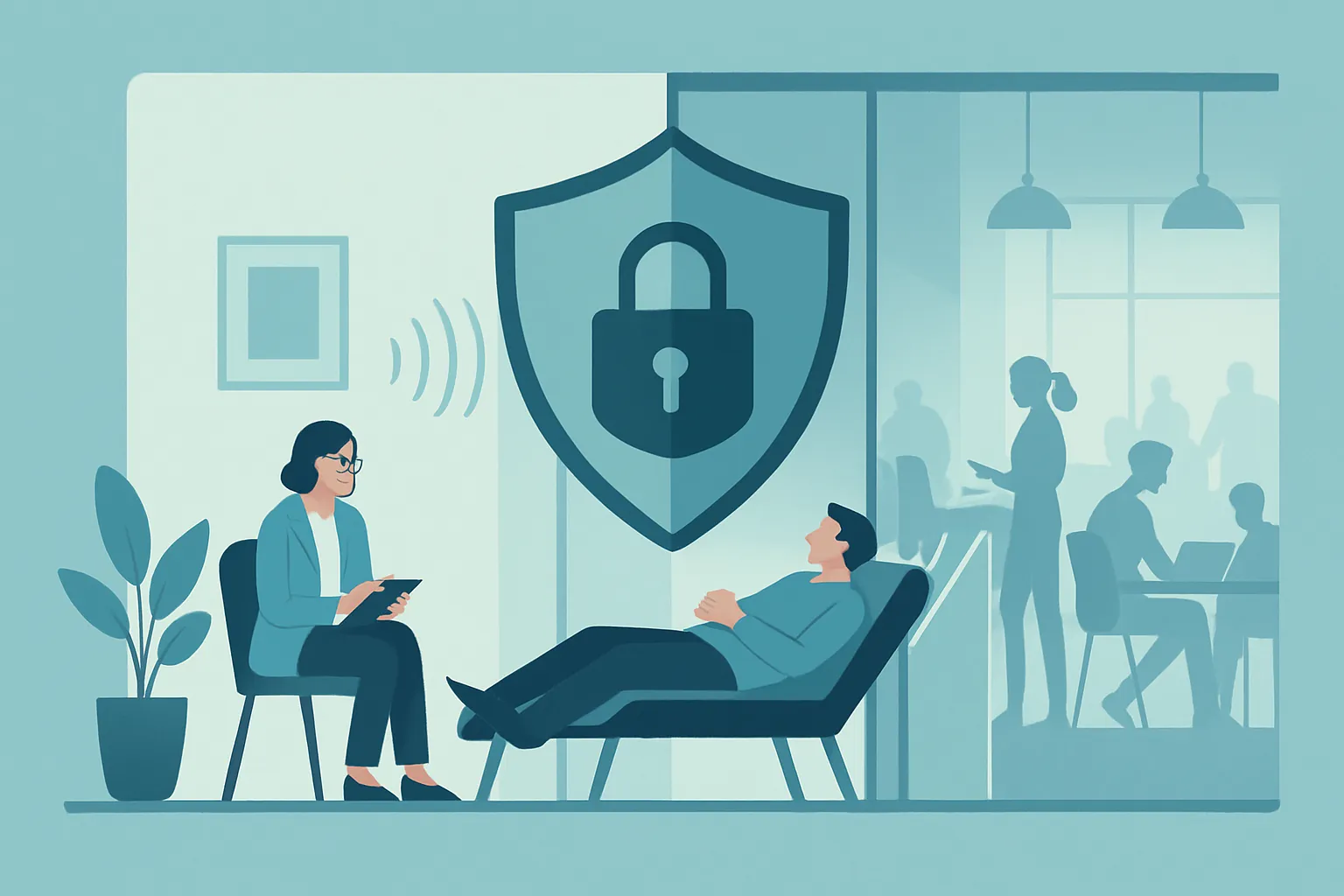
Coworking spaces offer low startup costs and easy access, but their thin partitions, glass walls, shared HVAC systems, and open common areas create structural threats to client confidentiality. To practice ethically in one, clinicians should add sound masking outside the room, choose corner offices with opaque walls, schedule sessions during off-peak hours, and keep records on a secured network rather than public Wi-Fi. Above all, the environment's limits must be disclosed to clients through informed consent before the first session.
The Hidden Cost of an Affordable Office: Confidentiality in a Coworking Space
If you're getting ready to open your own practice, you already know the tension well: the excitement of finally having your own space, set against the reality of deposits, build-out costs, and a lease you'll be paying for years. To soften that first hit, more and more clinicians are eyeing coworking spaces—WeWork, Regus, and similar operators—as a home for their practice. The polished interiors, the central locations, and above all the lower monthly cost are genuinely hard to argue with.
But our profession carries an obligation most tenants in those buildings never have to think about: protecting the client's psychological safety through confidentiality. When a client glances at the glass partition and asks, "I can hear the meeting next door—can they hear me?", even the most refined clinical technique loses its footing. The therapeutic frame has already cracked. So the question is worth taking seriously: is a coworking practice clinically and ethically defensible, and if you do choose one, what safeguards are non-negotiable?
Where the Coworking Model Collides With the Therapy Frame
In counseling, the room is never just a room. The physical environment functions as a kind of third presence in the work—a silent partner in the therapeutic alliance. Professional ethics codes (the APA Ethical Principles in the US, the BACP framework in the UK, and equivalents elsewhere) place client privacy at the very center of practice. Coworking spaces, by contrast, are designed for openness, visibility, and chance encounters. That's a structural conflict, not a detail to be smoothed over.
1. Thin walls and glass partitions
Most coworking layouts maximize usable square footage with lightweight drywall or glass partitions. Visually open, acoustically porous. The fear that a client's crying or a raw moment of anger might carry into the next suite doesn't just risk a breach—it quietly suppresses self-disclosure and makes the clinician hesitate to push where the work needs to go.
2. Sound leakage through shared HVAC
Even when the walls are solid, the ceiling plenum often isn't. Heating and cooling ducts frequently run continuously across multiple suites, and sound travels through them. This crosstalk can carry session content—and, worse, identifying details about a client—into rooms you have no control over. That's not background noise; it's a confidentiality violation waiting to happen.
3. Encounters in shared areas
Lounges, elevators, and corridors mean your client may run into employees from a dozen other companies on the way in. With the stigma around seeking mental health care still very real, the simple possibility of being seen is enough to erode attendance and, for some clients, end the work before it starts.
Coworking vs. Private Practice: A Clinical Comparison
None of this makes a coworking practice impossible. But the risk profile and the due-diligence checklist look very different from a conventional lease. The table below compares the two environments on the factors that actually matter clinically.
| Factor | Coworking Space | Private Practice |
|---|---|---|
| Soundproofing (STC rating) | Typically low (glass walls, gaps) | High (acoustic build-out possible) |
| Visual privacy | Needs window film; gaps likely | Fully controllable |
| Client flow | Shared (lounge, elevators) | Independent waiting area possible |
| Startup cost | Low (small deposit, no build-out) | High (deposit + acoustic build-out) |
| Ethical risk | High (mitigation required) | Low (controllable) |
Table 1. Comparing environmental factors in coworking vs. private practice settings.
A Realistic Checklist for Practicing in a Coworking Space
If the economics still point you toward coworking, there are defensive measures you should treat as the price of admission. These are the minimum safeguards that protect both the client and you against an ethics complaint.
1. Use sound masking and white noise
When you can't soundproof, you cover sound with sound. Place a white noise machine outside the door, in the corridor—not inside the room—so that conversation doesn't read clearly to anyone passing by. Inside, low ambient music helps neutralize incoming noise without intruding on the session.
2. Claim a corner room with opaque walls
Before you sign, get the floor plan and request a corner suite with the fewest adjacent neighbors. Favor opaque partition walls over all-glass rooms. If glass is unavoidable, add double curtains or acoustic panels to cut reflection and block sightlines.
3. Schedule off-peak
Weekday evenings—after the neighboring tenants have left for lunch or gone home—and weekends make strong primary session slots. Ambient noise drops, and the odds of your client crossing paths with a stranger fall dramatically.
4. Secure your network and your records
Public Wi-Fi is a liability. Sensitive notes and assessment results should move only over a personal hotspot or a separate secured network. Paper charts left on a desk are exposed to cleaning crews and other tenants—so encrypted digital records aren't a convenience, they're a control. If you handle protected health information, make sure your tools and your handling meet your jurisdiction's standard (HIPAA in the US, GDPR in the UK/EU).
Closing the Gap Between the Environment and the Standard of Care
A coworking practice carries a real economic advantage, but it shifts a heavy share of ethical and environmental control onto you. Where perfect soundproofing can't be guaranteed, informed consent comes first: the client must understand the environment's limits and agree to them before the work begins. In the end, what holds a session together isn't the finish of the room—it's the client's felt sense of safety.
And data security deserves as much attention as the walls. In a setting with as many external variables as a coworking space, it's harder to stay fully present with the client. This is where a security-first AI documentation partner earns its place. Modalia AI transcribes and summarizes sessions inside a hardened cloud environment, so you can attend to the nonverbal exchange instead of your notepad—and so a misplaced paper file never becomes the source of a breach. Used well, it lets you compensate for the limits of a physical wall with digital security and technical support, and hold your standard of care steady in almost any room.
Frequently Asked Questions
References
- 1.
- 2.
- 3.
Frequently asked questions
Is it ethical to run a counseling practice in a coworking space?
It can be, but only with active mitigation. Coworking layouts aren't built for confidentiality, so you must add soundproofing measures, control client flow, secure records, and—critically—disclose the environment's limits to clients through informed consent before the first session.
How do I soundproof a coworking therapy office?
Place a white noise machine in the corridor outside the door rather than inside, add low ambient music inside the room, choose a corner suite with opaque walls, and apply acoustic panels or double curtains to any glass partitions to cut sound reflection and block sightlines.
What's the biggest confidentiality risk in a shared office?
Two stand out: sound leaking through shared HVAC ducts (crosstalk) that thin walls can't stop, and clients being seen by other tenants in lounges, elevators, and corridors. Both can expose a client's identity even when the room itself feels private.
How should I handle client records in a coworking space?
Never use public Wi-Fi for sensitive material. Work over a personal hotspot or a separate secured network, keep records encrypted and digital rather than on paper that cleaning crews can see, and make sure your handling meets your jurisdiction's standard—HIPAA in the US or GDPR in the UK and EU.
This article was written and reviewed using Modalia AI's clinical guidelines, with professional human review before publication.
Related articles
 Clinical Skills
How to Write Better Supervision Questions: Getting What You Actually Need from Your Supervisor
Stuck on what to ask in supervision? Use these structured question strategies to turn vague check-ins into focused clinical insight.
7 min read Clinical Skills
From "The Client Seems Depressed" to a Clinical Hypothesis: How Word Choice Elevates Your Case Reports
Turn vague observations into precise clinical hypotheses. A practical guide to terminology and sentence formulas that make your case reports read like expert work.
7 min read Clinical Skills
The Wounded Healer Trap: Why "I Want to Heal Myself" Sinks Your Counseling Grad School SOP
Why admissions faculty flinch at "I want to heal my own wounds"—and how to transform personal pain into a research-grade statement of purpose that gets you in.
6 min read