When Friends and Family Ask You to Be Their Therapist: How to Decline Gracefully and Refer Well
A clinician's guide to handling counseling requests from friends and family—how to set the boundary, validate their courage, and refer with warmth.
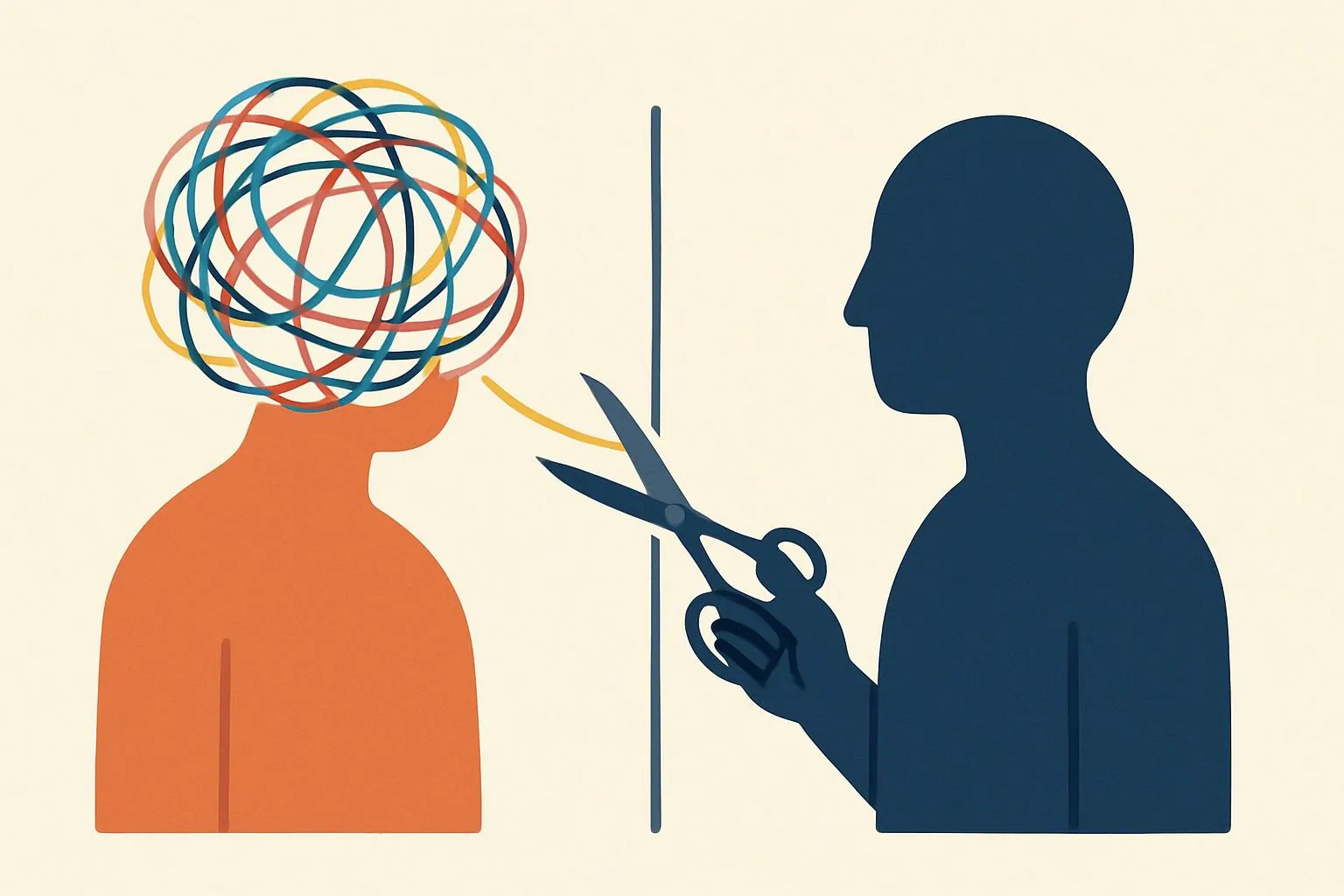
Key takeaway
When friends or family ask you to be their therapist, agreeing creates a dual relationship that compromises the very tools therapy depends on: objective neutrality and a clean transference field. Prior knowledge becomes a filter, your stake in their life skews your judgment, and contaminated transference/countertransference undermines outcomes. Both the ACA and BACP/NASW caution against dual relationships precisely because they harm the client. Declining is therefore not coldness but the most ethical way to ensure the person gets effective care—explained through a medical metaphor, paired with validation of their courage, and completed with a warm hand-off to a trusted colleague.
"Can't You Just Talk to Me About It?" Declining a Loved One's Request Without Damaging the Relationship
If you're a counselor or therapist, you've probably felt that small jolt at a family dinner or over drinks with old friends. "You're the expert—could you take a look at what's going on with my kid?" Or, more directly, "I've been really down lately. I think talking to you would be perfect."
The instinct to help is almost reflexive in our profession. But when the person asking is a close friend or a family member, that instinct collides with one of the most consequential boundaries in clinical practice: the dual relationship.
The closer the bond, the harder the no. Decline poorly and you risk being seen as withholding, stingy with your expertise, or quietly judgmental. Yet we know what the people asking often don't: a counseling relationship layered on top of an existing personal one loses its objectivity, blunts its effectiveness, and can damage the very relationship it was meant to protect. So how do you honor your professional ethics, protect the connection, and actually steer the person toward better help? This piece walks through why direct treatment of loved ones fails, and a concrete, three-part way to decline warmly and refer well.
Why You Can't Treat the People You Love: The Clinical and Ethical Case
Not treating friends and family is more than a rule of etiquette—it sits at the heart of what makes therapy work. Professional ethics codes, including the ACA Code of Ethics in the US and the BACP and NASW frameworks in the UK and across social work, all caution practitioners to avoid dual or multiple relationships that risk impairing judgment or harming the client. The reason is structural: two of therapy's core instruments—objective neutrality and a usable transference field—stop functioning when a personal history is already in the room.
1. Lost Objectivity and Clinical Blind Spots
With a sibling or a friend, you arrive carrying years of prior information and feeling. "That's just how she's always been" becomes a powerful filter that keeps you from hearing the client's present concern on its own terms. Worse, you become a stakeholder in the outcome. If a friend is weighing whether to leave a marriage, some part of you is unconsciously calculating what that change means for you—your social circle, your loyalties, your own comfort. That stake quietly bends the intervention away from the client's interests.
2. Contaminated Transference and Countertransference
In the consulting room, the feelings a client projects onto the therapist (transference) are valuable clinical material. But when a personal relationship already exists, those projections fuse with real shared history, and the analysis becomes impossible to do cleanly. You're vulnerable, too: the inflated sense of responsibility—"what if I can't fix this for someone I love?"—is countertransference that makes the professional holding function very hard to sustain.
For these reasons, a clinician has to be genuinely convinced of something before the conversation even starts: declining to treat a loved one is not a refusal—it's the most ethical choice available, the one that protects them and gets them the most effective care. That conviction is what lets your language be both firm and gentle.
Supportive Relationship vs. Therapeutic Relationship: What's Actually Different
Non-clinicians often blur the line between "advice from a friend" and "professional therapy." Naming the difference explicitly helps. What you can offer a loved one is personal support; professional treatment belongs with a third party. The contrast looks like this:
| Dimension | Social Support (Friend/Family) | Therapeutic Relationship (Counselor/Client) |
|---|---|---|
| Primary purpose | Mutual connection, comfort, emotional exchange | The client's problem-solving, insight, behavior change |
| Direction | Reciprocal—both share struggles | One-directional—focus stays on the client |
| Objectivity | Subjective, partisan, empathically aligned | Objective neutrality, analytic stance |
| Boundary | Fluid and open | Structured frame: time, place, fee |
| Confidentiality | Based on trust, no legal duty | Legal and ethical obligation (with defined exceptions) |
Table 1. Structural differences between a social relationship and a professional counseling relationship.
A Three-Step Strategy: Refer Like a Professional Without Causing Hurt
So what do you actually say? "I can't, it's against the ethics code" lands as a brush-off. Try this three-part sequence instead.
Step 1: Use a Medical Metaphor
The cleanest way to make the invisible structure of therapy visible is the surgeon analogy. It depersonalizes the no and foregrounds your professional stance.
"Treating a family member or close friend is a bit like a surgeon operating on their own child. Their hands shake—not from a lack of skill, but because they care too much to be precise. Because I know you and care about you, I'd lose the objectivity you'd actually need. You deserve the best possible care, and we're simply too close for me to be the one who provides it."
Step 2: Affirm Their Courage and Validate the Problem
Acknowledge that asking for help took real courage. This replaces the feeling of being turned away with the feeling of being understood.
"Thank you for trusting me with this. I can feel how much you want to work through it, and how hard it's been to carry alone. From a professional standpoint, what you're describing is exactly the kind of thing that genuinely improves with the right support."
Step 3: Offer a Concrete, Trustworthy Alternative (Active Referral)
Don't stop at "go find someone." A warm hand-off to a trusted colleague or service is where your professional network earns its keep.
"I know a colleague who is genuinely excellent with exactly this—depression, kids, couples work, whatever fits. I think you'd click with them. If you're open to it, I can share their details or even write a referral note. They'll be able to help you far more objectively than I could—and I'll be cheering you on the whole way, as your friend."
If they prefer to search on their own, point them to reputable directories—your national professional association's "find a therapist" tool (for example, the ACA, BACP, or APA referral directories) or a vetted platform like Psychology Today—rather than leaving them to navigate alone.
Conclusion: The Boundary Is the Most Professional Form of Care
Declining a loved one's request isn't callousness. It's the responsible act of a professional ensuring the person gets the best possible treatment. Inside the consulting room we have to be the clear-eyed clinician; outside it, we get to remain the warm friend or family member. Holding that line is what protects both of us.
There's a practical corollary worth naming. When you refer a person out—or when a colleague refers a new client to you—you need to grasp the case quickly and build an accurate plan of intervention. With clients who bring complex histories, the sheer volume of information from intake can consume the energy you'd rather spend on the relationship itself. This is where a security-first AI partner for counselors can genuinely help: accurate transcription of the session, support with case conceptualization, and faster documentation, so the administrative load lifts and you can stay fully present for the clinical work. Refer your loved ones to the best colleague you know, and give your own clients the high-density attention they deserve. That's what a thoughtful, modern practice looks like.
References
- 1.
- 2.
- 3.
- 4.
Frequently asked questions
Is it ever ethical to provide therapy to a friend or family member?
Major ethics codes (ACA, BACP, NASW, APA) advise avoiding dual relationships because they impair objectivity and risk harming the client. In rare, unavoidable situations—such as a remote area with no other provider—a clinician may have to weigh limited options, but the default standard is to decline and refer to a qualified colleague.
How do I say no without hurting the relationship?
Lead with a medical metaphor (a surgeon doesn't operate on their own child) to depersonalize the boundary, then validate the courage it took to ask, and finish with a concrete referral. Framing the no as protecting their care—not rejecting them—preserves the relationship.
What is a 'warm hand-off' in a referral?
Instead of telling someone to 'find a therapist,' you actively connect them to a specific, trusted clinician—sharing contact details, offering to write a referral note, or pointing them to a reputable professional directory. It signals continued support rather than dismissal.
Why does a prior personal relationship harm the therapy itself?
Existing knowledge becomes a filter that distorts how you hear the client's current concerns, your personal stake in their decisions biases your interventions, and transference and countertransference get tangled with real shared history—making them impossible to use as clean clinical material.
This article was written and reviewed using Modalia AI's clinical guidelines, with professional human review before publication.
Related articles
 Case Conceptualization
Breaking the "Yes, But" Game: A Transactional Analysis Guide for Therapists
Every suggestion you offer gets met with "Yes, but..." Here's the TA structure behind that stall—and four clinical moves to break it.
7 min read Case Conceptualization
Yalom's The Gift of Therapy: Passages Every New Counselor Should Copy by Hand
Irvin Yalom's prescription for therapists who fear silence: meet your client as a "fellow traveler" and let the here-and-now become the heart of the work.
6 min read Case Conceptualization
Working With Silence in Therapy: What Client Silence Means and How to Hold It
Silence in session isn't empty space. Learn to read its clinical meaning, tell productive from defensive silence, and use it as a therapeutic tool.
6 min read