Reading the Unconscious: Using Defense Mechanisms in Psychoanalytic Case Conceptualization
A clinician's guide to identifying a client's defense mechanisms—by maturity level—to read unconscious patterns and build a sharper case conceptualization.
Key takeaway
When a client's behavior seems contradictory, it often reflects unconsciously constructed defense mechanisms, and identifying a client's primary defenses is central to case conceptualization. Defenses fall along a continuum—immature, neurotic, and mature—and their maturity correlates closely with ego strength and prognosis. In practice, three strategies sharpen detection: noticing mismatches between content and affect, using countertransference diagnostically, and analyzing recurring verbal patterns in the session record.
Why Did the Client Go Silent Right Then? Mapping the Unconscious Through Defense Mechanisms
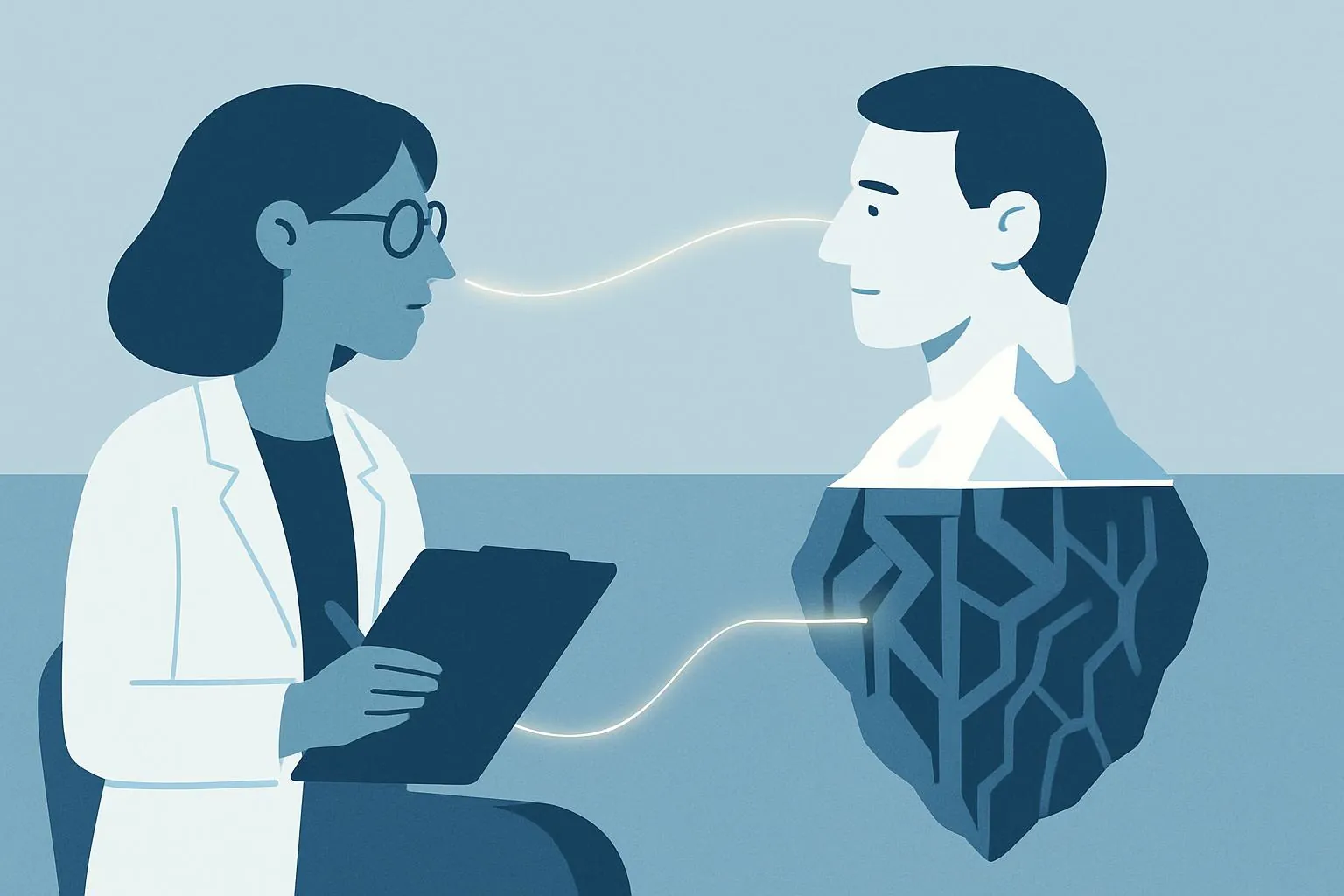
Every clinician knows the moment: a client insists they want change, then refuses a pivotal intervention at the decisive instant—or turns on you with anger that seems to come from nowhere. The reaction can be disorienting enough to make even experienced counselors question their own competence. From a psychoanalytic perspective, though, these contradictions are rarely random. They are most often the visible edge of a defense mechanism—an unconscious structure the client has built to protect themselves.
Reading the unconscious dynamics beneath a client's presenting problem is the heart of case conceptualization. Identifying the defenses a client relies on most heavily helps you understand their personality structure and, crucially, gives you a compass for strengthening the therapeutic alliance. Recent clinical literature also suggests that the maturity of a client's defenses is closely tied to their prognosis. So how do we catch the defense—that subtle signal living in the gap between what a client says and what they leave unsaid—and move toward deeper insight? This article lays out a practical approach to using defense mechanisms in case conceptualization.
Understanding the Armor: Defense Levels and What They Mean Clinically
Not every defense is pathological. Defenses are adaptive efforts to shield the ego from anxiety it cannot yet tolerate. George Vaillant and other psychoanalytic researchers organized defenses along a developmental continuum of maturity. By noticing which level of defense a client reaches for under stress, you can begin to gauge their ego strength and psychological developmental stage.
The table below groups commonly observed defenses by maturity level, with the clinical signs to watch for and a corresponding direction for intervention. Use it as a scaffold for analyzing a client's patterns more systematically.
| Defense Level | Key Mechanisms & Features | Clinical Signs (What the Client Does) | Intervention Strategy |
|---|---|---|---|
| Immature | Projection, Denial — distorts reality and locates the source of conflict outside the self | "You're saying that because you don't like me, right?" / "My problem isn't the drinking—it's my partner's nagging." | Build trust through empathic reflection rather than confrontation. Focus on strengthening reality testing. |
| Neurotic | Repression, Rationalization, Reaction Formation — pushes feeling out of awareness or supplies a plausible reason | (Forgets a significant event) / "I wasn't really angry—there was just nothing I could do about it." | Bring the unconscious into awareness through interpretation. Trace the links between conflicting feelings and behavior. |
| Mature | Sublimation, Humor — transforms conflict into socially acceptable expression | "Putting that anger into a painting actually settled me." / (Names a painful situation with wit) | Reinforce and support the healthy coping. Use it as a catalyst for ego growth. |
Table 1. Clinical features and intervention strategies by defense maturity level.
Whether a client leans primarily on projection or sidesteps feeling through intellectualization has a decisive bearing on how you set treatment goals. And when you can see the client not as "resistant" but as someone working hard to protect themselves, genuine empathy finally has somewhere to begin.
Three Field-Tested Strategies for Reading Hidden Patterns
Knowing the theory of defenses and catching them live in the room are two different skills. When a client speaks quickly or is emotionally flooded, the important cues are easy to miss. Here are three concrete ways experienced clinicians detect and work with defenses in practice.
-
Catch the Mismatch Between Content and Affect
When a client describes a horrific experience of abuse with a flat expression—or even a smile—that incongruity is a strong signal that isolation of affect is at work. Rather than getting pulled into the content, name the gap gently: "What you're describing sounds incredibly painful, yet your face looks calm. What are you noticing inside right now?" This invites the defense into the room without forcing it open.
-
Use Countertransference as a Diagnostic Instrument
If you find yourself unaccountably irritated with a client, drained of energy, or seized by an urge to overprotect them, consider projective identification. The client may be projecting an internal feeling they cannot bear onto you, prompting you to carry and feel it on their behalf. In these moments, your own emotional reaction becomes a mirror reflecting the client's unconscious.
-
Analyze Verbal Habits and Recurring Patterns Closely
Qualifiers like "to be honest," "it's nothing, but," or "whatever"—and the habit of changing the subject whenever a particular theme surfaces—are tracks left by a defense. These micro-level nuances are hard to register in real time. Reviewing the session transcript or detailed notes afterward, with attention to what the client is working not to say, is essential to catching them.
How Precise Records Sharpen Clinical Insight—and Where AI Fits
Case conceptualization through defense mechanisms ultimately comes down to detail. A word the client lets slip, a split-second of silence, the faint countertransference you felt—these accumulate into a psychological map of the client. Realistically, though, capturing every nonverbal cue and every exchange while simultaneously conducting the session is nearly impossible. Focus too hard on note-taking and you lose eye contact; stay fully present with the client and the key verbal pattern slips out of memory.
To resolve that dilemma, a growing number of clinicians are adopting AI-assisted session-recording and transcription workflows. Beyond simple dictation, accurate transcription lets you go back and examine the defensive language patterns you missed in the moment.
- 📝 A faithful transcript: Reviewing the client's actual words (verbatim), free of memory distortion, lets you locate the precise point where denial or rationalization surfaced.
- 🔍 Data-informed pattern analysis: Surfacing recurring keywords and affect-laden language helps you extract the client's core conflict more objectively.
- 🧠 Reclaimed clinical attention: Relieved of the documentation burden, you can stay fully in the here and now with the client and meet the feeling that lives beneath the defense.
Reading a client's defenses isn't about prying off their armor. It's about understanding why the armor was needed in the first place, so they can set it down safely when they're ready. In your next session, listen closely to the client's story—and consider letting the right tools help you hear the unconscious voice beneath it. Deeper case conceptualization often begins in that small difference in how we record what we hear.
Modalia AI is a security-first AI partner built for this kind of work, supporting counselors with transcription, case conceptualization, and documentation so attention can stay where it belongs—on the client.
References
- 1.
Frequently asked questions
What are defense mechanisms in counseling?
Defense mechanisms are unconscious strategies clients use to protect the ego from anxiety it cannot yet tolerate. They are adaptive efforts, not inherently pathological, and identifying a client's primary defenses helps clinicians understand their personality structure and guide treatment.
How does defense maturity relate to prognosis?
Defenses fall along a continuum from immature (projection, denial) to neurotic (repression, rationalization) to mature (sublimation, humor). Greater maturity generally reflects stronger ego strength, and clinical research links higher defense maturity to a more favorable prognosis.
How can I detect a client's defenses during a session?
Three strategies are especially effective: noticing mismatches between content and affect (e.g., a flat expression while describing trauma), using your own countertransference as a diagnostic mirror, and reviewing the session transcript afterward for recurring verbal habits and avoided topics.
Should I confront a client's defenses directly?
Not usually—especially with immature defenses, where empathic reflection and trust-building come first. With neurotic defenses, gentle interpretation that links conflicting feelings to behavior is more productive than direct confrontation. The goal is to understand why the defense is needed, not to strip it away.
This article was written and reviewed using Modalia AI's clinical guidelines, with professional human review before publication.
Related articles
 Case Conceptualization
Breaking the "Yes, But" Game: A Transactional Analysis Guide for Therapists
Every suggestion you offer gets met with "Yes, but..." Here's the TA structure behind that stall—and four clinical moves to break it.
7 min read Case Conceptualization
Yalom's The Gift of Therapy: Passages Every New Counselor Should Copy by Hand
Irvin Yalom's prescription for therapists who fear silence: meet your client as a "fellow traveler" and let the here-and-now become the heart of the work.
6 min read Case Conceptualization
Working With Silence in Therapy: What Client Silence Means and How to Hold It
Silence in session isn't empty space. Learn to read its clinical meaning, tell productive from defensive silence, and use it as a therapeutic tool.
6 min read