Erikson to Piaget: A Developmental Psychology Field Guide for Counselors
Understand the child beneath every adult client. Use Erikson and Piaget to sharpen case conceptualization—plus a smarter way to capture developmental history.
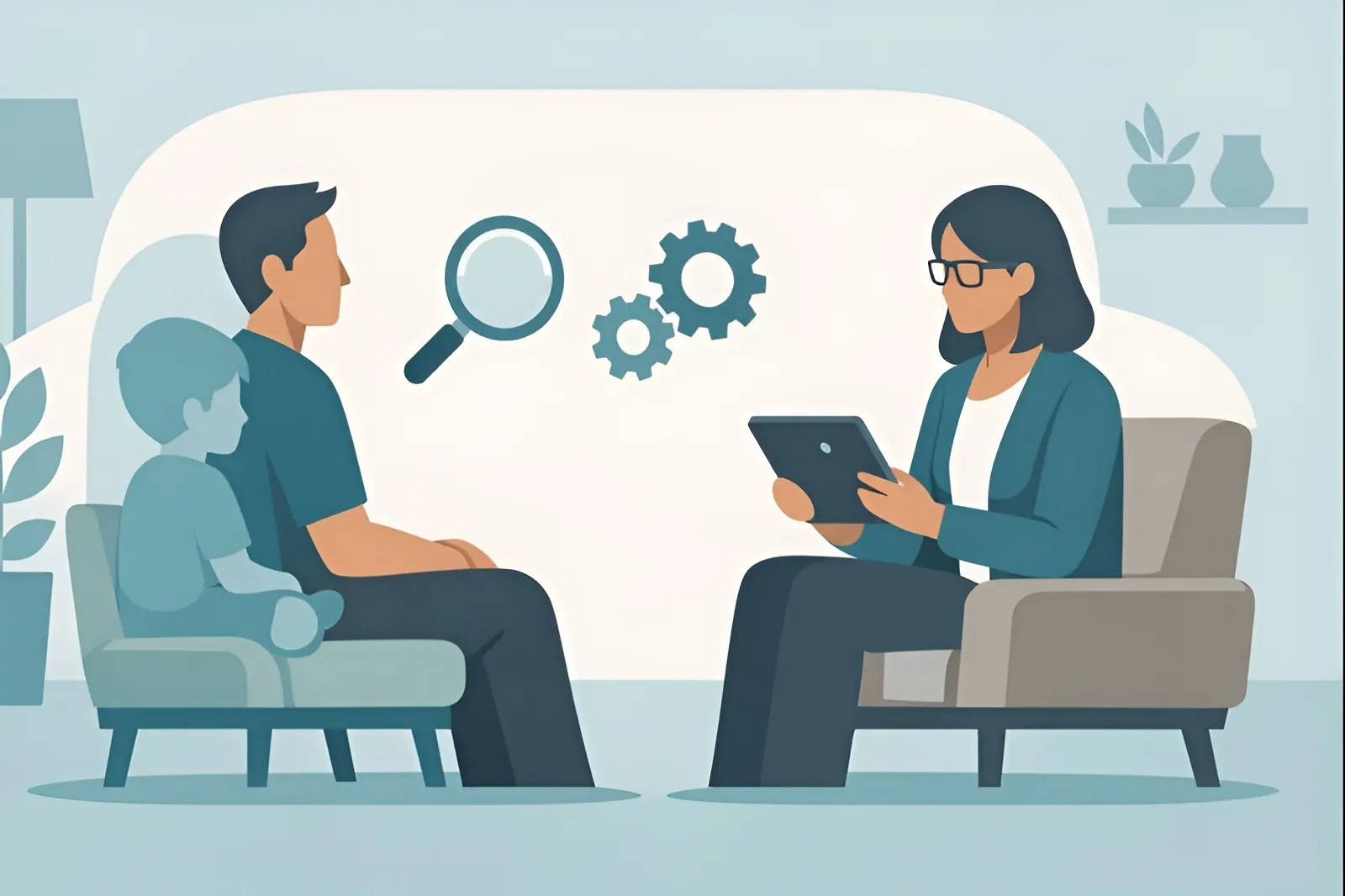
Key takeaway
Adult clients' presenting symptoms often trace back to unresolved developmental tasks. Erikson's psychosocial stages offer a framework for identifying the social crises and deficits behind a client's struggles, while Piaget's cognitive-developmental theory helps locate which stage of thinking an irrational belief is fixated at. Integrating both perspectives gives clinicians a more dimensional understanding for case conceptualization and intervention planning—operationalized here through structured life-history interviewing, empathic confrontation, and decentering work.
The Child Behind the Adult Client: What Developmental Theory Adds to the Consulting Room 🔍
We meet adults in our offices, but their presenting concerns often carry the unfinished business of a much younger self. "Why can't I trust anyone?" "Why does the smallest setback feel like the whole world is collapsing?" To answer questions like these, it helps to return to the foundations of developmental psychology.
It's easy to file developmental theory away as something memorized for a licensing exam and rarely revisited. But Erikson's psychosocial stages and Piaget's cognitive-developmental theory are more than academic scaffolding—they are among the most reliable compasses we have for conceptualizing a client's current symptoms and choosing where to aim an intervention. This piece distills the parts most useful at the point of care, so you can read a client's life history with sharper developmental insight.
Two Lenses, One Client: Integrating Erikson's Emotion with Piaget's Cognition
Many clinicians instinctively treat the emotional and cognitive dimensions of a client as separate tracks. In reality, personality structure develops with these two interlocking like gears. Where Erikson asks, "What social crisis did this person face at this stage?" Piaget asks, "What schema did they use to make sense of the world at that stage?" Holding both questions at once is what makes a dimensional case formulation possible.
Consider a client presenting with borderline personality features. Through Erikson's lens, you might hypothesize a rupture at the earliest trust vs. mistrust stage. Through Piaget's lens, you might notice that preoperational, egocentric thinking has persisted into adulthood—distorting how the client reads other people's intentions. Neither account is complete on its own; together they explain far more.
Table 1 — Erikson vs. Piaget: A Clinician's Comparison
| Erik Erikson — Psychosocial Development | Jean Piaget — Cognitive Development | |
|---|---|---|
| Core focus | Ego identity, relationships, resolving conflict with social demands | Thought processes, information processing, assimilation and accommodation of schemas |
| Clinical question | "Did the client resolve earlier developmental crises in their favor?" | "Which developmental stage of thinking is the client's irrational belief fixated at?" |
| Hallmark deficits | Basic mistrust, shame, guilt, inferiority, identity confusion | Black-and-white thinking, overgeneralization, egocentric interpretation, absent abstraction |
| Therapeutic aim | Restored trust and ego integration through reparenting | Schema revision and more adaptive thinking through cognitive restructuring |
Three Ways to Bring Developmental Theory into the Session
Knowing a theory and applying it are different skills. Here are three concrete strategies for rapidly framing a complex presentation through a developmental lens—and putting that frame to work in session.
1. Structure the life-history interview around developmental tasks
During intake, go beyond mapping family relationships and organize your questions around the core task of each developmental stage. Alongside "Were you ever separated from your parents as a young child?" (trust), ask "Once you started school, did you feel reasonably competent—at schoolwork, with friends?" (industry vs. inferiority). This helps you locate the point at which development stalled rather than collecting biography for its own sake.
2. Use empathic confrontation for developmental trauma
Reframe the client's present-day behavior not as a character flaw but as a developmental adaptation that once served survival: "The way you keep your guard up and stay wary of people—that was a genuinely smart strategy you built to protect yourself in an unpredictable environment as a child. The trouble is that the same strategy now gets in the way of your adult relationships." This lowers defensiveness and strengthens the working alliance.
3. Practice cognitive decentering
Drawing on Piaget, check whether the client is still operating from egocentrism—unable to hold a perspective other than their own. Questions that invite perspective-taking, such as "What do you imagine your mother was feeling in that moment?", act as scaffolding that helps the client move past a fixated stage of cognitive development.
Capturing a Complex History Without Losing the Moment
Work developmentally and you inevitably handle an enormous amount of information—a life from infancy to the present, pivotal events, the emotions attached to them, attachment patterns with caregivers. Assembling those puzzle pieces creates a familiar dilemma: do I hold the client's gaze and stay present, or do I look down and take notes so I don't lose something important?
The stakes are highest exactly when a client is reliving a painful memory and emotion is rising. Dropping your eyes to write at that moment can be corrosive to rapport. Yet listening without any record risks losing the decisive developmental clue—a separation at age three, bullying in grade school—that you'll wish you had when you sit down to formulate the case later.
A technological way to ease the load
To resolve this tension, a growing number of clinicians are adopting AI-assisted session documentation and transcription. Used well, technology stops competing with the work of therapy and starts protecting your attention for it.
- Catching the developmental details: an offhand "...I actually grew up at my aunt's house for a while" is exactly the kind of clue that's easy to miss in the moment and easy to recover from an accurate transcript.
- Preserving non-verbal context: because the audio is retained, you can revisit the moments where a voice trembled or trailed into silence as the client touched a particular memory—context a text-only note loses.
- Less time on transcription, more on thinking: trimming the hours spent producing a session transcript frees that energy for the clinical reasoning of applying Erikson and Piaget to your client.
Modalia AI is a security-first AI partner built for this kind of work—handling transcription, case conceptualization support, and documentation so clinical attention stays where it belongs.
Conclusion: Understand the Past to Heal the Present
Erikson's and Piaget's theories are not knowledge sealed inside a textbook—they are among the most precise maps we have for understanding the suffering of the person sitting across from us. Developmental theory lets us grasp why a client behaves as they do and set a concrete direction for how to help.
The next time you listen, try listening for the developmental history hidden behind the words. And to hold that complex, sprawling story in full, consider building a smarter clinical setup—one that lifts the burden of note-taking while deepening your insight. A counselor with more presence and clearer understanding is, in the end, the counselor whose clients heal and grow.
An action plan for this week: Take one client's presenting concern and map it onto Erikson's developmental stages—then hypothesize which stage's deficit connects to the current symptom. Consider an automated documentation tool so none of that thinking slips away mid-session.
Frequently asked questions
How do Erikson and Piaget complement each other in case conceptualization?
Erikson illuminates the emotional and social dimension—which developmental crises a client resolved or failed to resolve—while Piaget reveals the cognitive dimension, showing which stage of thinking an irrational belief is fixated at. Used together, they produce a more dimensional formulation than either lens alone.
What is empathic confrontation in developmental work?
It's reframing a client's problematic behavior not as a character flaw but as a developmental adaptation that once served survival. Naming the original protective function lowers defensiveness and strengthens the working alliance before inviting change.
How can I structure a life-history interview developmentally?
Organize questions around the core task of each developmental stage rather than collecting biography at random—for example, probing early separations (trust) and school-age competence (industry vs. inferiority)—so you can pinpoint where development stalled.
Why use AI transcription in developmentally focused therapy?
Developmental work generates a large volume of history, creating a dilemma between staying present and taking notes. AI-assisted documentation captures fleeting developmental clues and preserves non-verbal context, freeing clinical attention for case conceptualization.
This article was written and reviewed using Modalia AI's clinical guidelines, with professional human review before publication.
Related articles
 Case Conceptualization
Breaking the "Yes, But" Game: A Transactional Analysis Guide for Therapists
Every suggestion you offer gets met with "Yes, but..." Here's the TA structure behind that stall—and four clinical moves to break it.
7 min read Case Conceptualization
Yalom's The Gift of Therapy: Passages Every New Counselor Should Copy by Hand
Irvin Yalom's prescription for therapists who fear silence: meet your client as a "fellow traveler" and let the here-and-now become the heart of the work.
6 min read Case Conceptualization
Working With Silence in Therapy: What Client Silence Means and How to Hold It
Silence in session isn't empty space. Learn to read its clinical meaning, tell productive from defensive silence, and use it as a therapeutic tool.
6 min read