Digital Phenotyping and the Future of Psychological Assessment: Merging Wearable Data with Standardized Testing
How digital phenotyping captures the everyday life clients can't fully report—and how clinicians can fuse it with standardized testing for sharper, more efficient assessment.
Key takeaway
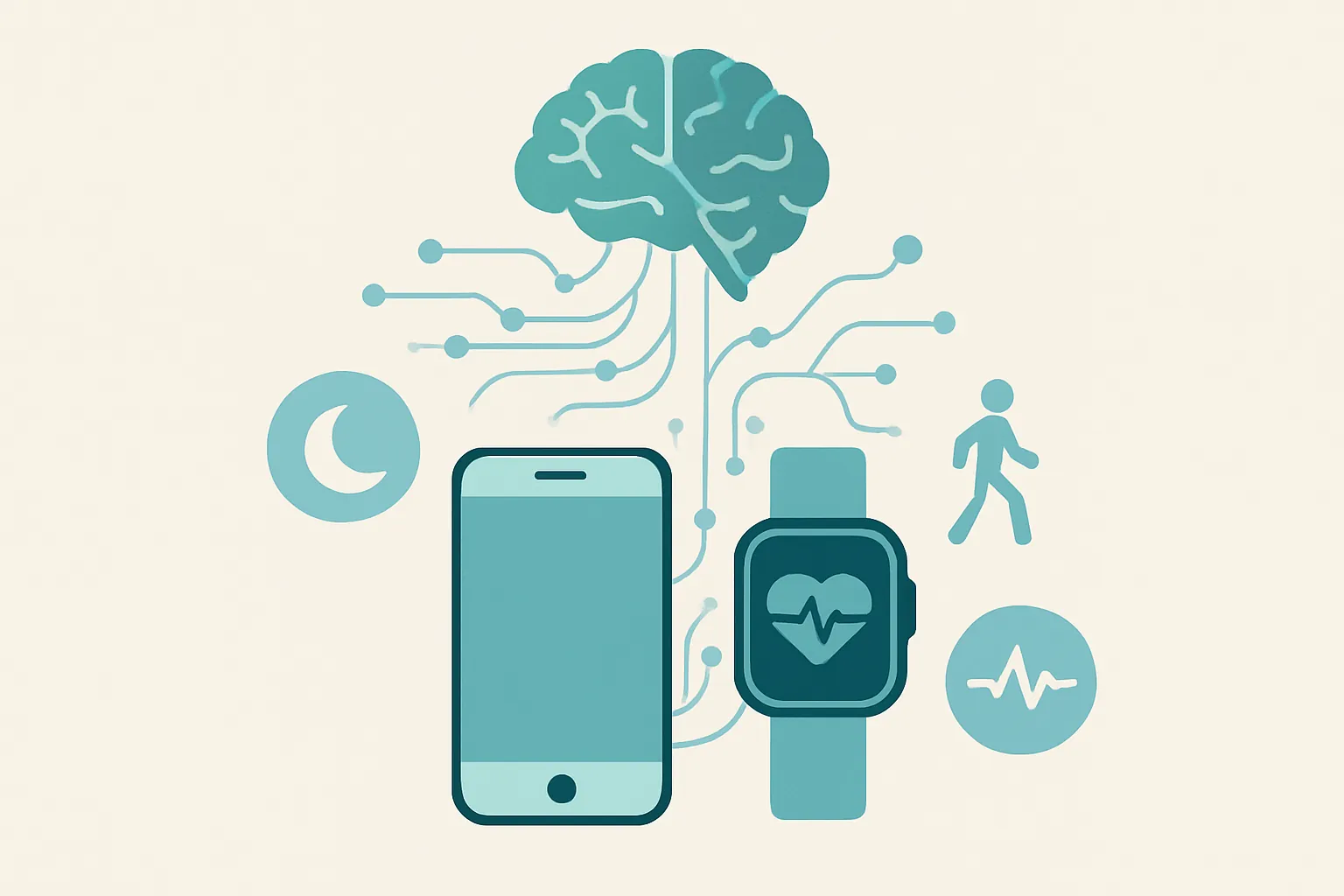
Client self-report carries built-in limits: emotion distorts recall and social desirability bias shapes what clients disclose. Digital phenotyping addresses this by inferring behavior and mental-health states from smartphone and wearable signals—GPS mobility, sleep patterns, typing speed—captured continuously in everyday life. Fusing trait-focused standardized tests with state-sensitive digital data yields a more dimensional picture of the client. In practice, the core strategies are data-informed empathy, robust informed consent, and AI tools that ease the analytic load.
When the Smartphone Knows More Than the Session: Digital Phenotyping and the Next Era of Assessment
"I'm honestly doing well this week. I wasn't depressed, and I slept fine."
When a client walks in and says this with a bright affect, most of us feel a flicker of relief alongside a quiet question mark. Every clinician has run up against the limits of self-report. Memory is reshaped by current mood, and the pull of social desirability bias—the wish to look like a "good" client who is making progress—is impossible to ignore entirely.
So what if we could see, with reasonable fidelity, what a client's week actually looked like outside the consulting room? That is the premise of digital phenotyping: inferring behavioral patterns and mental-health states from the data people generate through their smartphones and wearables. Bringing this "real-world" signal into treatment—signal that case notes and standardized testing alone rarely capture—is no longer a distant prospect but a present clinical question. This article looks at how the approach can sharpen everyday practice, and what ethical and practical groundwork it demands of us.
1. The Voice of Quiet Data: What Digital Phenotyping Actually Is
The term was coined by Jukka-Pekka Onnela of the Harvard T.H. Chan School of Public Health, who defined it as the moment-by-moment quantification of behavior and mental-health status using data from an individual's interactions with personal digital devices. The appeal is that it sidesteps the retrospective bias baked into traditional assessment, capturing daily life in something close to an ecological momentary assessment (EMA) frame. Two broad data streams matter clinically.
Passive Data and Its Clinical Value
This is data gathered automatically, without any action from the client. A contraction in GPS mobility radius—how far someone travels from home over a week—can signal the anergia and social withdrawal central to depression. Irregular sleep patterns inferred from a device's accelerometer may flag a manic episode in bipolar disorder or the prodrome of an anxiety flare. Researchers have even reported that shifts in keyboard typing speed and error rates can track cognitive slowing or emotional dysregulation.
Active Data and Symptom Monitoring
This is what the client logs deliberately—mood check-ins, brief voice memos, symptom ratings entered through an app. A feeling captured in the moment between sessions often reflects "the emotion as it actually was" far more accurately than a recollection offered days later in the room. For client formulation, this kind of in-context data is a decisive source of nuance.
Complementarity With Standardized Tests
If instruments such as the MMPI-2 or TCI excel at mapping a client's stable traits, digital phenotyping is well suited to tracking the shifting states that move hour to hour. Fuse the two and you approach something like precision medicine for psychotherapy—an account of the client that is dimensional rather than flat.
2. Traditional Assessment vs. Wearable-Augmented Assessment
Many clinicians push back: how can a machine measure the human mind? But digital phenotyping is not a replacement for clinical intuition—it is a tool that strengthens clinical insight. What matters is understanding clearly how the two paradigms differ and how they reinforce each other.
Table 1. Traditional Psychological Assessment vs. Digital Phenotyping
| Dimension | Traditional Assessment | Digital Phenotyping |
|---|---|---|
| When data is collected | A single snapshot inside the consulting room (cross-sectional) | Continuous, longitudinal monitoring across daily life |
| Subjectivity | Subject to self-report and defensive distortion | Behavioral logs and biosignals; bias minimized |
| Ecological validity | Lower—test conditions may diverge from real life | Higher—data reflects the client's actual environment |
| Clinical use | Diagnosis, personality structure, treatment planning | Early detection of relapse; real-time check on whether treatment is working |
3. Putting It Into Practice—And Doing It Ethically
Translating this into the consulting room takes more than collecting data; it means using it to strengthen the therapeutic alliance and sharpen intervention. Three strategies are worth weighing right away.
Data-Informed Empathy
When a client says they "couldn't sleep," consider reviewing their wearable sleep data together. Objective figures help the client face their own state without over- or under-stating it. A question like, "The data shows you were waking around 3 a.m. fairly often—what was going through your mind then?" can open real depth. It also lets your progress notes record concrete shifts in circadian rhythm rather than vague impressions.
Ethical Sensitivity and Transparent Consent
The most important piece is clinical ethics. Digital data carries an obvious risk of privacy intrusion. From the outset, spell out exactly what will be collected and confirm that it will be used for treatment alone—securing genuine informed consent. The therapeutic frame has to come first, so the client experiences this data as a compass for their recovery rather than as surveillance.
Using AI Tools to Lower the Technical Load
Analyzing large volumes of digital data and tying it back to fifty minutes of conversation is more than unaided cognition can manage. The real task is integrating in-session verbal material with the out-of-session nonverbal signal that digital phenotyping provides—and this is where current AI tools can genuinely help.
For example, **AI-assisted transcription and clinical-note platforms—tools like Nabla or Upheal—**can automatically convert a session into text and surface key themes and emotional arcs. The clinician can then compare that distilled inner experience against the wearable's activity data (outward behavior), catching discrepancies between what a client says and does, or timing an intervention more precisely. Technology should not replace the clinician; it should carry the administrative and analytic weight so you can keep your eyes on the client a little longer.
Closing: A New Stethoscope Made of Data
Just as Freud charted the uncharted terrain of the unconscious, twenty-first-century clinicians now hold a new map called digital phenotyping. The data accumulating inside a client's phone may be signals of pain they never said aloud, or never could. The ability to read that data clinically—and to fold it into a warm, human interpretation—will be core competence for the next generation of practitioners.
You don't need to fit every client with a wearable tomorrow. Start small: when you write up your notes, ask about a client's sleep app or screen-time figures. And to keep the essence of therapy from drowning in the flood of information, it's worth evaluating an AI solution that organizes session content systematically. When the cold precision of data meets the warmth of a clinician's interpretation, the capacity to heal multiplies. Modalia AI—a security-first AI partner for counselors, built around transcription, case conceptualization, and documentation—is designed for exactly that meeting point.
How Modalia AI Fits In
Modalia AI is a security-first AI partner for counselors and therapists. It transcribes sessions, supports case conceptualization, and streamlines documentation—so the analytic and administrative load of integrating data sources doesn't come at the cost of presence with your client.
References
- 1.
- 2.
Frequently asked questions
What is digital phenotyping in mental health?
Digital phenotyping is the moment-by-moment quantification of behavior and mental-health status using data from a person's own devices—smartphone GPS mobility, accelerometer-inferred sleep, typing patterns, and app-based mood logs. It lets clinicians observe a client's real-world functioning continuously rather than relying solely on retrospective self-report.
How does digital phenotyping differ from standardized psychological testing?
Standardized instruments like the MMPI-2 or TCI are strong at mapping stable traits at a single point in time. Digital phenotyping tracks shifting states longitudinally in everyday settings, with higher ecological validity. Used together, they give a more dimensional picture and can flag relapse early or confirm whether treatment is working.
What are the ethical concerns with using client device data?
The main risk is privacy intrusion. Clinicians must obtain genuine informed consent that specifies exactly what data is collected and confirms it is used for treatment only. Framing the data as a recovery compass rather than surveillance—and grounding it in a strong therapeutic alliance—is essential before any collection begins.
Do clinicians need AI tools to use digital phenotyping?
Not strictly, but integrating continuous device data with session content quickly exceeds unaided cognition. AI-assisted transcription and note platforms can distill sessions into key themes and emotional arcs, which clinicians can then compare against wearable activity data to spot say-do discrepancies and time interventions more precisely.
This article was written and reviewed using Modalia AI's clinical guidelines, with professional human review before publication.
Related articles
 Case Conceptualization
Breaking the "Yes, But" Game: A Transactional Analysis Guide for Therapists
Every suggestion you offer gets met with "Yes, but..." Here's the TA structure behind that stall—and four clinical moves to break it.
7 min read Case Conceptualization
Yalom's The Gift of Therapy: Passages Every New Counselor Should Copy by Hand
Irvin Yalom's prescription for therapists who fear silence: meet your client as a "fellow traveler" and let the here-and-now become the heart of the work.
6 min read Case Conceptualization
Working With Silence in Therapy: What Client Silence Means and How to Hold It
Silence in session isn't empty space. Learn to read its clinical meaning, tell productive from defensive silence, and use it as a therapeutic tool.
6 min read