Will Insomnia Apps Replace Therapists? Digital Therapeutics and the Clinician's Role
Digital therapeutics for insomnia are here. Discover what only human clinicians can do—and how to build a hybrid practice that uses DTx as a co-therapist.
Key takeaway
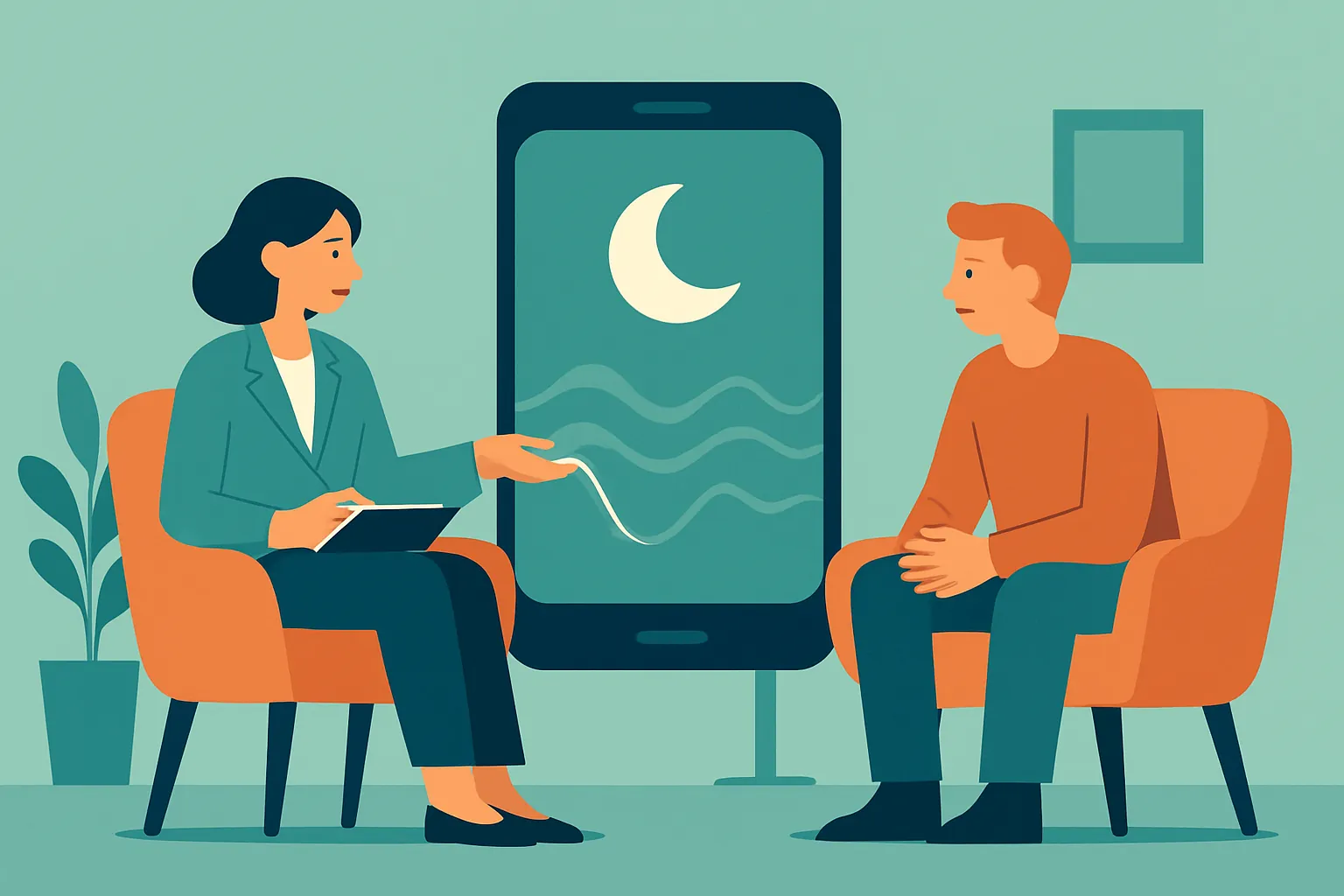
Digital therapeutics (DTx) for insomnia—such as FDA-cleared programs delivering CBT-I—excel at standardized protocols, 24/7 access, and objective data tracking, but they cannot form a therapeutic alliance, read nonverbal cues, or differentiate complex comorbidity. Rather than replacing clinicians, DTx automates structured, repetitive interventions so therapists can focus on the deeply human work machines can't do. The stepped-care model lets clinicians route mild cases to a DTx first, then use app-collected sleep data to drive deeper sessions. The clinician's future edge is High Touch: offloading administrative and documentation burden to technology and reinvesting that energy in the client relationship.
When a Client Says "I'll Just Use an App": Preparing for the Digital Therapeutics Era
Digital therapeutics (DTx) for insomnia have moved from concept to clinic. Prescription-grade programs that deliver cognitive behavioral therapy for insomnia (CBT-I) through a smartphone—FDA-cleared options like SomRyst, alongside widely studied programs such as Sleepio—are now part of the treatment landscape. For the first time, some clients arrive saying they'd rather work through an app than book a session.
For clinicians, this is more than a technology story. It surfaces a quiet anxiety—"Can a machine actually do what I do?"—and a practical question: how should we integrate these tools into real clinical work? We're standing at a genuine inflection point.
But anxiety isn't the only available response. Used well, DTx automates the repetitive, highly structured parts of care, freeing clinicians to concentrate on the higher-order, distinctly human work of therapy. So is the therapist-in-your-pocket a threat or a partner? This piece looks at insomnia DTx through a clinical-psychology lens, compares what machines and humans each do best, and offers a survival strategy—and a few ethical reflections—for a changing field.
1. App vs. Clinician: Not Competition, but a Division of Labor
The fear that DTx will replace clinicians comes from a narrow view of therapy—as if counseling were merely information delivery or technique application. It's true that highly protocolized, structured interventions like CBT-I are well suited to algorithmic delivery. A growing body of clinical research shows that digital CBT-I can meaningfully improve sleep efficiency in patients with uncomplicated insomnia.
But that isn't the end of the clinician. It's the moment the boundary between what machines do well and what humans do well becomes clear. DTx is excellent at precise data capture, around-the-clock access, and standardized psychoeducation. Clinicians work with subtle resistance, make sense of layered psychological problems, and—above all—deliver healing through the therapeutic alliance.
| Dimension | Digital Therapeutic (DTx) | Clinical Professional (Human) |
|---|---|---|
| Core strength | Standardized protocol delivery, objective data tracking (e.g., sleep time), cost efficiency | Building the therapeutic relationship, reading nonverbal cues, differentiating comorbidity |
| Therapeutic approach | Algorithm-driven, stepwise tasks (sleep restriction, stimulus control) | Analyzing defense mechanisms, providing emotional support, flexibly revising the treatment plan |
| Limitations | Low adherence / high drop-out, difficulty with crisis intervention, no genuine empathy | Time and cost constraints, variability by clinician skill, potential for subjective bias |
| Best fit | Uncomplicated insomnia; motivated, tech-comfortable clients | Complex insomnia with co-occurring depression/anxiety; clients needing emotional support |
Table 1. Comparing the role and characteristics of digital therapeutics and clinical professionals in insomnia care.
2. The Hybrid Model: Putting DTx to Work as a Clinical Tool
The savvy clinician hires DTx not as a competitor but as a co-therapist. The stepped-care model is already gaining traction precisely for this reason: it allocates treatment resources according to symptom severity. Clients with milder symptoms—or those facing cost barriers—can start with a DTx, while the clinician uses the app's sleep-diary data to drive deeper work. This frees clinicians from delivering the same sleep-hygiene education over and over, and lets them concentrate on the client's core psychological dynamics.
Three Practical Strategies for Clinical Integration
- Act as a data-informed supervisor. Bring the client's app data—sleep efficiency, wake times, sleep-onset latency—directly into the session. Go beyond "How did the app feel?" toward genuine interpretation: "Your sleep-onset latency has dropped, but your subjective fatigue hasn't changed. Let's talk about that gap." This reinforces a crucial framing: the app is a tool; the therapy lives in the analysis you do together.
- Manage adherence and strengthen motivation. The biggest weakness of DTx is the high rate of clients who abandon it midway. Use motivational interviewing (MI) to encourage consistent use, and hold the frustration or technical friction clients hit along the way. A machine sends an alert that says "You didn't complete your task." A clinician can name the feeling that made the task hard.
- Differentiate complex presentations and intervene in crises. An app sees only what the client enters. A clinician can read suicidal ideation or serious depressive signs in a client's expression and tone of voice. Identifying PTSD or major depressive disorder hiding behind insomnia—and, when needed, intervening immediately or referring for medication—remains the exclusive domain of the human professional.
3. The Higher the Tech, the More It's About High Touch
As DTx becomes routine, the value of human contact—High Touch—paradoxically rises. The clinician's irreplaceable contribution is interaction in the here and now and the depth of real empathy. The task isn't to fear technology but to pour the time it frees up back into the client relationship. Doing that, however, requires first streamlining the administrative and documentation work that surrounds therapy.
Many clinicians burn the energy they should spend analyzing client data and shaping treatment plans on transcribing recordings and writing session notes instead. Just as DTx automates the treatment protocol, clinicians need a technology partner to support documentation and analysis. Security-first, AI-based clinical documentation tools can accurately convert sessions to text, surface key themes, and separate speakers. Used thoughtfully, they offer three benefits:
- Restored presence. Free of the burden of note-taking, you can give your full attention to a client's eyes and expression—strengthening the therapeutic alliance.
- Objective self-review. Revisiting AI-organized conversation patterns lets you see your own clinical habits and the verbal cues you missed, with more objectivity.
- More effective supervision. Generating an accurate session transcript quickly means you can bring richer material to supervision—earning guidance on deep case conceptualization rather than basic reporting.
Modalia AI is built for exactly this gap: a security-first AI partner for counselors that supports transcription, case conceptualization, and documentation, so the energy you reclaim goes back to the client.
The capable clinician of the near future will prescribe a digital therapeutic when it fits, minimize administrative load with AI documentation, and spend the energy they reclaim fully present with the client's inner world. The change has already begun. Invite these smart tools into your consulting room—and build a deeper, more efficient journey of healing.
FAQ
If you're working out where DTx fits in your own practice, the questions below are a useful starting point.
References
- 1.
- 2.
Frequently asked questions
Can a digital therapeutic for insomnia replace a therapist?
No. DTx excels at delivering standardized CBT-I, tracking objective sleep data, and offering 24/7 access, but it cannot form a therapeutic alliance, read nonverbal cues, or differentiate comorbid conditions. It's best understood as a co-therapist that handles structured tasks while the clinician leads relational and complex clinical work.
What is the stepped-care model for insomnia?
Stepped care allocates treatment resources by symptom severity. Clients with milder, uncomplicated insomnia—or cost constraints—can begin with a digital CBT-I program, while clinicians reserve deeper, in-person sessions for complex or comorbid presentations and use the app's sleep-diary data to guide treatment.
Which clients are best suited to a DTx versus a clinician?
DTx fits motivated, tech-comfortable clients with uncomplicated insomnia. Clients with co-occurring depression or anxiety, those needing significant emotional support, or anyone showing crisis risk are better served by a human clinician—or a hybrid approach combining both.
How can clinicians manage low adherence to insomnia apps?
Drop-out is the main weakness of DTx. Motivational interviewing helps sustain engagement: encourage consistent use, hold the client's frustration and technical friction, and frame the app as a tool whose value is realized through the analytic work you do together in session.
This article was written and reviewed using Modalia AI's clinical guidelines, with professional human review before publication.
Related articles
 Case Conceptualization
Breaking the "Yes, But" Game: A Transactional Analysis Guide for Therapists
Every suggestion you offer gets met with "Yes, but..." Here's the TA structure behind that stall—and four clinical moves to break it.
7 min read Case Conceptualization
Yalom's The Gift of Therapy: Passages Every New Counselor Should Copy by Hand
Irvin Yalom's prescription for therapists who fear silence: meet your client as a "fellow traveler" and let the here-and-now become the heart of the work.
6 min read Case Conceptualization
Working With Silence in Therapy: What Client Silence Means and How to Hold It
Silence in session isn't empty space. Learn to read its clinical meaning, tell productive from defensive silence, and use it as a therapeutic tool.
6 min read