Beyond Wellness Perks: How EAP Clinicians Become Strategic Partners in Organizational Health
EAP work means serving two clients at once—the employee and the organization. Here's how clinicians manage workplace stress while reshaping unhealthy culture.

Key takeaway
An Employee Assistance Program (EAP) clinician works in a dual role: a healer who supports individual mental health and a consultant who diagnoses and improves organizational culture. The starting point is understanding the "dual client" structure, where both the employee in the room and the company paying for services are clients. Effective work within limited sessions blends solution-focused brief therapy with CBT, uses anonymized data to assess psychological safety and connect findings to leadership coaching, and translates patterns into qualitative insight reports for leadership. Structured intake instruments and AI-assisted transcription help reduce the documentation load that erodes clinical quality.
Beyond a Wellness Perk: How EAP Clinicians Help Rescue an Organization
Two phrases have come to define the modern workplace: "quiet quitting" and "the Great Resignation." Neither is merely a labor-market trend. Both are unmistakable signals of psychological burnout and collapsing engagement inside organizations. So a question for the clinicians and counseling psychologists reading this: When a working adult brings their distress into your office, can we really treat it as a purely individual problem?
The Employee Assistance Program (EAP) clinician is no longer just a "grievance handler." We are simultaneously healers tending to individual mental health and organizational psychology consultants diagnosing and treating a sick workplace culture. Yet in practice, the essential therapeutic work is often crowded out—by a hard cap on sessions, by the ethical tension between client confidentiality and the company's appetite for reporting, and by a crushing administrative load.
This article takes a clinical look at the strategies and practical know-how an EAP clinician needs to manage workplace stress effectively and, beyond that, to move an organization's culture in a healthier direction.
1. From Individual Healing to Organizational Change: The EAP Clinician's Dual Mandate
Unlike a typical community clinic, EAP work has a dual-client structure. The employee sitting across from you and the company footing the bill are both your clients. This is precisely where many early-career EAP clinicians get disoriented. Clinically, you are attending to one person's emotional pain; organizationally, that work has to connect to goals like return-to-function and productivity.
Successful EAP practice depends on recognizing that these two aims are not in conflict—they are complementary. Industrial and organizational (I/O) psychology research has repeatedly shown that as employees' psychological capital improves, organizational citizenship behavior (OCB) rises and turnover intention falls.
[Table 1] Structural Differences: General Psychotherapy vs. Employee Assistance Programs (EAP)
| Dimension | General Clinical/Counseling Psychology | Employee Assistance Program (EAP) |
|---|---|---|
| Presenting concerns | Broad: personality, relationships, developmental trauma | Job stress, conflict with supervisors, burnout, organizational adjustment |
| Treatment goals | Symptom relief, self-actualization, change in personality structure | Restoring occupational function, sustaining work productivity |
| Duration | Can be long-term (open-ended) | Brief by design (typically capped at 6–12 sessions) |
| Reporting obligations | Confidentiality is absolute except for risk of harm to self/others | Confidentiality is the rule, but aggregate organizational trends must be reported |
2. Practical Strategies for Managing Workplace Stress and Improving Culture
So how does a clinician both help a client within a limited number of sessions and nudge the surrounding culture in a positive direction? Three approaches have proven their effectiveness in EAP settings.
Strategically Combining Solution-Focused Brief Therapy (SFBT) and CBT
Because EAP sessions are limited, the work should center on problem-solving in the here and now rather than open-ended psychodynamic exploration. In workplace conflict especially, CBT techniques are useful for revising irrational beliefs—for example, "I must be approved of by every single colleague." At the same time, SFBT tools like the miracle question and scaling questions help clients quickly surface resources and prior successes they already possess, restoring a sense of occupational self-efficacy.
Assessing Psychological Safety and Linking It to Leadership Coaching
Even if one client's stress resolves, the problem will recur if the surrounding team culture is coercive. Using anonymized data gathered across individual sessions, the clinician should assess the organization's level of psychological safety. If grievances cluster repeatedly within a particular department, the issue is unlikely to be individual—it's far more likely a leadership problem. Here the clinician partners with HR to act as a consultant, recommending tailored coaching or training for that department's leaders, such as reading and responding to team members' emotions rather than dismissing them.
Writing Data-Informed Organizational Insight Reports (Executive Summary)
The value of an EAP clinician has to be demonstrable outside the therapy room. A purely quantitative report—"case volume rose 10%"—gives leadership little real insight. What leadership needs is qualitative analysis distilled from session content, such as: "Among mid-level employees in their thirties, complaints of burnout driven by unclear roles and responsibilities (R&R) have risen sharply." That kind of finding becomes decisive evidence for the policy changes leaders make to improve culture.
3. Running an EAP Efficiently: A Technological Approach and Recommendations
Many EAP clinicians pour more energy into post-session documentation and statistical reporting than into the sessions themselves. EAP work carries a double burden: you must capture each client's core issues precisely and derive organizational implications from them. Overloaded administrative work eventually erodes the quality of the clinical work itself.
To sustain effective EAP services, professionals should weigh the following practices.
- Use structured intake instruments. Administer validated job-stress and burnout measures—such as the Maslach Burnout Inventory (MBI), the Job Content Questionnaire (JCQ), or the Perceived Stress Scale (PSS)—ahead of the first session to save time and secure objective baseline data.
- Hold regular peer supervision. Share cases with colleagues who understand the particularities of organizational clients (internal politics, performance reviews) to prevent your own burnout.
- Adopt a smart documentation system. Lean on tools that shorten recording time without letting the core of the session slip away.
AI-assisted session transcription and summarization has recently emerged as a genuinely useful tool in EAP settings. By accurately converting complex workplace-conflict narratives or a client's lengthy account into text—and surfacing core keywords (harassment, burnout, turnover, and so on)—AI frees the clinician from the burden of note-taking so they can focus fully on the interaction with the client. Over time, that accumulated text data becomes a powerful evidence base for organizational-culture analysis reports, sharpening the EAP clinician's clinical insight even further.
Corporate counseling has moved well past "employee welfare." It is now central to an organization's risk management and growth strategy. May your expertise reach beyond the therapy room to become a driving force for healthy change across the entire organization.
Frequently asked questions
What does "dual client" mean in EAP work?
In an Employee Assistance Program, both the employee in the room and the organization paying for services are clients. The clinician attends to the individual's emotional distress while also serving the organization's goals of restored function and productivity—aims that are complementary rather than contradictory, provided confidentiality is protected and only anonymized, aggregate trends are reported.
Which therapy models work best within EAP session limits?
Because EAP engagements are typically capped at 6–12 sessions, present-focused, problem-solving models work best. Combining CBT (to revise irrational workplace beliefs) with solution-focused brief therapy techniques like the miracle question and scaling questions helps clients restore occupational self-efficacy quickly.
How can a clinician influence organizational culture, not just individuals?
By analyzing anonymized patterns across cases to assess psychological safety, flagging departments with clustered grievances as potential leadership issues, partnering with HR on tailored leadership coaching, and delivering qualitative executive-summary reports that give leaders evidence for culture-level policy change.
What assessment tools are useful at EAP intake?
Validated, globally recognized measures such as the Maslach Burnout Inventory (MBI), the Job Content Questionnaire (JCQ), and the Perceived Stress Scale (PSS) can be administered before the first session to save time and establish an objective baseline.
This article was written and reviewed using Modalia AI's clinical guidelines, with professional human review before publication.
Related articles
 Clinical Skills
How to Write Better Supervision Questions: Getting What You Actually Need from Your Supervisor
Stuck on what to ask in supervision? Use these structured question strategies to turn vague check-ins into focused clinical insight.
7 min read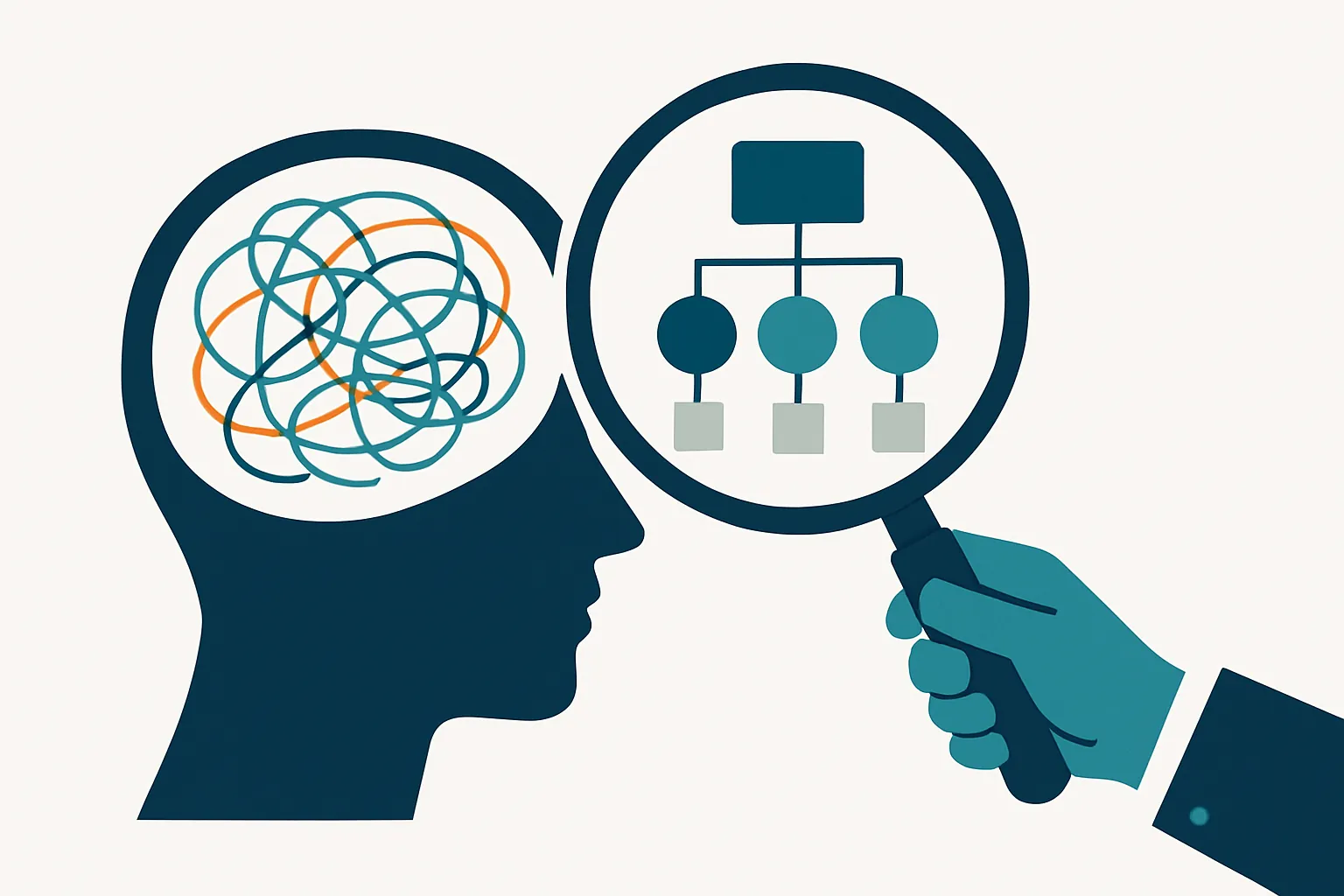 Clinical Skills
From "The Client Seems Depressed" to a Clinical Hypothesis: How Word Choice Elevates Your Case Reports
Turn vague observations into precise clinical hypotheses. A practical guide to terminology and sentence formulas that make your case reports read like expert work.
7 min read Clinical Skills
The Wounded Healer Trap: Why "I Want to Heal Myself" Sinks Your Counseling Grad School SOP
Why admissions faculty flinch at "I want to heal my own wounds"—and how to transform personal pain into a research-grade statement of purpose that gets you in.
6 min read