Eating Disorders and the Need for Control: Understanding Restriction and Bingeing in Clinical Work
Anorexia and bulimia are rarely about food. Learn to read both as control strategies—and three interventions that restore healthy agency.
Key takeaway
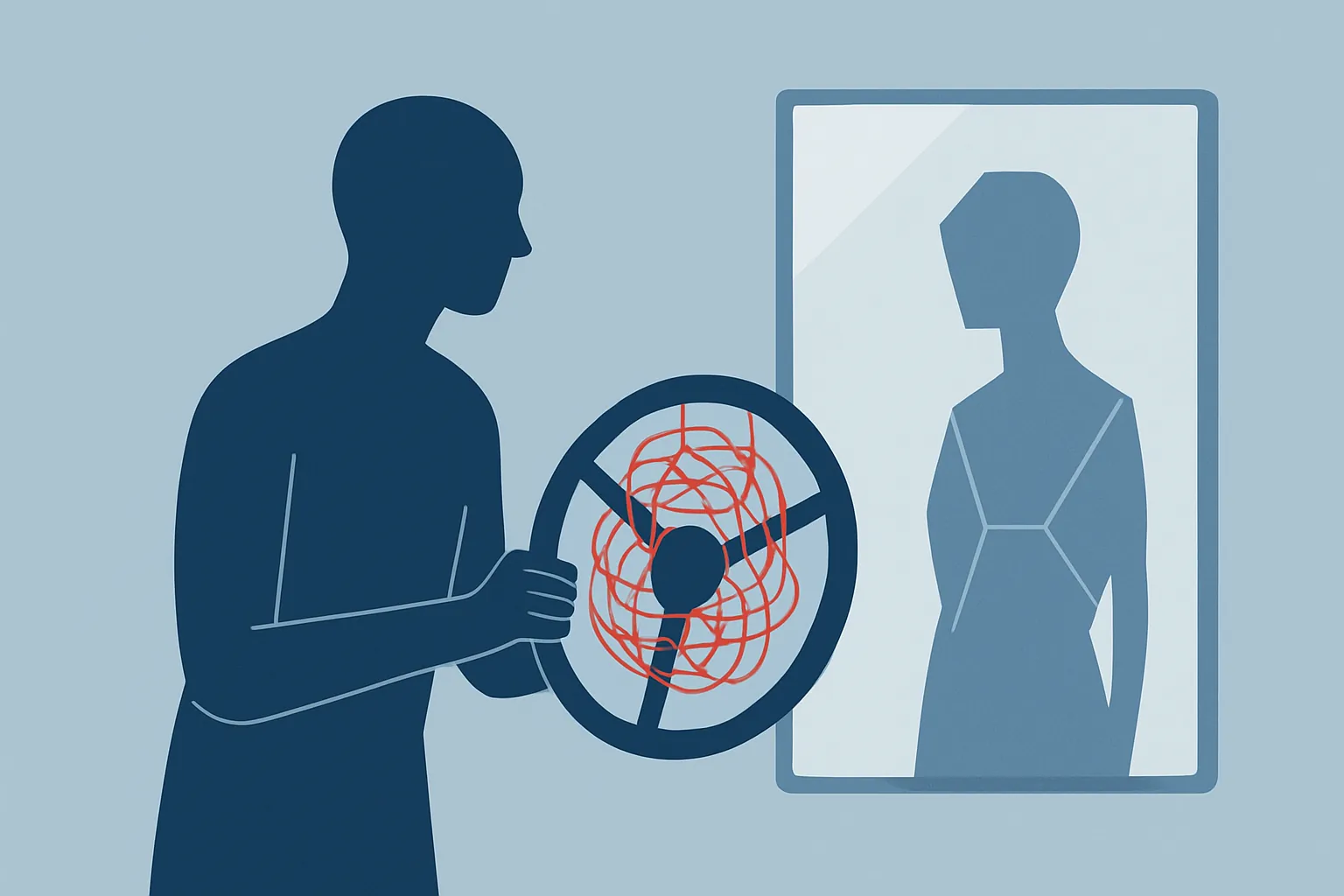
Eating disorders are best understood not as problems with food but as psychological strategies for securing a sense of control in an uncertain life. Anorexia experiences over-control through rigid restriction as ego-syntonic—part of the self—while bulimia cycles through loss of control and compensatory behavior, carrying deep shame. Both originate from the same root: a preoccupation with, and fear of, losing control, and for the client the symptom often functions as the only thing keeping life bearable. Effective intervention begins by validating the symptom's adaptive function, externalizing the disorder from the client, and helping them experience healthy control in domains beyond food and weight.
Not Food, but Life: The Inner World of the Client with an Eating Disorder
Have you ever felt like you've hit a wall working with a client who has an eating disorder? The body is visibly in danger, yet the client experiences that dangerous state as an achievement or a source of safety. It's a paradox that makes eating disorders among the most clinically demanding—and relapse-prone—presentations we encounter.
It's easy to find ourselves rising and falling with the numbers: weight, calories, portions, purge counts. But the heart of the work isn't the food itself. It's the psychological function the food is being asked to serve.
Contemporary clinical thinking increasingly reframes both anorexia nervosa and bulimia nervosa not as simple body-image distortions or failures of impulse control, but as strategies for securing a sense of control in an unpredictable world. For the client, the eating behavior is both weapon and shield—the one thing that quiets life's chaos. The question for us is not how to disarm them, but how to understand why they needed the weapon in the first place, and how to help them find a safer alternative.
The Core Mechanism: Distorted Autonomy and the Illusion of Control
For a client with an eating disorder, eating—or not eating—is rarely a physiological act of managing hunger. It is closer to a ritual that confirms self-efficacy. Through the lens of schema therapy and enhanced cognitive behavioral therapy (CBT-E), these clients have come to equate their worth with their ability to control body shape and weight.
When a client with anorexia looks at an emaciated body, the dominant feeling is often not misery. It is a sense of superiority and pure autonomy—the conviction that they have conquered an instinct that governs everyone else.
The client with bulimia, by contrast, lives through an intense loss of control when rigid restriction collapses into a binge. The compensatory behaviors that follow—purging, laxative use, compulsive exercise—are an attempt to reclaim control. Restriction and bingeing look like opposite behaviors, but they grow from the same psychological root: a preoccupation with control and a fear of losing it.
This is why it helps to ask what the symptom is giving the client—the secondary gain. Asking someone to stop the behavior can feel like asking them to let go of the only steering wheel that has ever responded to their hands.
Restriction vs. Bingeing: A Clinical Comparison of How Control Is Managed
While control is the shared core, the way it presents—and the client's relationship to their own symptoms (ego-syntonicity)—differs sharply between the two. Recognizing this distinction shapes everything from early rapport-building to how we frame treatment goals.
| Dimension | Anorexia Nervosa (Restriction) | Bulimia Nervosa (Bingeing) |
|---|---|---|
| Form of control | Over-control. A sense of accomplishment achieved through rigid restriction. | Oscillation between loss and recovery of control. Impulsive bingeing followed by compulsive purging. |
| Ego-syntonicity | High. The symptom is experienced as part of identity or as a strength. Treatment resistance is significant. | Low. The symptom is experienced as shameful and distressing (ego-dystonic). Motivation for treatment is comparatively higher. |
| Core affect | Superiority, pride, anxiety (about gaining weight) | Shame, guilt, self-loathing, helplessness |
| Therapeutic focus | Softening rigidity. Helping the client experience flexibility—rather than control—as a source of safety. | Emotion regulation and impulse management. Building skills to tolerate negative affect without food. |
Table 1. How anorexia and bulimia manage control: clinical features compared.
Three Interventions for Rebuilding a Sense of Control
How do we help a client set down a false sense of control and recover genuine self-regulation? Three strategies tend to earn their keep in session.
1. Validate the Function of the Symptom
Early on, the most important move is to resist treating the symptom as purely pathological. Try naming its adaptive function aloud: "It sounds like controlling food has been exactly what you needed to get through some very hard things. It may have felt like the only thing keeping you safe."
The door to change opens only when the client perceives you not as an adversary trying to seize their control, but as someone who understands their survival strategy.
2. Externalize the Eating Disorder
Drawing on narrative therapy, work to separate the client from the disorder. Give the eating disorder an external identity—"the ED voice," or a nickname the client chooses—so it can be examined as an object rather than an inner truth. A question like "Was that thought yours, or was that the eating disorder talking?" becomes a powerful tool for defusion: it helps the client step back from compulsive cognition, break the reflex of blind obedience, and observe their own state with some distance.
3. Expand the Territory of Agency
Control that has narrowed to food and weight needs to be widened into other domains of life. Design concrete behavioral experiments that let the client experience healthy efficacy through relationships, hobbies, study, or even small daily acts—tidying a room, keeping a plant alive. Reframes like "Let's find a sense of control in the walking route you chose today, not in the number on the scale" diversify the sources of self-worth and, in doing so, loosen the client's dependence on the eating symptom.
Conclusion: The Hunger Beneath the Hunger
Eating disorder work can feel like walking on thin ice. Clients are exquisitely attuned to a small shift in our expression or a single word, and may experience even gentle structure as an intrusion on their control. At the same time, the material they bring—food logs, obsessive calorie tracking, purge frequencies—is dense and detailed. Holding all of that data while staying emotionally present with the person in front of you takes enormous energy.
This is where thoughtful documentation support can act as a quiet co-therapist. When the obsessive numbers and recurring patterns a client pours out are captured accurately, you can put down the burden of note-taking and stay with the client's eyes and the here-and-now of the interaction. Used well—and with the security and confidentiality these clinical conversations demand—an AI partner like Modalia AI can surface subtle language habits, avoidance patterns, and the very patterns of control that neither you nor the client had fully noticed, turning them into material for therapeutic insight.
The client who walks into your office may not be starving for food at all. They may be starving for love, for recognition, for a sense that something in their life answers to them. May this lens on control, and these strategies, be a small lamp on the path you and your client walk together.
Frequently asked questions
Why is it more useful to see an eating disorder as a control issue than as a food problem?
Because for the client the eating behavior functions as a way to secure a sense of control in an unpredictable life. Treating it only as a food or weight problem misses the psychological need the symptom is meeting and tends to increase resistance. Framing it as a control strategy lets you validate that need and offer safer alternatives.
What is the key clinical difference between anorexia and bulimia in this framework?
Both share a preoccupation with control, but they differ in ego-syntonicity. In anorexia, rigid restriction is often experienced as part of identity and as a strength, making it ego-syntonic and treatment-resistant. In bulimia, the binge-purge cycle is experienced as shameful and distressing (ego-dystonic), which often leaves more room for treatment motivation.
How does externalizing the eating disorder help in session?
Externalization—naming the disorder as an 'ED voice' or a client-chosen nickname—separates the client from the pathological thinking. It supports defusion, letting the client step back from compulsive cognition, question blind obedience to it, and observe their own state with more distance and objectivity.
What does 'expanding agency' look like as an intervention?
It means widening the client's sense of control beyond food and weight into other life domains through concrete behavioral experiments—relationships, hobbies, study, or small daily acts like tidying a room or caring for a plant. Experiencing healthy efficacy elsewhere diversifies the sources of self-worth and reduces dependence on the eating symptom.
This article was written and reviewed using Modalia AI's clinical guidelines, with professional human review before publication.
Related articles
 Case Conceptualization
Breaking the "Yes, But" Game: A Transactional Analysis Guide for Therapists
Every suggestion you offer gets met with "Yes, but..." Here's the TA structure behind that stall—and four clinical moves to break it.
7 min read Case Conceptualization
Yalom's The Gift of Therapy: Passages Every New Counselor Should Copy by Hand
Irvin Yalom's prescription for therapists who fear silence: meet your client as a "fellow traveler" and let the here-and-now become the heart of the work.
6 min read Case Conceptualization
Working With Silence in Therapy: What Client Silence Means and How to Hold It
Silence in session isn't empty space. Learn to read its clinical meaning, tell productive from defensive silence, and use it as a therapeutic tool.
6 min read