How EMDR Works in PTSD Treatment: The AIP Model and a Clinician's Practical Guide
How EMDR reprocesses frozen trauma memories through bilateral stimulation—the neuroscience behind the method and field-ready strategies for your sessions.
Key takeaway
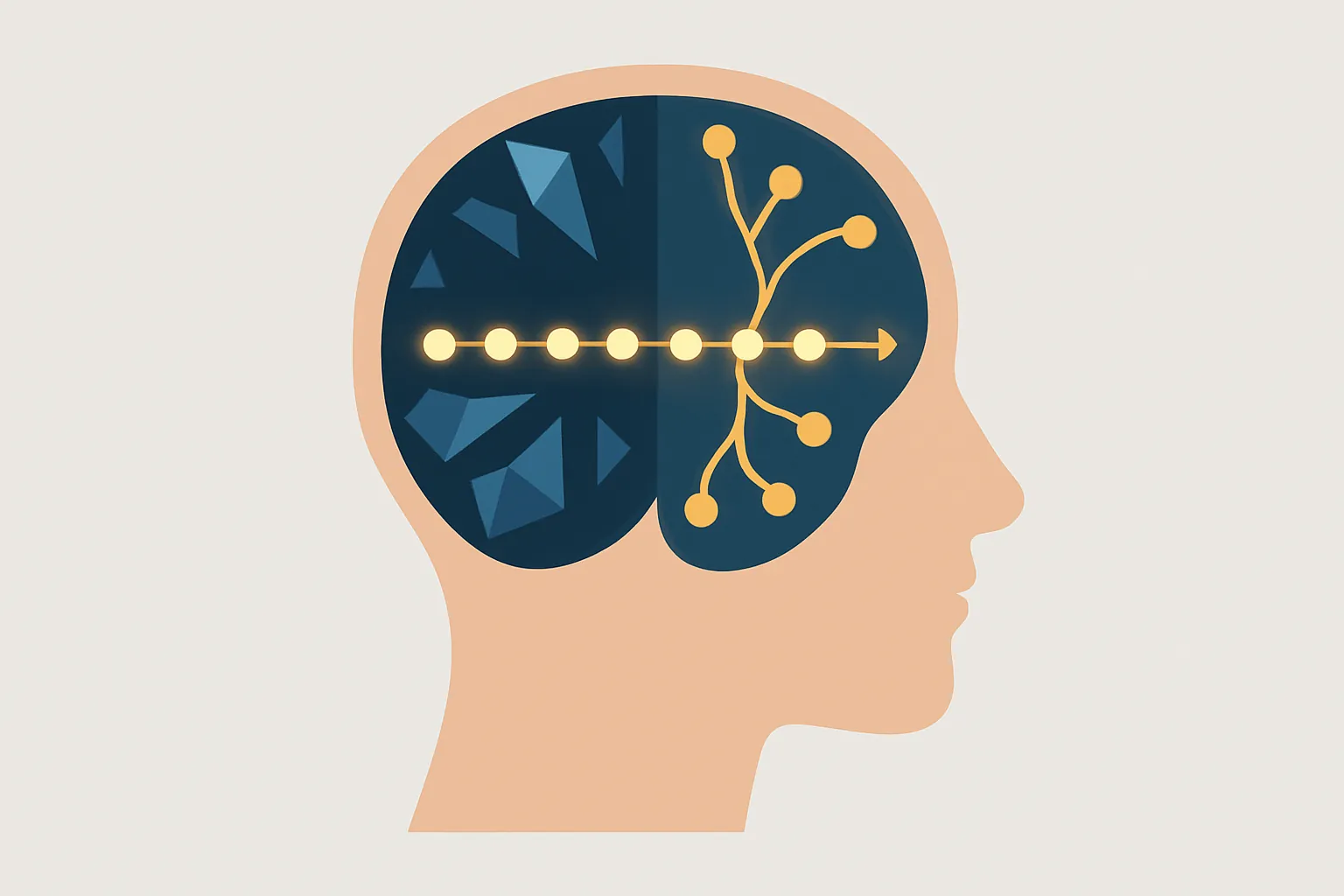
Eye Movement Desensitization and Reprocessing (EMDR) is a structured psychotherapy that uses bilateral stimulation (BLS) to reprocess trauma memories that became "stuck" in the brain's networks after an overwhelming event. Grounded in Francine Shapiro's Adaptive Information Processing (AIP) model, it reduces the emotional charge attached to traumatic memories through neurophysiological mechanisms—without requiring detailed verbal recounting of the event. Unlike traditional talk therapy, the clinician minimizes intervention and acts as a facilitator of the client's own healing process, which is why EMDR is recognized internationally as a frontline, evidence-based treatment for PTSD.
When Trauma Stops the Clock: Why EMDR Is a Frontline PTSD Treatment
"It happened ten years ago—but in my head, it's still happening right now, in this very moment."
If you work with clients who carry post-traumatic stress disorder (PTSD), you know the wall this describes. We empathize, we hold space, we offer support through talk therapy—and yet the painful memory often refuses to fade. Worse, returning to it through narrative can sometimes intensify the trauma rather than ease it, as flashbacks reactivate the same neural distress. For the clinician, that loop can breed a deep sense of helplessness and, over time, burnout.
So why do ordinary memories soften with time while traumatic ones stay "frozen" in the brain, preserved in their original, raw form? And how can we safely thaw them? This article takes a clinician's-eye look at Eye Movement Desensitization and Reprocessing (EMDR)—an evidence-based, internationally endorsed PTSD treatment—and translates its mechanisms into strategies you can apply in the room.
The Key to the Frozen Brain: The AIP Model and Bilateral Stimulation
EMDR's originator, Francine Shapiro, framed trauma through the Adaptive Information Processing (AIP) model. The premise: the brain has an innate capacity to metabolize painful experience and integrate it as adaptive memory—much the way broken skin scabs over and regenerates. But an event that overwhelms this processing system can leave the memory unmetabolized, locked in the neural network in its original, unintegrated state, complete with the images, beliefs, emotions, and body sensations encoded at the moment of trauma.
This is where EMDR's signature mechanism—bilateral stimulation (BLS)—comes in. Tracking the clinician's fingers with side-to-side eye movements, listening to alternating tones in each ear, or feeling alternating taps on the knees all stimulate the brain's left and right hemispheres in turn. Several processes appear to be at work:
- Dual attention. The client holds the distressing memory in mind while simultaneously attending to a present, safe, external stimulus (the BLS). This keeps them from being swallowed by the past and acts as an anchor in the here and now.
- A REM-like effect. Rapid eye movements appear to evoke brain activity resembling REM sleep—the state in which we dream—accelerating the association and processing of fragmented memory.
- Desensitization. Repeated stimulation helps settle amygdala hyperactivation, reducing the intense emotional charge fused to the memory.
Traditional Talk Therapy vs. EMDR: What's Actually Different
Many clinicians weigh EMDR against cognitive behavioral therapy (CBT) or psychodynamic approaches, unsure which intervention fits a given client. EMDR is not simply "rolling the eyes around"; it is a structured, eight-phase psychotherapy that integrates cognition, emotion, and somatic sensation. Understanding the contrast helps you build a treatment plan matched to the client.
Table 1. Clinical differences between traditional talk therapy and EMDR
| Dimension | Traditional talk therapy (CBT / psychodynamic) | EMDR |
|---|---|---|
| Treatment focus | Restructuring irrational beliefs; insight; emotional catharsis | Neurophysiological reprocessing and integration of the memory |
| Clinician's role | Interpreter, educator, active listener | Facilitator—a co-passenger on the train, intervening minimally |
| Trauma exposure | Detailed narration; prolonged exposure | Focus on the memory's image, but no detailed recounting required |
| Homework | Substantial (thought records and similar tasks) | Minimal (perhaps logging dreams or insights) |
| Best-fit clients | Clients with strong verbal expression | Also effective for hard-to-verbalize trauma, children, and dissociative presentations |
A Practical Guide: Three Strategies for a Successful EMDR Session
Beyond theory, applying EMDR in the room means meeting countless variables. Clients may become hyperaroused, or swing the other way into dissociation and go blank. Three practical strategies help.
- Invest in preparation: building a solid "Safe Place." Before touching any trauma memory, give the client a psychological safety mechanism they can retreat to whenever they feel overwhelmed. Don't settle for "imagine somewhere calm." Help them render the place vividly across senses—what they see, hear, smell, and feel in the body—then strengthen it with short, slow BLS (installation). If the Safe Place isn't robust, do not begin trauma processing.
- Respond flexibly to "blocking." During processing, a client may report "nothing's coming up" or "the screen's gone dark." This can be resistance—or dissociation. Stay calm. Invite them to "stay with that darkness for a moment," or change the state by switching the type of stimulation (eye movements → tapping). A well-timed cognitive interweave can gently unblock a stalled processing channel.
- Get out of the way: "Let it go." The urge to relieve a client's pain quickly can pull us into questioning or interpreting. But in EMDR the clinician is not the agent of healing—you are the co-passenger watching the client's own brain do the work. Minimal language—"Just notice that," "Go with that"—keeps you from interrupting the client's processing. That restraint is the skill.
A Clinical Dilemma: Documentation vs. Full Presence
EMDR sessions demand intense clinician focus. While delivering bilateral stimulation with one hand (or a device), you must also read subtle nonverbal cues in real time—pupil changes, shifts in breathing, changes in skin color.
Here the documentation dilemma appears. You need to track shifting SUDs (Subjective Units of Distress) and VOC (Validity of Cognition) scores, the associative content as it processes, and changes in body sensation—yet the moment you look down to write, your attunement with the client can break. Trauma clients are especially sensitive to where the clinician's gaze goes.
To resolve this, many clinicians now bring AI-assisted session transcription and analysis tools into their practice. With the right support, you can set the pen down and give your full attention to the client's eyes and the emotional currents moving through the session—Modalia AI, a security-first partner built for counselors, is designed for exactly this kind of transcription, case conceptualization, and documentation support, so the record takes care of itself while you stay present.
Conclusion: More Time Looking Into the Client's Eyes
EMDR is a powerful tool for setting a client's stopped clock back in motion. Reprocessing a painful memory so that it finally becomes a past event—one that no longer governs the present—can feel almost like magic, yet it rests on solid neurophysiological grounding.
To strengthen your EMDR practice, consider these action items:
- 🧘 Practice self-regulation. Your own steadiness transfers to the client. Apply grounding techniques to yourself first, before the session begins.
- 📚 Stay in supervision. EMDR is potent, and potency carries risk. When working with complex presentations such as C-PTSD, work under qualified supervision—the EMDR International Association (EMDRIA) is a good starting point for finding accredited consultants and training.
- 🎙️ Automate your session records. Use AI speech recognition to transcribe sessions and surface key themes automatically. This frees you to give 100% of your attention to the client's nonverbal signals during EMDR—and it becomes valuable longitudinal data for tracking shifts in the client's negative cognition over time.
For a client moving through the long tunnel of trauma, we are both the guide and the steady companion. Set down the burden of note-taking, and stay longer—and more deeply—with the healing you can see in your client's eyes.
References
- 1.
- 2.
Frequently asked questions
How is EMDR different from CBT or prolonged exposure for PTSD?
CBT and prolonged exposure rely on detailed narration of the trauma and structured homework, with the clinician acting as educator and interpreter. EMDR focuses on neurophysiological reprocessing through bilateral stimulation, requires no detailed recounting of the event, and positions the clinician as a minimal-intervention facilitator. This makes EMDR especially useful for hard-to-verbalize trauma, children, and dissociative presentations.
What is the AIP model in EMDR?
The Adaptive Information Processing (AIP) model, developed by Francine Shapiro, proposes that the brain naturally metabolizes painful experience into adaptive memory. When an event overwhelms this system, the memory stays unprocessed and locked in the neural network in its original raw form. EMDR's bilateral stimulation is theorized to restart that processing so the memory can integrate adaptively.
Why is a Safe Place established before trauma processing in EMDR?
The Safe Place is a psychological resource the client can retreat to if they become overwhelmed. Building it vividly across the senses and reinforcing it with short, slow bilateral stimulation gives the client emotional stability before any reprocessing begins. If the Safe Place isn't robust, trauma processing should not start.
Do I need additional training or supervision to practice EMDR?
Yes. EMDR is powerful, and that potency carries risk—particularly with complex presentations such as C-PTSD. Clinicians should complete recognized EMDR training and work under qualified supervision. The EMDR International Association (EMDRIA) is a useful starting point for accredited training and consultants.
This article was written and reviewed using Modalia AI's clinical guidelines, with professional human review before publication.
Related articles
 Case Conceptualization
Breaking the "Yes, But" Game: A Transactional Analysis Guide for Therapists
Every suggestion you offer gets met with "Yes, but..." Here's the TA structure behind that stall—and four clinical moves to break it.
7 min read Case Conceptualization
Yalom's The Gift of Therapy: Passages Every New Counselor Should Copy by Hand
Irvin Yalom's prescription for therapists who fear silence: meet your client as a "fellow traveler" and let the here-and-now become the heart of the work.
6 min read Case Conceptualization
Working With Silence in Therapy: What Client Silence Means and How to Hold It
Silence in session isn't empty space. Learn to read its clinical meaning, tell productive from defensive silence, and use it as a therapeutic tool.
6 min read