The Empty Chair, Done Deeper: Resolving Unfinished Business in EFT
Advanced empty chair strategies in Emotion-Focused Therapy—from transforming maladaptive emotion to handling flooding, dissociation, and resistance.
Key takeaway
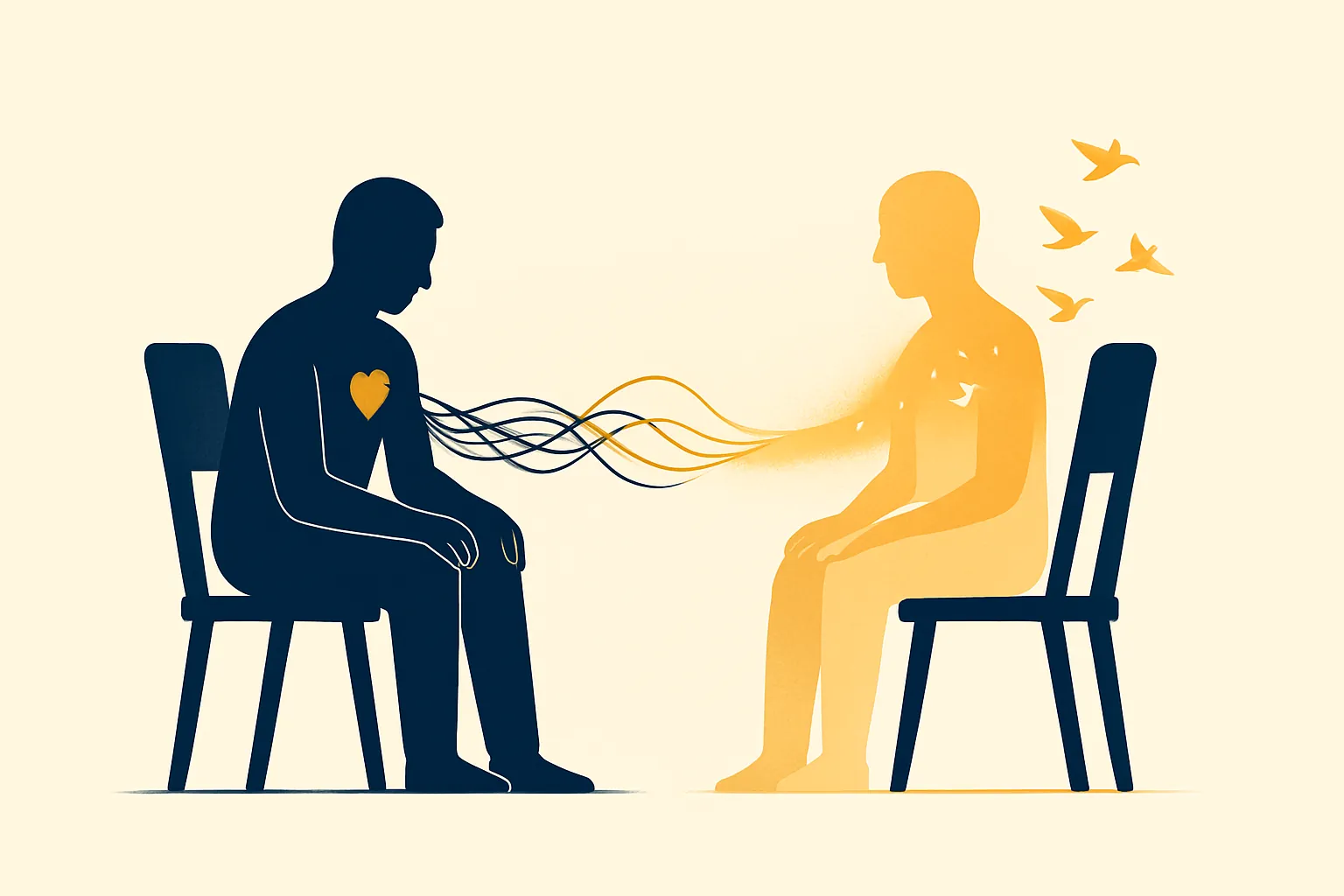
Unfinished business is the lingering resentment, anger, or grief toward a significant other that keeps shaping a client's present relationships and self-worth. The empty chair technique in Emotion-Focused Therapy (EFT) is a primary tool for it, but as Leslie Greenberg argued, the goal is not catharsis—it is structural transformation, replacing a primary maladaptive emotion (shame, fear) with an adaptive one (assertive anger, healthy grief). In real sessions, clinicians meet flooding, dissociation, and resistance, met respectively with grounding and by treating the resistance itself as material for dialogue. True resolution is not forgiving the other person but withdrawing the unmet need placed on them and taking responsibility for meeting it oneself.
"I Still Can't Forgive Them": Meeting the Ghosts in the Consulting Room
Every week, somewhere in your caseload, there is a story that never ended. Resentment toward a father who died ten years ago. Anger at an ex-spouse that has never cooled. A humiliating remark from a childhood teacher, replayed in adult relationships. Clock time has moved on, but the client's psychological clock stopped the moment the wound was made. This is unfinished business—and left unattended, it quietly contaminates current relationships and erodes self-worth.
Many clinicians reach for the empty chair technique from Emotion-Focused Therapy (EFT), only to find the work stalling. Sometimes it stops at a cathartic outburst that changes nothing. Sometimes the client balks—"It feels strange talking to an empty chair"—and we lose our footing. And sometimes we hold back entirely, afraid of retraumatizing the person in front of us. But the empty chair is not role-play. It is a precise piece of emotional surgery: a procedure for activating and restructuring the emotion schemes that have hardened inside the client. This article is for clinicians who already know the basics and want to use this powerful tool more safely and more deeply.
Transforming Emotion: Beyond Catharsis to Structural Change
The aim of the empty chair is not to drain off bottled-up feeling. As Leslie Greenberg put it, "emotion transforms emotion." When we work with unfinished business, we first activate the client's primary maladaptive emotion toward a significant other—often shame or fear—and then guide a shift toward an adaptive emotion, such as assertive anger or healthy grief. The new emotion is what reorganizes the old scheme.
- Catching the marker, precisely. The cue to propose the technique arrives when a client voices intense, unresolved feeling about a past figure—"If only my father hadn't…". What matters is that the client is feeling it now, vividly in the room, not narrating it from a distance.
- Contact and activation. As you invite the client to imagine the other person in the chair, use concrete sensory anchors. "What expression is on their face as they look at you? What's the tone of their voice?" These cues act as a switch that ignites the emotion scheme.
- Deepening the dialogue. Move past surface complaint toward the core pain. Beneath "I hate you" often lies an aching "I wanted to be loved." Your role is to help the client discover that buried need for themselves.
A common error among newer clinicians is treating the expression of feeling as the destination. The table below distinguishes simple catharsis from the structural transformation EFT is actually after.
| Simple catharsis | Structural emotional transformation | |
|---|---|---|
| Goal | Temporary tension release, venting | Revising the core emotion scheme; changing self/other representations |
| Process | Strong expression of anger or sadness | Staying with the primary emotion (fear/shame), then shifting to an adaptive one (anger/grief) |
| Outcome | Momentary relief, but the feeling returns | A changed view of the other; a felt sense of empowerment |
| Therapist role | Safe audience, encourager | Choreographer of emotion; director of process |
Table 1. Catharsis versus emotional transformation.
Obstacles in the Room—and How to Respond
A technique that looks flawless on paper meets the unexpected in live work. The most common challenges are emotional flooding and dissociation: the client either shuts the feeling down because it is unbearable, or is swept away by it and gains no insight at all. Here, the therapist must become a careful attunement instrument.
1. Over-Arousal: Grounding and Distance
If the client begins to hyperventilate or freezes in fear, stop the work immediately and bring attention back to the here-and-now. "Take your eyes off the chair for a moment and look at me. Notice your feet on the floor." Re-establish a sense of safety first. Physically moving the empty chair farther away can also help create psychological distance.
2. Resistance and Awkwardness: Meeting the Alienated Self
When a client turns cynical—"What's the point of this?"—a critical or protective part is at work. Don't try to force past it; receive it. "You're right, it can feel strange. But maybe that strangeness is protecting something. Shall we listen to what that protector is saying?" Make the resistance itself material for the dialogue.
3. Completing the Work: Letting Go, Not Forgiving
Many clients believe they have to forgive before they can be free. But genuine resolution is something else: withdrawing the need they placed on the other person, and taking responsibility for meeting it themselves. When a client can say, "Even if you never loved me, I can care for myself now," the unfinished business finally moves into the album of the past.
Precise Records, Fuller Clinical Insight
Empty chair work is intensely dynamic. A tremor in the voice, the length of a silence, a foot kicking at the chair or a body drawing inward—an enormous amount of clinical information pours out in fleeting moments. Reconstructing a session transcript from memory alone is nearly impossible, and the risk of losing a crucial emotional cue is high.
This is where a security-first AI partner for counselors can serve as a kind of co-therapist. Beyond converting speech to text, the right tools can surface the moments of strongest reaction, the core vocabulary a client returns to again and again, and the talk-time balance between counselor and client.
- ✅ Recovering nonverbal cues. Replay subtle shifts you missed in the moment against an accurate transcript, and build a sharper intervention plan for the next session.
- ✅ Stronger supervision material. Instead of guessing "what did the client say again?", bring exact context to your supervisor and receive more precise guidance.
- ✅ Self-review and growth. Did you cut off the client's emotional expression, or let them stay with it long enough? Use objective data to examine your own style.
Working with unfinished business takes courage—from the client and from you. With the advanced strategies above and thoughtful use of modern tools, you can be the steady guide who helps a client say goodbye to the ghosts of the past and live fully in the here-and-now.
References
- 1.
Frequently asked questions
What is the goal of the empty chair technique in EFT?
Not catharsis, but structural change. The aim is to activate the client's primary maladaptive emotion toward a significant other—often shame or fear—and guide a shift to an adaptive emotion such as assertive anger or healthy grief, which reorganizes the underlying emotion scheme.
How do I respond when a client becomes flooded or dissociates during the work?
Stop and bring attention to the here-and-now. Have the client look at you, notice their feet on the floor, and re-establish safety. Moving the empty chair physically farther away can create helpful psychological distance before resuming.
What if a client resists, calling the exercise pointless or awkward?
Treat the resistance as a protective part rather than an obstacle to break through. Acknowledge that it can feel strange, and explore what the protector is guarding—turning the resistance itself into productive material for the dialogue.
Does resolving unfinished business require forgiveness?
No. True resolution is withdrawing the unmet need the client placed on the other person and taking responsibility for meeting it themselves—being able to say, in effect, "Even if you never loved me, I can care for myself now."
This article was written and reviewed using Modalia AI's clinical guidelines, with professional human review before publication.
Related articles
 Case Conceptualization
Breaking the "Yes, But" Game: A Transactional Analysis Guide for Therapists
Every suggestion you offer gets met with "Yes, but..." Here's the TA structure behind that stall—and four clinical moves to break it.
7 min read Case Conceptualization
Yalom's The Gift of Therapy: Passages Every New Counselor Should Copy by Hand
Irvin Yalom's prescription for therapists who fear silence: meet your client as a "fellow traveler" and let the here-and-now become the heart of the work.
6 min read Case Conceptualization
Working With Silence in Therapy: What Client Silence Means and How to Hold It
Silence in session isn't empty space. Learn to read its clinical meaning, tell productive from defensive silence, and use it as a therapeutic tool.
6 min read