Why a Family Falls Apart *Now*: Reading Life-Cycle Turning Points Through the Genogram
Use Carter & McGoldrick's family life cycle and the genogram to locate the hidden dynamics and developmental turning points behind a client's presenting crisis.
Key takeaway
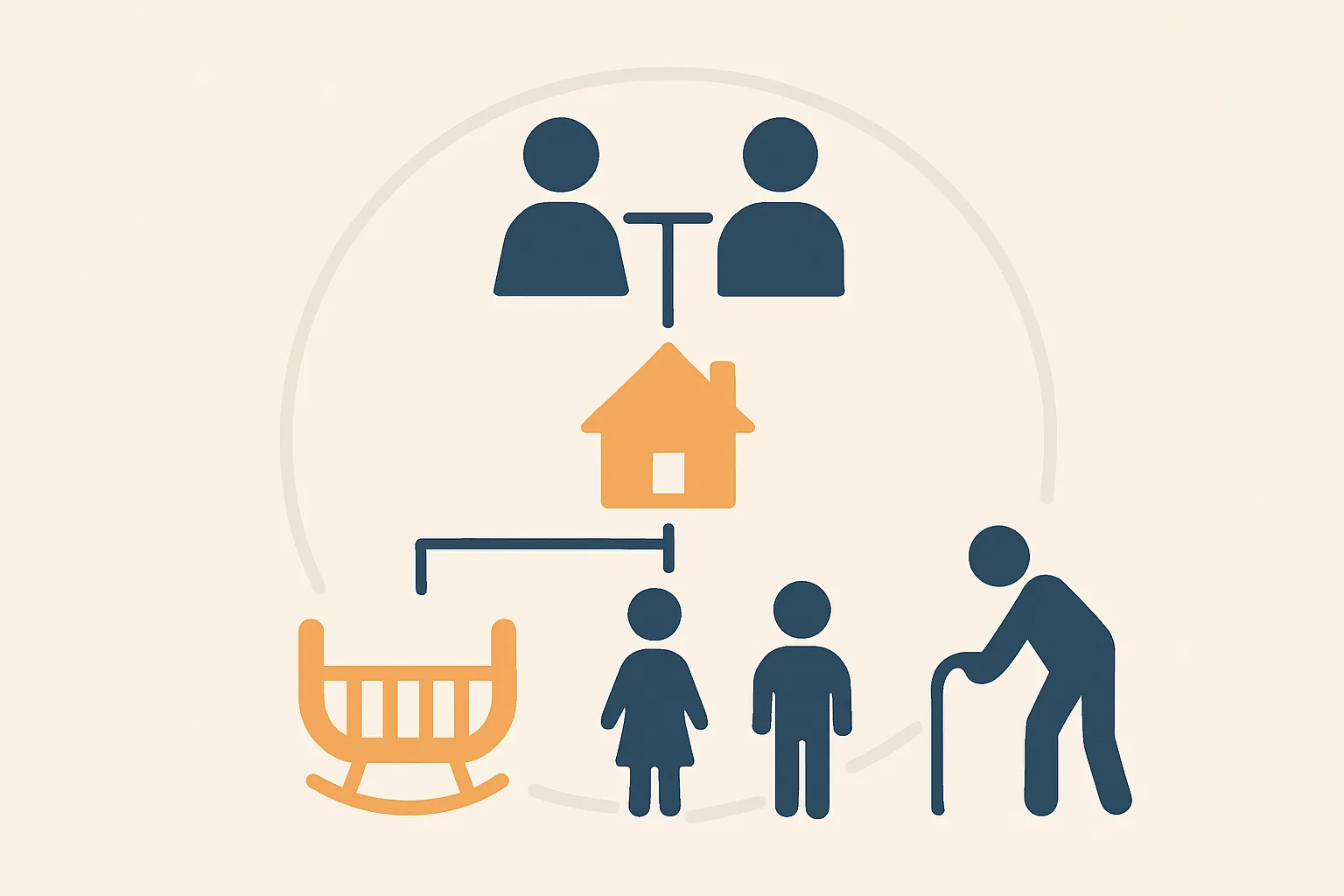
To understand why a client's symptom is surfacing *now*, look beyond individual dynamics to the family system's movement through time. Carter and McGoldrick's family life cycle reframes symptoms as the developmental growing pains of a system adapting to change rather than individual pathology. Crises ignite where vertical stressors handed down across generations intersect with horizontal stressors like marriage, childbirth, or a child leaving home, and the genogram makes that intersection visible. Targeted moves — tracing anniversary reactions, reframing the symptom's function, and asking circular questions — help clients see their family dynamics in three dimensions.
The Question Behind Every Presenting Problem: Why Now?
Clients arrive with very different concerns — depression, anxiety, a teenager acting out, a marriage in trouble. The surface varies, but a seasoned clinician always asks one underlying question: why did this problem surface now? Similar tensions almost certainly existed a year ago and six months ago. Something disturbed the family's equilibrium and tipped it into crisis. Identifying that something is both the opening move of therapy and its conceptual core.
When we concentrate on a single client's internal dynamics, it's easy to lose sight of the family system's movement through time. A family is not a still photograph; it's a film in continuous motion. The family life cycle perspective developed by Carter and McGoldrick lets us re-read a client's symptom not as "individual pathology" but as "a system straining to adapt to change." The challenge is practical: fully structuring a tangled family history inside the constraints of a session is genuinely hard. How do we keep the core pattern in view amid a flood of detail, and turn it into insight the client can use?
This article works through developmental-stage crises using the family life cycle, then shows how the genogram makes a family's turning points visible. The aim is to help you see a client's family system in three dimensions and locate more effective points of intervention.
Finding Where Vertical and Horizontal Stress Collide
The first step in analyzing a family crisis is understanding the two axes of stress. Family systems theory divides the stress a family carries into vertical stressors and horizontal stressors, and in clinical practice a client's crisis usually detonates where the two axes cross. Consider a client who has inherited a vertical legacy of emotional cutoff from their family of origin and then meets the horizontal turning point of a first child's birth: the latent anxiety amplifies and can surface as marital conflict or postpartum depression.
As the client talks, your work is to sort these two stressors apart and read their interaction. The genogram functions as the map that visualizes exactly where the axes meet. It does more than diagram who's related to whom — structured well, it lets you see, at a glance, the anxiety handed down across generations (vertical) alongside the developmental task the family faces right now (horizontal).
Table 1 — Comparing the Stressors That Trigger a Family Crisis
| Vertical stressors | Horizontal stressors | |
|---|---|---|
| Definition | Relational patterns, myths, secrets, and genetic factors transmitted across generations | Developmental and situational events a family encounters as time unfolds |
| Common examples | Family history of alcohol dependence, transmitted violence, rigid expectations around gender roles | Marriage, childbirth, a child's adolescence, launching/empty nest, retirement, onset of chronic illness, job loss |
| Clinical signature | Operates unconsciously and automatically; rationalized as "that's just how our family is" | Splits into predictable developmental crises and unpredictable situational ones (accident, early death) |
| Goal of intervention | Recognizing and interrupting transmitted dysfunctional patterns (raising differentiation) | Establishing the new family rules a transition demands and strengthening adaptability |
Turning Points Across the Life Cycle: Who Enters and Who Leaves
In the family life cycle, crises cluster around moments when a member enters or leaves the system. At these points the family's boundaries have to be renegotiated and roles redistributed. Your task is to locate which stage the client currently occupies and identify what resistance they're hitting as they try to meet that stage's developmental task.
1. The newly married couple: setting a boundary with the family of origin
Two people joining means two family systems joining. The central task here is emotional independence from each family of origin and the formation of a couple subsystem. Beneath the conflicts that bring newlyweds to therapy, you'll often find enmeshment with — or cutoff from — in-laws. Use the genogram to trace the relational patterns on both sides and explore why the couple struggles to author a new set of "rules that are ours alone."
2. The family with young children: parenting roles vs. the couple bond
A child's arrival turns a two-person system into a three-person one, and the classic crisis is triangulation. To discharge anxiety between the partners, a child gets pulled in, or one parent becomes over-involved with the child. On the genogram, mark the closeness between parent and child and the distance between the partners so the client can see this dynamic rather than just hear about it.
3. The family with adolescents: control vs. autonomy
This is the highest-stress stretch of the entire life cycle. The adolescent demands autonomy while the parents try to hold on to control. Tension peaks when a parent's midlife crisis overlaps with the teenager's developmental push. Keep in mind that the adolescent's "problem behavior" is often a functional symptom — detouring around marital conflict, or holding the family together by uniting the parents around a shared concern.
4. Launching children and later life: loss and redefinition
Alongside the "empty nest," caregiving reverses as adult children begin caring for aging parents. Role loss through a spouse's death or retirement can precipitate crisis. Here the genogram is invaluable for examining how past losses — bereavement, divorce — are being projected onto the present loss, and whether an unresolved grief process is still running underneath.
Putting the Genogram to Work: Concrete Intervention Strategies
The genogram is not merely a data-collection instrument; the act of building it is itself a powerful therapeutic intervention. Constructing it together establishes a collaborative alliance and helps the client develop the metacognition to view their own family objectively. Three strategies translate well to practice.
1. Tracing and interpreting coincidence
As you build the genogram, watch the dates and ages. Strikingly often, the timing of a client's current crisis matches the age at which a major event struck in the parent or grandparent generation. This is the anniversary reaction, or coincidence. An interpretive observation — "Your father died when you were exactly the age your son is now" — can become a powerful turning point, helping the client recognize where their present anxiety originates.
2. Reframing the symptom's function
Once the genogram reveals the family pattern, redefine the client's symptom as an "effort to adapt" rather than "pathology." An interpretation such as "Your depression may have been an unconscious attempt to absorb the family's feelings and quiet the conflict between your parents" relieves guilt and builds motivation for change.
3. Using circular questioning
With the genogram drawn, ask the client circular questions about the relationships: "When your mother becomes depressed, how does your father respond? And what does your brother do then?" Questions like these pull the client out of linear causality ("the problem is so-and-so's fault") and widen the view toward circular causality (everyone shapes everyone else).
Conclusion: Capturing Complex Family Dynamics Without Losing the Thread
Analyzing a family crisis through a life-cycle lens and visualizing it on a genogram adds essential depth to therapy. Only when we understand the cross-generational anxiety and the growing pains of a developmental transition flowing beneath a symptom can we fully empathize and guide effective change. Hold to a stance that sees the client's present pain not as a cross-section but as part of a historical current.
In the room, though, capturing a client's intricate family relationships — the many dates, the events — in real time and structuring them on the spot is no small task. While you're holding eye contact and listening closely to build rapport, it's easy to miss a decisive year or a subtle relational cue, or to leave a note unwritten.
To close that gap, many clinicians now lean on AI session-note tools. These can accurately transcribe the family names, key dates, and emotional shifts mentioned during a session, freeing you from the burden of note-taking so you can stay fully present to nonverbal cues and the genogram as a whole. The ability to surface recurring patterns or how often a particular period comes up as structured data can be a meaningful aid to clinical insight. Modalia AI is built for this work — a security-first AI partner for counselors that handles transcription, case conceptualization, and documentation so the clinical thinking stays yours.
A genogram is never a finished picture; it's a map revised and expanded throughout therapy. Let the technology sharpen the accuracy of your records, and lay your clinical intuition over the genogram with greater precision — a steady guide who doesn't lose the path amid a family's confusing crisis.
References
- 1.
Frequently asked questions
What's the difference between vertical and horizontal stressors?
Vertical stressors are patterns, myths, secrets, and genetic factors transmitted across generations — they operate unconsciously and get rationalized as "that's just how our family is." Horizontal stressors are the developmental and situational events a family meets over time, such as marriage, childbirth, a child's adolescence, the empty nest, or retirement. Crises typically erupt where the two axes intersect.
Why does the family life cycle ask "why now?" about a symptom?
Similar tensions usually predate the presenting problem, so the clinically useful question is what disturbed the family's equilibrium at this moment. Locating the developmental transition or anniversary that tipped the system into crisis reframes the symptom as adaptive strain rather than individual pathology and points to a more precise intervention.
How is a genogram different from a simple family tree?
A family tree records who is related to whom. A genogram is structured to show relational dynamics — closeness, distance, cutoff, triangulation — alongside dates and ages, so a clinician can see transmitted anxiety (vertical) and the current developmental task (horizontal) together. It doubles as a therapeutic intervention, building metacognition as the client helps construct it.
What is an anniversary reaction and how do I use it clinically?
An anniversary reaction (or coincidence) is when a client's current crisis aligns with the age at which a major event occurred in a parent or grandparent generation. Tracking dates and ages on the genogram surfaces these matches, and an interpretive observation about the alignment can help the client recognize where present anxiety originates.
This article was written and reviewed using Modalia AI's clinical guidelines, with professional human review before publication.
Related articles
 Case Conceptualization
Breaking the "Yes, But" Game: A Transactional Analysis Guide for Therapists
Every suggestion you offer gets met with "Yes, but..." Here's the TA structure behind that stall—and four clinical moves to break it.
7 min read Case Conceptualization
Yalom's The Gift of Therapy: Passages Every New Counselor Should Copy by Hand
Irvin Yalom's prescription for therapists who fear silence: meet your client as a "fellow traveler" and let the here-and-now become the heart of the work.
6 min read Case Conceptualization
Working With Silence in Therapy: What Client Silence Means and How to Hold It
Silence in session isn't empty space. Learn to read its clinical meaning, tell productive from defensive silence, and use it as a therapeutic tool.
6 min read