Family Sculpting: Visualizing Relational Dynamics Without Words
Talk-based therapy hits a wall when families defend, deflect, and intellectualize. Family sculpting makes hidden dynamics visible—here's how to use it well.
Key takeaway
Family sculpting is an experiential technique developed by Virginia Satir in which family members physically arrange one another's position, posture, and gaze in the room, making relational dynamics visible that words rarely reveal. Because it engages the body rather than language, it bypasses defenses like intellectualization and rationalization, exposing triangulation, enmeshment, isolation, and power imbalances in a way both the therapist and the family can see and feel. In practice it unfolds in four stages—warm-up and selecting a sculptor, nonverbal arrangement, sharing the felt experience, and restructuring toward a desired ideal—and pairing the session with an AI transcription tool lets the clinician stay fully present to nonverbal cues instead of scrambling to take notes.
When Words Aren't Enough: Making the Family System Visible
Have you ever sat with a family in session and felt yourself getting lost in the sheer volume of words—everyone talking over one another, defending, deflecting, while the emotional truth that actually matters stays carefully out of reach? In deeply conflicted family systems, language often stops being a tool for connection and becomes a tool for defense. Members explain, blame, and fall silent in precisely the ways that keep the real dynamic hidden.
This is where one well-chosen experience can do what a hundred careful conversations cannot. Family sculpting, an experiential technique developed by Virginia Satir, asks family members to express their relationships through physical space and body posture—turning hidden emotion and power structure into something you can literally see. There is a world of therapeutic difference between a client saying "we just don't communicate" and the whole family physically standing with their backs to one another. This article looks at why family sculpting remains an essential clinical tool, how to apply it effectively, and where to be cautious.
1. Beyond Language: How Family Sculpting Works Clinically
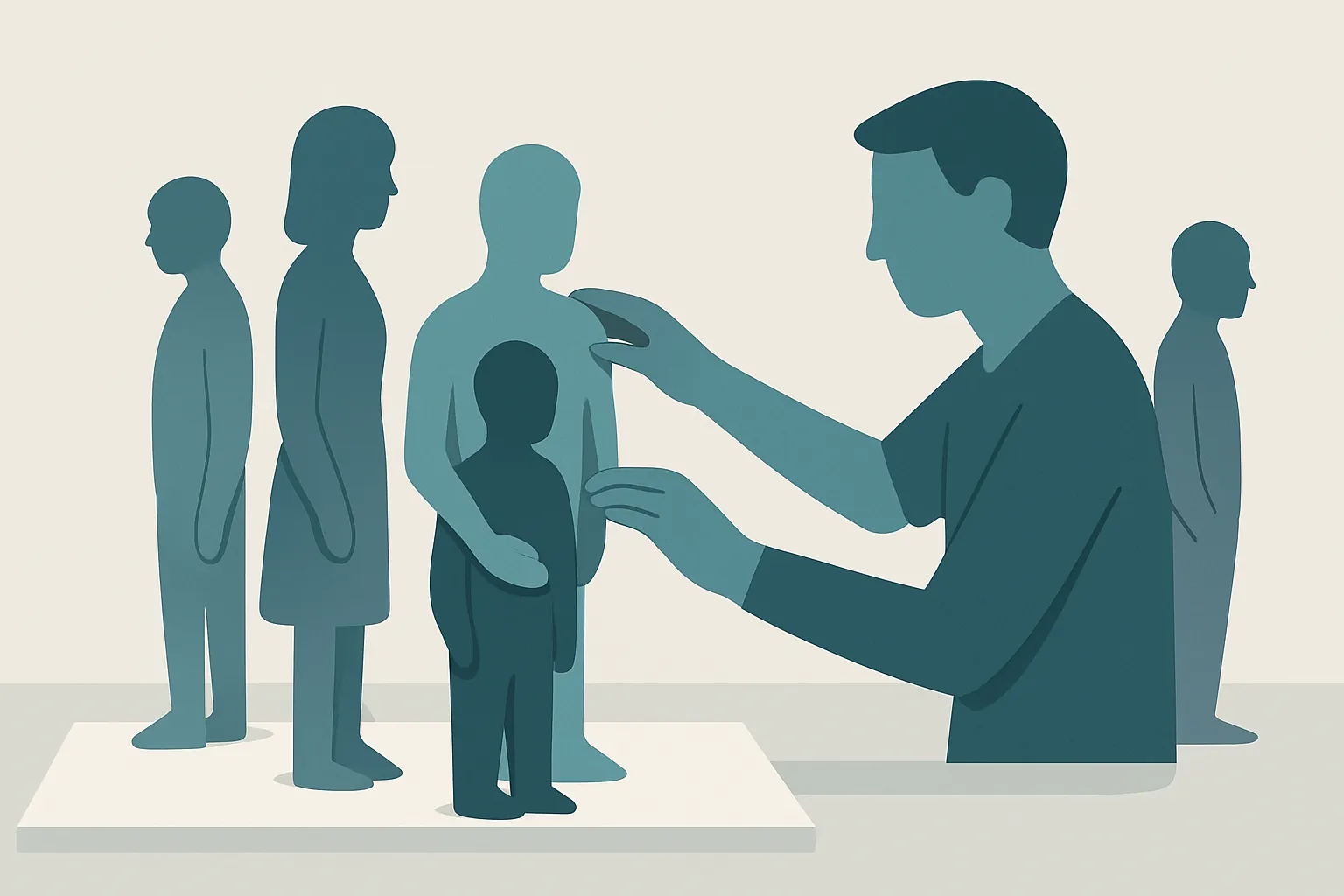
Family sculpting is not role-play. It blends family systems theory with the phenomenological, here-and-now sensibility of Gestalt work. The client—acting as the "sculptor"—shapes the other family members like clay, deciding where each person stands, how they hold their body, where they look, and what their face expresses. In the process, the family's triangulation, enmeshment and isolation, and imbalances of power get projected, often unconsciously, into physical space.
Bypassing defenses, reaching insight directly
In talk-based work, defenses like intellectualization and rationalization fire constantly. Because sculpting recruits the body, it sidesteps those cognitive defenses and arrives at core affect far more quickly than discussion usually allows.
Making systemic dynamics visible
A central aim of family work is grasping circular causality. A sculpture shows at a glance who blames whom, who hides behind whom (a placating stance, in Satir's terms), and who is trying to control the whole arrangement. That visibility delivers powerful insight—not only to the therapist, but to the family members themselves.
Catharsis and exploring alternatives
After sculpting the painful current reality, you can invite the sculptor to build a second sculpture of the family they wish they had. This strengthens motivation for change and gives the treatment goals a concrete, felt shape.
The table below contrasts the therapeutic focus of conventional talk-based therapy with family sculpting.
Table 1. Talk-Based Therapy vs. Family Sculpting
| Dimension | Conventional talk-based therapy | Family sculpting |
|---|---|---|
| Primary medium | Language, dialogue, narrative | Body, space, distance, nonverbal expression |
| Defenses | Easy to defend via logic, blame, silence | Exposed immediately and intuitively through physical placement |
| Therapeutic focus | Reconstructing and reinterpreting past events | Experience and emotion in the here and now |
| Therapist role | Listener, interpreter, mediator | Director, facilitator, observer |
| How it's encoded | Cognitive memory (content) | Sensory, embodied memory (experience) |
2. A Practical Guide: Applying Family Sculpting in Session
Even a theoretically elegant technique can confuse clients if it's handled clumsily. Family sculpting depends on a staged approach and the therapist's careful guidance—and above all on establishing a safe, containing holding environment before you begin.
Stage 1: Warm-up and selecting the sculptor
Explain the purpose of the exercise and offer an invitation: "What if we showed our family today with our bodies instead of our words?" Choose a sculptor—often the least threatened member, or alternatively the one with the clearest sense of the problem.
Stage 2: Sculpting and placement
The sculptor arranges the family without speaking. Here the therapist preserves the nonverbal detail with concrete prompts: "Which way are they facing?" "How far apart are they standing?" "What are their hands doing?" It can help to invite postures drawn from Satir's communication stances—Placating, Blaming, Super-Reasonable, and Irrelevant.
Stage 3: Debriefing and sharing the felt experience
Once the sculpture is complete, have everyone hold the pose for about a minute and notice what it evokes. Then help each member put the inner experience into words: "What's it like to stand there?" "Who feels closest to you right now?"
Stage 4: Restructuring
Invite the family to alter the painful current sculpture and rebuild it as the relational configuration they want. From that revised image, you can draw concrete, actionable steps toward change.
3. Clinical Implications: Turning a Powerful Experience Into a Usable Record
Family sculpting can open a breakthrough by making a system's dynamics visible. But many clinicians struggle to capture that vivid, embodied experience in their notes and analyze it afterward. Dynamic movement, the spontaneous exclamations that erupt in the moment, the subtle shifts in affect—these are hard to preserve through typed text alone.
The insights that pour out during the debriefing stage are among the session's most valuable assets. This is exactly the moment when a therapist must not miss nonverbal signals because they're buried in note-taking. Letting technology carry the documentation load can be a smart strategy here.
Streamlining documentation with AI
Consider devoting your attention fully to observing and intervening in the family's dynamics, and delegating the verbatim record to an AI-based transcription tool. Capturing the sculptor's directions and the family's feedback accurately as text gives you a rich resource for later supervision and case analysis. A security-first partner like Modalia AI is built for this—handling transcription, case conceptualization, and documentation so the clinical record doesn't compete with clinical presence.
Documenting nonverbal cues in detail
While the AI organizes the spoken text, you can focus on observational notes that machines miss—[Client A's clenched fist], [Client B's averted gaze]—the kind of detail that lifts the quality of the work to another level.
Action items
- If a case has felt stuck this week, try a quick mini-sculpture using coins or figurines before committing to a full enactment.
- When you run a sculpting session, obtain consent to record, use a transcription tool, and afterward analyze the mismatches between verbal interaction and physical placement.
Family sculpting is like a key that opens a family's closed inner world. Catching the truth glimpsed through that opening—without letting it slip away—is the work of the skilled clinician. May the technique, and the efficient documentation behind it, bring a fresh current of change into your consulting room.
References
- 1.
Frequently asked questions
What is family sculpting in therapy?
Family sculpting is an experiential technique developed by Virginia Satir in which a family member (the "sculptor") physically arranges the others' position, posture, distance, and gaze to represent their relationships. It makes relational dynamics—triangulation, enmeshment, power imbalance—visible and felt rather than merely discussed.
Why use family sculpting instead of talk-based therapy?
Talk-based work invites defenses like intellectualization, rationalization, blame, and silence. Because sculpting engages the body rather than language, it bypasses those cognitive defenses and reaches core affect quickly, offering immediate insight to both the therapist and the family.
What are the stages of a family sculpting session?
Four stages: (1) warm-up and selecting a sculptor, (2) nonverbal sculpting and placement, (3) debriefing and sharing the felt experience, and (4) restructuring the sculpture into the family's desired ideal to generate concrete steps toward change.
How can I document an experiential session like this?
Pair the session with an AI-based transcription tool to capture spoken directions and feedback automatically. This frees you to record nonverbal observations—clenched fists, averted gazes, shifts in distance—and to compare verbal interaction against physical placement afterward in supervision.
This article was written and reviewed using Modalia AI's clinical guidelines, with professional human review before publication.
Related articles
 Case Conceptualization
Breaking the "Yes, But" Game: A Transactional Analysis Guide for Therapists
Every suggestion you offer gets met with "Yes, but..." Here's the TA structure behind that stall—and four clinical moves to break it.
7 min read Case Conceptualization
Yalom's The Gift of Therapy: Passages Every New Counselor Should Copy by Hand
Irvin Yalom's prescription for therapists who fear silence: meet your client as a "fellow traveler" and let the here-and-now become the heart of the work.
6 min read Case Conceptualization
Working With Silence in Therapy: What Client Silence Means and How to Hold It
Silence in session isn't empty space. Learn to read its clinical meaning, tell productive from defensive silence, and use it as a therapeutic tool.
6 min read