The First 48 Hours After a Trauma Session: When Secondary Traumatic Stress Hits Hardest
The 48 hours after a trauma session are when STS activates most sharply. Learn the early warning signs and a five-step, body-based recovery routine grounded in clinical research.
Key takeaway
The window immediately after a trauma session—roughly the first 48 hours—is when secondary traumatic stress (STS) activates most acutely and, if left unprocessed, is most likely to become chronic. Drawing on Stamm (2010) and Figley (1995), the priorities are threefold: recognize early signs such as intrusive imagery, avoidance, and hyperarousal; discharge the activation through the body—movement, temperature, and sensory grounding—as Van der Kolk (2014) emphasizes; and break isolation with a brief check-in to a colleague, even within full confidentiality. A simple five-step routine—release through the body, connect with a peer, and track your own state—protects long-term clinician health.
When the Scene Keeps Replaying: The First 48 Hours After a Trauma Session
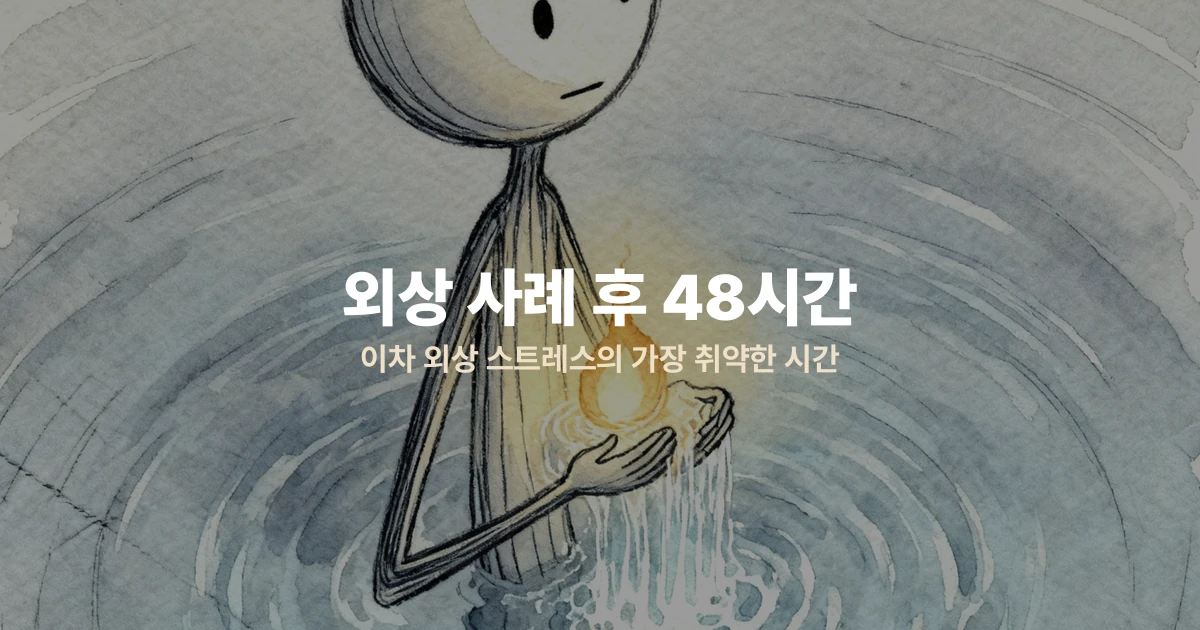
Did today's session carry a heavy trauma narrative? If you've gone home and the scene keeps replaying in your mind, that is not a sign of weakness. It's a sign that your empathy did its job. It's also a sign that the most vulnerable window for secondary traumatic stress (STS) has just opened.
Stamm's (2010) ProQOL work and Figley's (1995) foundational research on secondary trauma point in the same direction: the first 48 hours after a trauma session are when STS symptoms activate most sharply, and—left unaddressed—are most likely to consolidate into something chronic. How you spend those hours shapes both your short-term recovery and your long-term health as a clinician. This article maps out why that window matters clinically, the early warning signs of STS, the evidence behind body-based recovery, the role of peer connection, and how to structure those 48 hours as a deliberate clinical routine.
Why 48 Hours? The Clinical Background of Secondary Traumatic Stress
Secondary traumatic stress is a PTSD-like response that develops in clinicians through repeated exposure to clients' trauma narratives. Its core symptom clusters mirror PTSD: intrusion, avoidance, and hyperarousal.
The first 48 hours are especially vulnerable for three reasons.
First, memory consolidation is most active during this window. Before trauma-related imagery and affect are consolidated into long-term memory, timely processing in this period can help prevent STS from becoming chronic.
Second, the body's arousal response is still switched on. After absorbing an intense trauma narrative, the clinician's nervous system resonates with the client's trauma response and sustains a state of sympathetic activation. If that physiological arousal isn't discharged, it feeds intrusive thoughts and hyperarousal.
Third, isolation is the single strongest amplifier of STS. Thoughts like "I shouldn't talk about this" or "It would mean I'm weak" push clinicians to carry it alone—and that is exactly what makes the 48 hours longer and harder than they need to be.
Recognizing the Early Warning Signs of Secondary Traumatic Stress
Responding well depends on noticing the STS signals that surface within the first 48 hours.
| Symptom type | What it looks like | Clinical meaning |
|---|---|---|
| Intrusion | The session replays on a loop; trouble falling asleep | STS is activating |
| Avoidance | Reluctance to think about that client; dread before the next session | Avoidance response beginning |
| Hyperarousal | Startling at small sounds; persistent tension | Sustained autonomic activation |
| Shift in meaning | "What am I even doing?" "Can I keep doing this work?" | Declining compassion satisfaction |
| Somatic symptoms | Headache, indigestion, shoulder tension, fatigue | Somatization |
If two or more of these persist beyond 48 hours, it's appropriate to reach for supervision or peer support right away.
Body-Based Recovery: Why You Release Through the Body Before the Mind
STS is not, at its root, a cognitive problem. It's the resonance of a trauma response stored in the body. As Van der Kolk (2014) describes, traumatic experience is processed at a pre-verbal, somatic level—and the same principle applies to STS.
That's why cognitive strategies—"reframing the thought" or "just forgetting it"—rarely work well within the first 48 hours. A weight the body is holding has to be released through the body.
The most effective body-based recovery methods fall into two families.
Movement-based
| Method | Time | Effect |
|---|---|---|
| A short walk | 15–30 min | Lowers sympathetic arousal, lifts mood |
| Rhythmic exercise (running, swimming) | 20–30 min | Bilateral stimulation similar in spirit to EMDR |
| Gentle stretching or yoga | 10–20 min | Releases physical tension, engages the parasympathetic system |
Temperature- and sensory-based
| Method | Effect |
|---|---|
| A warm shower | Restores a sense of bodily boundary; cues a relaxation response |
| Hands in warm water | Parasympathetic activation; immediate ease |
| Slowly sipping a warm drink | Sensory anchoring to the present; guards against dissociation |
Whatever the method, the common thread is directing attention to bodily sensation. Shifting attention away from the imagery of the trauma narrative and toward present physical sensation is the core mechanism of body-based recovery.
Peer Connection: Support That Works Even Within Confidentiality
Social support is central to STS recovery precisely because isolation is its most powerful amplifier.
The crucial point is that the belief "I can only get support if I share the case details" is simply wrong. Meaningful support is fully possible inside the bounds of confidentiality.
"I heard something heavy today." "I had a hard session today." "I'm having a rough time right now."
That single sentence is where peer support begins. Without disclosing any case content, simply letting a colleague know that you're struggling is enough to pull you out of isolation.
Peer debriefing tends to take three forms.
Form 1: A short message (lowest barrier to entry). "Heavy session today. Could we talk for a few minutes?"
Form 2: A brief call or in-person chat (10–15 minutes). No case content—keep the conversation centered on your own emotional state. "I'm feeling a lot of helplessness right now," or "I notice an urge to avoid this," stays focused on your own experience.
Form 3: Supervision (the most structured option). If STS symptoms persist beyond two days, bring it to supervision. "What state am I in after this case?" can be the central question.
A Five-Step Clinical Routine for the First 48 Hours
1. Right after the session: scan for body signals
The moment a trauma session ends, take 30 seconds to scan your body. Are your shoulders locked? Is your breathing shallow? Is your stomach unsettled? Noticing those signals is the first step of 48-hour recovery.
2. The first two hours: body-based recovery
Within the first two hours after work, do something body-based. A walk, a shower, stretching—any form of moving the body comes first. Staring at a screen or scrolling the news tends to raise physiological arousal rather than lower it.
3. That evening: send one line to a colleague
Send a short message to a fellow counselor that evening. A single "I had a heavy session today" makes the 48 hours something you don't have to weather entirely alone.
4. Before sleep: a brief end-of-day note
Before falling asleep, jot down a line or two about your state after the session. The intensity of any STS symptoms, what recovery you did, what you'll need tomorrow. This becomes a self-monitoring baseline to compare against the next day.
5. After 48 hours: re-check your STS symptoms
Once 48 hours have passed, check whether the symptoms have eased. If intrusion, avoidance, or hyperarousal are still strong, that's the point to seek supervision or a peer debrief. Left unaddressed, the risk of chronic STS climbs.
Leaving the 48 Hours Open Is Itself Clinical Practice
When the scene replays after a trauma session, that is not weakness. It's evidence that your empathy worked—and a signal that body-based recovery and peer connection are needed now.
Moving through these 48 hours with structure—releasing through the body, sending one line to a colleague, recording your own state—is what sustains your capacity for empathy over the long run and protects you from burnout. A simple self-monitoring journal, or a validated self-assessment such as the Professional Quality of Life (ProQOL) measure, can help you track STS symptoms and recovery across those first 48 hours and bring that record into supervision.
References
- 1.
- 2.
- 3.
Frequently asked questions
What is secondary traumatic stress (STS)?
Secondary traumatic stress is a PTSD-like response that develops in clinicians through repeated exposure to clients' trauma narratives. Its core symptoms mirror PTSD—intrusion, avoidance, and hyperarousal—and it differs from gradual burnout in its sudden, exposure-linked onset.
Why are the first 48 hours after a trauma session so important?
Three factors converge in this window: memory consolidation is most active, the body's sympathetic arousal is still switched on, and isolation tends to amplify symptoms. Timely, body-based processing during this period can help prevent STS from becoming chronic.
Can I get peer support without breaking client confidentiality?
Yes. Effective support does not require sharing case details. Simply telling a colleague "I had a heavy session today" or "I'm struggling right now"—keeping the focus on your own emotional state—is enough to break isolation, which is the strongest amplifier of STS.
When should I seek supervision after a trauma session?
If two or more STS symptoms (intrusion, avoidance, hyperarousal, shifts in meaning, somatic complaints) persist beyond 48 hours, it's appropriate to bring it to supervision or a peer debrief. Persistent symptoms left unaddressed carry a higher risk of chronic STS.
This article was written and reviewed using Modalia AI's clinical guidelines, with professional human review before publication.
Related articles
 Case Conceptualization
Breaking the "Yes, But" Game: A Transactional Analysis Guide for Therapists
Every suggestion you offer gets met with "Yes, but..." Here's the TA structure behind that stall—and four clinical moves to break it.
7 min read Case Conceptualization
Yalom's The Gift of Therapy: Passages Every New Counselor Should Copy by Hand
Irvin Yalom's prescription for therapists who fear silence: meet your client as a "fellow traveler" and let the here-and-now become the heart of the work.
6 min read Case Conceptualization
Working With Silence in Therapy: What Client Silence Means and How to Hold It
Silence in session isn't empty space. Learn to read its clinical meaning, tell productive from defensive silence, and use it as a therapeutic tool.
6 min read